
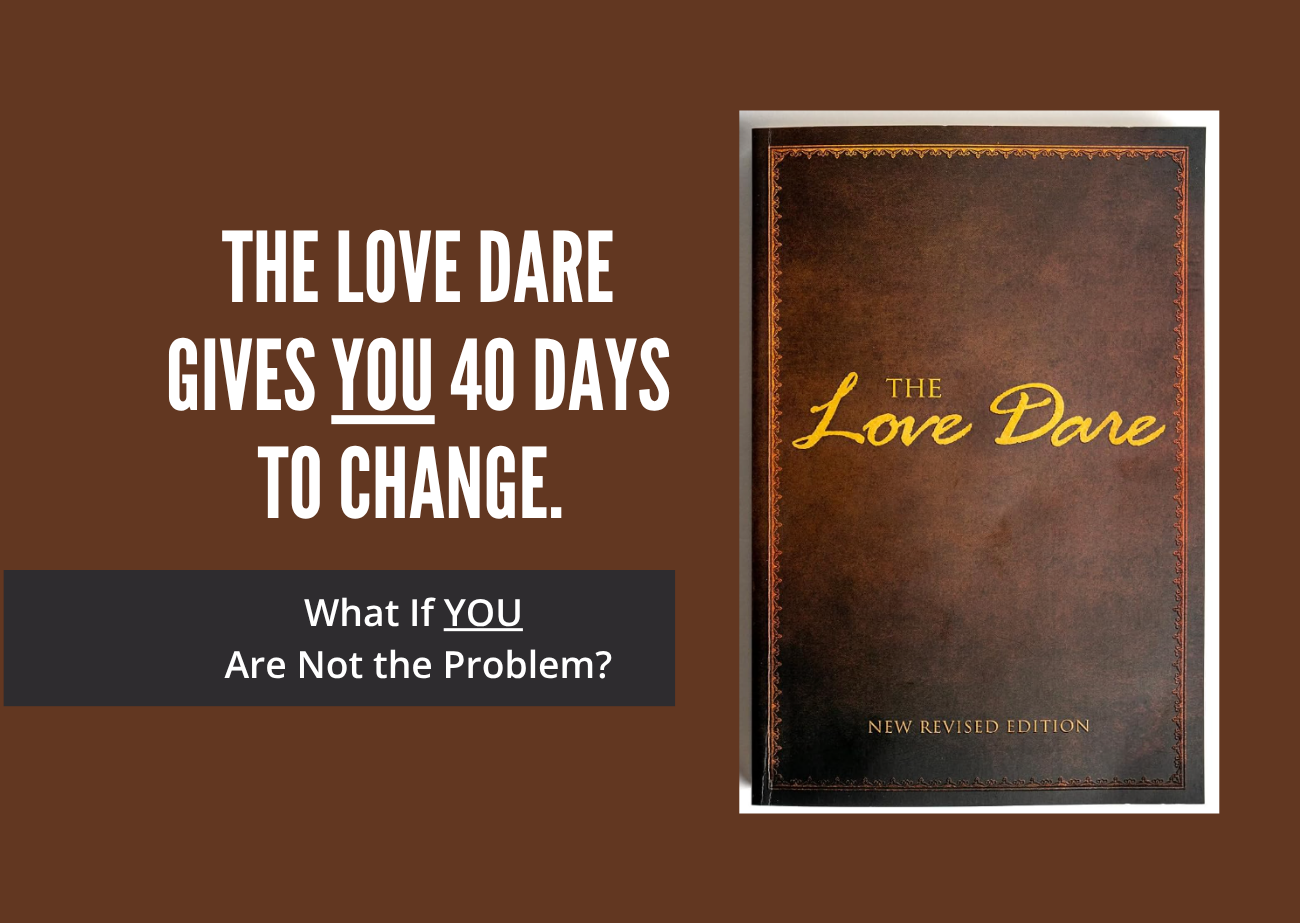
The Love Dare Gives You 40 Days to Change. What If You’re Not the Problem?
The Love Dare, by Alex and Stephen Kendrick, gives one spouse 40 days of specific things to do to strengthen a marriage.
Be patient. Be thoughtful. Give. Forgive. Sacrifice. Show love even when love isn’t returned.
In a basically healthy marriage that has gotten stale or disconnected, some of these exercises may encourage useful self-reflection.
But what if the real problem is abuse, chronic deception, coercion, infidelity, neglect, addiction, or another destructive pattern?
What if you spend 40 days changing yourself—but you’re not the person causing the serious problem?
Redemption Stories Can Become Easy Pat Answers
There’s nothing wrong with believing in repentance, redemption, or restored marriages. Christians believe people can genuinely change.
But I think the Kendrick approach can turn a very complicated marriage problem into an easy pat answer: love better, try harder, forgive, persist, and eventually the other person may respond.
That is a beautiful storyline when the person doing the serious harm is also the person who wakes up, takes responsibility, and changes.
But that isn’t how every destructive marriage works.
Sometimes the conscientious spouse is already praying, forgiving, sacrificing, accommodating, reading the books, making the appointments, and trying desperately to save the marriage.
Meanwhile, the person lying, cheating, controlling, intimidating, neglecting, or abusing them may have very little incentive to change.
In that situation, giving the conscientious spouse 40 more days of things to do may simply reinforce the idea that the solution is still somehow in their hands.
Does The Love Dare actually work?
This is where I think Christians should ask harder questions.
The Love Dare has sold extremely well. But popularity, inspiring stories, and a successful movie are not the same thing as evidence that a marriage intervention actually works.
I have not found peer-reviewed outcome research showing that completing The Love Dare repairs distressed marriages or makes abusive or chronically deceptive relationships safe.
And Christian marriage researcher and writer Sheila Wray Gregoire has raised much broader concerns than simply saying that a few readers disliked the book.
In her detailed critique, Gregoire argues that The Love Dare repeatedly encourages people to paper over serious relationship problems rather than confront them. She criticizes the book for giving virtually no guidance about boundaries, for failing to adequately distinguish ordinary marital conflict from abuse and infidelity, and for emphasizing marital permanence even when serious betrayal is present.
She also points to specific places where she believes the advice can put disproportionate responsibility on the more conscientious spouse. For example, she argues that the book can define “selfishness” in ways that make a spouse who is already carrying too much of the marriage feel guilty for objecting to the imbalance. She also criticizes its sexual advice for not giving meaningful caveats for situations involving mistreatment, coercion, illness, sexual pain, pornography, infidelity, or other circumstances where simply telling a spouse to be more sexually available can be harmful.
And that leaves us with a very important safety question:
Is a strategy designed to make one spouse more patient, loving, forgiving, and sacrificial appropriate when the central problem is the other spouse’s abuse, deception, betrayal, or refusal to take responsibility?
I don’t think Christians should assume the answer is yes.
Don’t hand someone the answer key
If you’re trying to determine whether someone has genuinely changed, don’t coach them through the test.
- “Ask me about my feelings.”
- “Take responsibility without blaming me.”
- “Respect my boundaries.”
- “Stop pressuring me.”
- “Apologize without excuses.”
If they then perform those exact behaviors, what have you learned?
Maybe they changed.
Or maybe you handed them the answer key.
That’s why I recommend learning the signs of genuine change in an abusive or deceptive partner—but not giving that checklist to the person you’re evaluating.
Real change doesn’t require you to supervise it
A genuinely changed person seeks appropriate help without making you arrange it.
They accept consequences. They respect boundaries. They stop demanding reassurance. They make amends without requiring immediate forgiveness or reconciliation.
Most importantly:
They keep changing even if you never come back.
You can read more in my interview about three signs that matter when determining whether an abusive spouse has really changed.
Watch the uncoached version
If you’ve spent years carrying your marriage, you probably don’t need another assignment.
You don’t have to manage your spouse’s rehabilitation. I’ve written more about why trying to fix an abuser doesn’t work.
Instead, watch.
What happens when nobody prompts them? How do they behave when reconciliation is uncertain? Do honesty, humility, responsibility, and respect appear without coaching?
Look at the fruit.
Real change doesn’t need an answer key.
 :
:
 :
: Buy PDF