The Good, the Bad, and the Ugly in His Needs, Her Needs
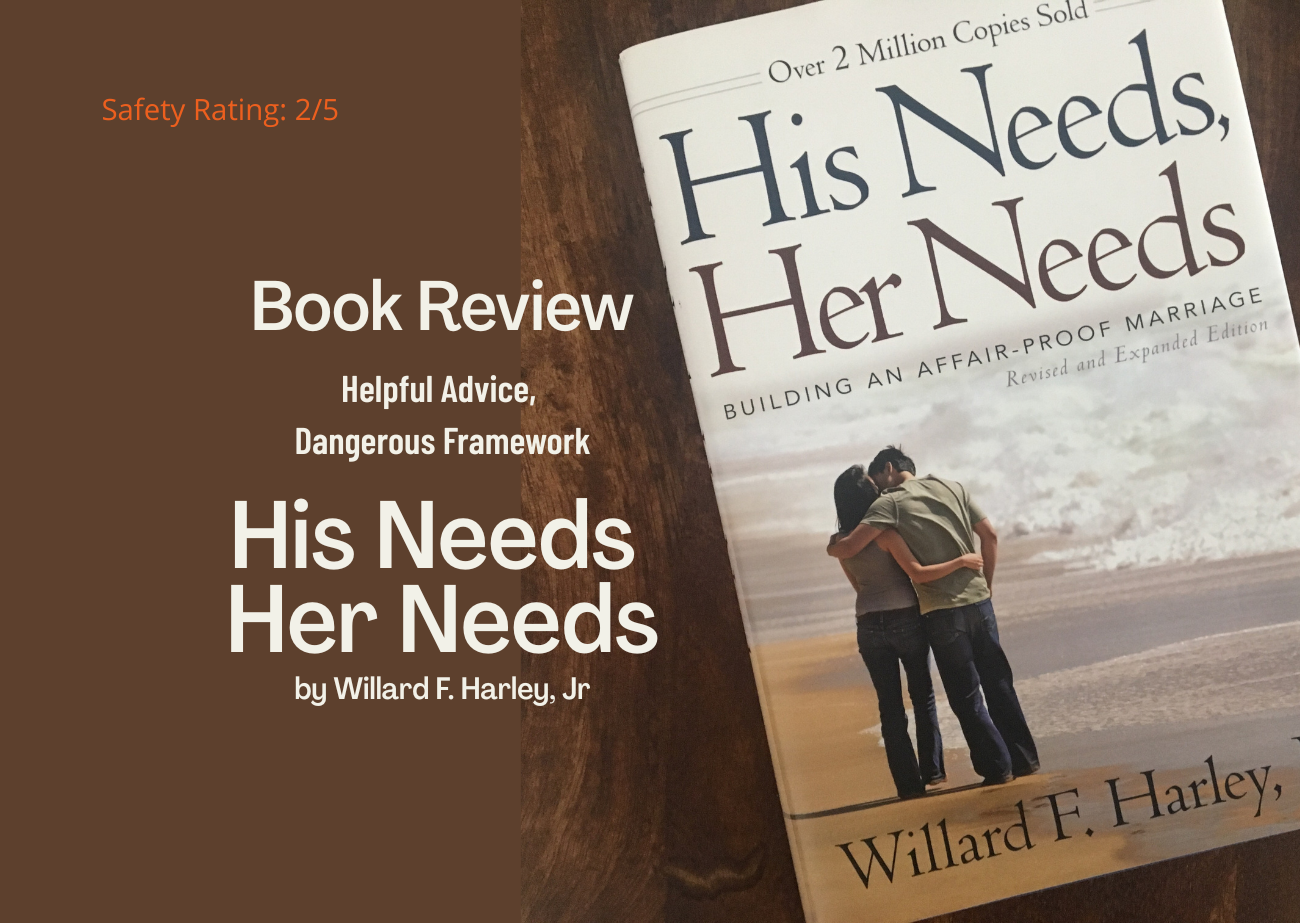
Willard F. Harley Jr.’s His Needs, Her Needs: Building an Affair-Proof Marriage includes the typical good advice for ordinary, safe marriages: honesty is important, affairs are condemned, fathers should be involved with their children. But it contains a dangerous framework: it can make a wife feel responsible for preventing her husband’s affair by being sexual enough, attractive enough, admiring enough, recreational enough, domestic enough, and continually pleasing—when his wedding vow of faithfulness should already be enough.
Start here: What worries me most
- Harley condemns affairs, but the book’s framework can hand cheaters a justification for having affairs.
- His “affair-proofing” logic shifts too much sympathy to the cheating spouse. The faithful spouse may be left asking, “Did I fail to perfectly meet enough needs?”
- The book repeatedly frames male sexual appetite as something wives must manage. That can become dangerous in coercive, entitled, porn-using, or sexually pressuring marriages. It also goes against decades of relationship research showing that a betrayed partner cannot stop a cheater from cheating by becoming nicer, thinner, prettier, more sexual, or more accommodating. (See chart below.)
- The “irresistible woman” ideal puts a crushing burden on wives. Despite the husband’s vow of faithfulness, the wife is expected to become a terrific sexual partner, favorite companion, attractive, domestic, and admiring. In this book, if she fails, his cheating is described as more likely—or more understandable.
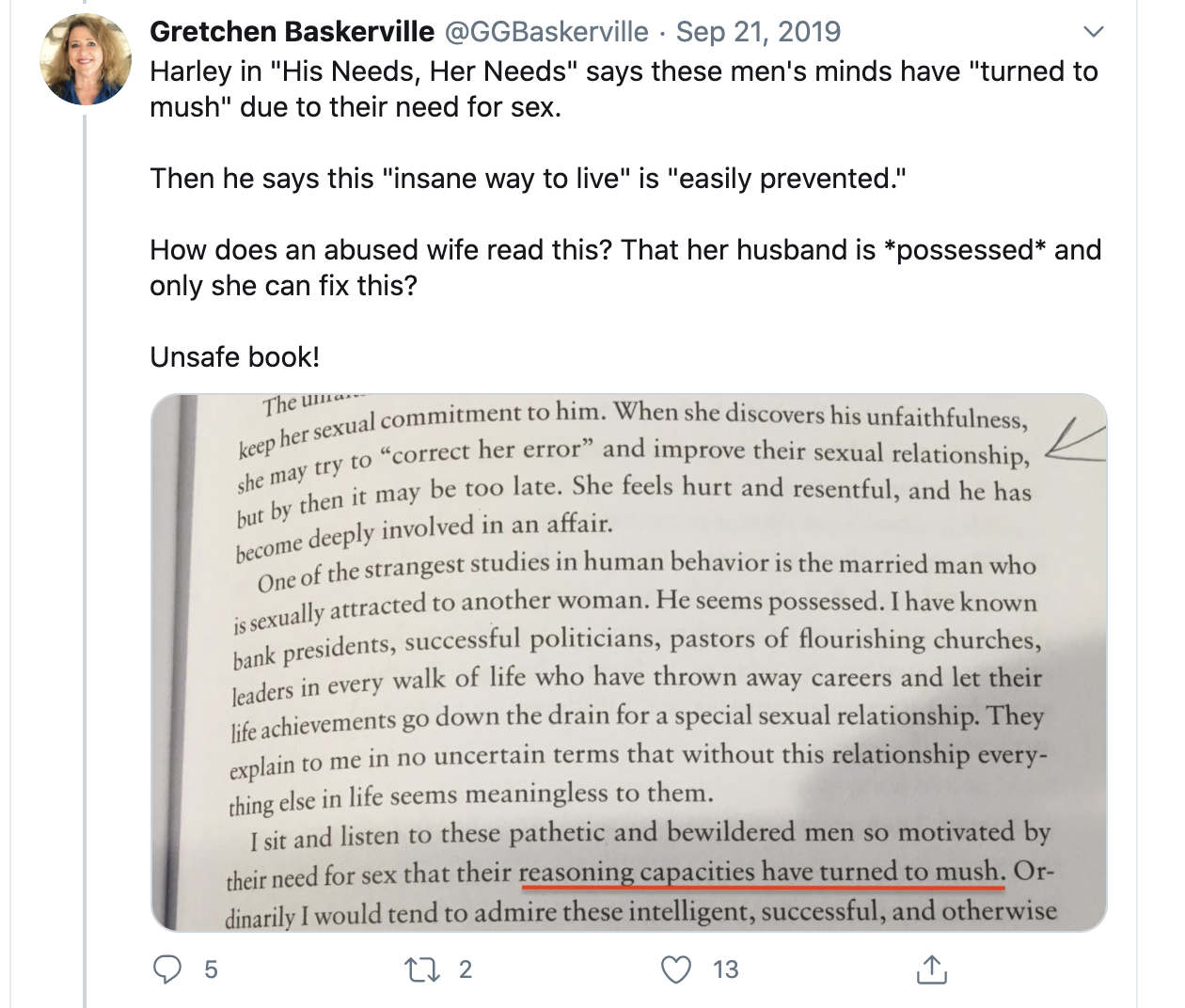
- Harley gives a nod to male self-control, but when a husband’s need for sex is placed on par with “air or water,” and affairs are described in terms of men seeming “possessed” and their minds “turn[ing] to mush,” wives are cast as the safeguard.
- The physical-attractiveness chapter is especially painful. When appearance is treated as a spouse’s “need,” aging, weight, hairstyle, clothing, and body shape can become part of a wife’s performance review.
- The domestic-support advice can make women’s invisible labor even more invisible. Children still need care, dishes still need washing, and homes still need running whether anyone earns “love units” from the work.
- The worst section invites the reader to feel sorry for the cheater. Harley describes the unfaithful spouse as torn between “the spouse left at home” and the affair partner, and even says the straying husband may feel he made a “great sacrifice” by returning home.
- The safety warning comes too late and is too thin. A marriage book that gives detailed instructions for rebuilding after betrayal must also clearly teach readers how to recognize abuse, coercive control, fear, intimidation, and danger.
- Divorce is condoned for abuse in this book, but not for cheating. And the author makes inaccurate claims about the effects of divorce on children. (See “Ugly” category, Point 11)
That is why I give this book a safety rating of 2 out of 5. Not because every page is bad. Some of it is useful. Harley values honesty, condemns affairs, encourages involved fatherhood, and says spouses should not suffer to meet each other’s needs. But a marriage book can contain good advice and still be unsafe for the people most likely to be harmed by applying it.
Contents
- Start here: What worries me most
- Quick verdict
- The receipts: the passages that concern me most
- The worst section: the cheater’s pain becomes the center
- Safety rating
- Comparison chart: ethical affair recovery vs. Harley’s framework
- The Good
- The Bad
- The Ugly Including Point 7, where readers are encourage to feel sorry for the poor cheater.
- Other books that handle these issues better
- Basic information
“`
Quick verdict
His Needs, Her Needs might be useful only for ordinary, non-abusive, good-faith marriages where both spouses are honest, safe, humble, and mutually responsible—and the one who had the affair is genuinely remorseful and takes full responsibility.
Harley condemns affairs in words, but his framework can still hand cheaters a ready-made excuse: “I cheated because my spouse wasn’t meeting my needs.”
I would not hand this book to someone whose spouse has a pattern of being coercive, sexually entitled, chronically unfaithful, porn-using, intimidating, addicted, financially controlling, or already blaming others for their own marriage-destroying sin. Nor would I hand it to a wife who is insecure, self-doubting, or eager to please.
Why? Because the book’s main framework can be weaponized:
“My affair was wrong, but you didn’t meet my needs.”
The “but” is the problem.
A faithful spouse with unmet needs has many honorable options: honest conversation, counseling, boundaries, ethical separation, divorce, prayer, friendship, self-control, grief, even sexual frustration. But a cheater chooses a secret life.
That is the heart of my concern. You cannot affair-proof a marriage by becoming more useful, sexual, attractive, domestic, recreational, admiring, or compliant. You can cook dinner, have sex, look fabulous, go fishing, admire him, keep the house peaceful, and still be cheated on.
The problem is not that the betrayed spouse failed to provide enough need-meeting. The problem is that the unfaithful spouse chose deception.
The receipts: the passages that concern me most
Here are the key passages readers need to see early. I’ve put the screenshots and page references here so people do not have to scroll to the bottom to understand the concern.
Receipt 1: Sexual frustration or infidelity
Early in the book, Harley frames sexual exclusivity as leaving a husband with a choice between sexual frustration and infidelity if his wife does not meet his sexual need. That is a terrible framing. Fidelity is not a choice between frustration and betrayal. Fidelity is a moral obligation, even in frustration.
Receipt 2: “Someone else may step forward”
At the end of the affection chapter, Harley warns wives about the power of male sexual appetite and says that if his need is not met, someone else may step forward. Even when Harley also tells husbands to be affectionate, the warning still lands heavily on wives: respond sexually, or risk betrayal. In my opinion, the advice is a backhanded way of excusing affairs.
Receipt 3: The husband’s “mistake”
In the sexual-fulfillment chapter, Harley describes a husband trusting his wife to be available when he has a need for sex, and says that in many marriages this trust became one of the biggest mistakes of his life. A wife in a difficult or coercive marriage may hear that sentence as a warning: if I am not available enough, his cheating will be understandable.
Receipt 4: “Correct her error”
Harley describes an unfaithful husband who justifies his affair in terms of his wife’s sexual failure, and then says she may try to “correct her error.” Even if Harley intends to describe the husband’s rationalization, he does not clearly stop and say: No. This was not her error to correct.
Receipt 5: Physical attractiveness and affair risk
Harley treats physical attractiveness as one of a spouse’s basic emotional needs. He advises women to evaluate posture, hairstyle, clothing, gestures, makeup, and weight. In an affair-proofing book, that can land like this: my body is now part of his fidelity plan. The burden for his fidelity is placed squarely on her.
Receipt 6: Domestic support and invisible labor
Harley’s domestic-support advice begins by establishing the wife’s responsibility for household tasks so the husband’s help can be appreciated. But childcare, meals, laundry, dishes, appointments, groceries, and school forms are not romantic favors. They are necessary labor.
Receipt 7: The cheater’s pain becomes the center of the story
This is the section I most want readers to see.
Near the end of the book, Harley invites us to feel sorry for the poor cheater. He explains that in many affairs the affair partner meets only one or two of the straying spouse’s needs while the betrayed spouse still meets the others. He describes the cheater as feeling a strong need for both “the spouse left at home” and the lover.
That phrase—“the spouse left at home”—is revealing. The betrayed spouse is not centered as the person who has been deceived, humiliated, sexually betrayed, exposed to risk, and robbed of reality. She becomes one source of need-meeting, while the affair partner becomes another.
Then Harley says the straying husband who returns home may feel he has made a “great sacrifice” for his family.
The faithful spouse lost truth, consent, sexual safety, emotional safety, time, dignity, health, and reality about the marriage they thought they had. But the emotional camera lingers on the cheater’s pain over losing the affair partner.
That is not affair recovery. That is cheater support.
Safety rating:
I give His Needs, Her Needs a 2 out of 5 safety rating.
When I rate a marriage book for safety, I am not asking only, “Does this book contain some good advice?” I am asking:
- Does it screen for abuse, coercive control, intimidation, and fear before giving reconciliation advice?
- Does it clearly distinguish ordinary marital unhappiness from destructive or dangerous patterns?
- Does it place responsibility for betrayal squarely on the betrayer?
- Does it give a spouse permission to seek outside help, separate, or divorce when safety requires it?
- Could a controlling, entitled, or unfaithful spouse weaponize this book?
On that scale, the book earns credit for condemning affairs, encouraging honesty, and recognizing that spouses can cause each other real pain. But it loses major safety points because it gives concrete instructions for affair recovery without comparable instructions for abuse recovery.
The danger is not mainly what Harley says about abuse. The danger is how little he says about it.
Comparison chart: ethical affair recovery vs. Harley’s framework
Use the chart below to compare a safer, more ethical approach to infidelity with the framework in His Needs, Her Needs.
| Topic | Professional / Scientific / Ethical Understanding | Harley’s Framework in His Needs, Her Needs |
|---|---|---|
| What cheating is | Infidelity is typically understood as a betrayal of trust and agreed boundaries, whether sexual, emotional, or both. Researchers commonly define it in terms of secrecy, broken expectations, and violation of the relationship contract. (PubMed) | Harley also treats affairs as devastating betrayal, but he strongly frames them as the outgrowth of unmet emotional needs and “affair vulnerability” within the marriage. |
| Primary moral responsibility | Ethical reasoning puts the primary responsibility for cheating on the person who chooses deception and betrayal. Relationship stress may be context, but it is not moral transfer of blame. Affair recovery models likewise put the burden of atonement and repair on the unfaithful partner. (The Gottman Institute) | Harley repeatedly explains affairs through deprivation and unmet needs, which can shift attention away from the cheater’s agency. He says people with unmet needs “wander into affairs,” and that unmet need creates “a thirst that must be quenched.” |
| Role of unmet needs | Research does find that dissatisfaction, conflict, opportunity, weak commitment, and poor boundaries can correlate with infidelity risk, but correlation is not excuse. Predictors increase risk; they do not erase responsibility. (PubMed) | Harley makes unmet needs the central explanatory engine. He says when spouses fail to meet one another’s most important needs, they “tend to choose” the same pattern: the affair. |
| How affairs are described | Professional accounts usually stress choice, secrecy, boundary failure, entitlement, and deception. Even when they discuss vulnerability, they do not usually narrate affairs as something that simply “happens” apart from agency. (PubMed) | Harley repeatedly uses language that softens agency: affairs “just seem to ‘happen,’” people “wander into affairs,” and Jolene was “literally hugged into having an affair.” Their brains turn into “mush.” |
| What betrayed spouses most need to hear | Professional and trauma-informed approaches usually emphasize that the betrayed partner did not cause the affair, that their reality should be taken seriously, and that trust must be rebuilt through transparency, accountability, and time. (American Psychological Association) | Harley does say trust cannot be turned on “like a light switch,” and he emphasizes honesty and openness in recovery. But his broader framework can still leave spouses feeling they should have prevented the betrayal by better need-meeting. |
| Gender expectations | Contemporary evidence-based approaches do not assume that men naturally need sex more, women naturally need affection more, and that marriage stability depends on each sex managing those opposite-sex needs. These sex-difference claims are not reliable enough to serve as moral rules for couples. (PubMed) | Harley builds the book around stereotyped male/female need profiles and repeatedly tells wives to grasp male sexual appetite as a key marriage reality.
The 20,000 Christian woman study done by Sawatsky, Gregoire, and Lindenbach (The Great Sex Rescue) shed new light on this issue. |
| Sex and infidelity | Mainstream ethical and clinical reasoning does not treat a spouse’s lack of sexual availability as making later cheating understandable in a blame-sharing sense. The moral breach remains the cheater’s. (The Gottman Institute) | Harley says some husbands feel “cheated” by a wife unwilling to meet that need, and that “many cannot” tough it out: “They find sex elsewhere.” They “seem possessed.” He adds that the unfaithful man justifies himself in terms of his wife’s “failure.” |
| Appearance and infidelity | Professional literature may discuss attraction and mate value in some research traditions, but responsible clinical/ethical guidance does not tell wives that failure to improve appearance meaningfully transfers responsibility for a spouse’s affair. (PubMed) | Harley says wives who refuse to improve physical appearance “greatly increase the risk” of a spouse having an affair. |
| Admiration and infidelity | A spouse’s criticism may strain a relationship, but ordinary ethical reasoning does not say a wife’s failure to admire a husband morally “tempts” him into adultery. (The Gottman Institute) | Harley warns wives, “Don’t tempt your husband to go outside your marriage for approval; he needs your appreciation.” |
| Recovery after an affair | Evidence-informed recovery emphasizes confession, no contact with the affair partner, transparency, accountability, attunement to the injured partner’s pain, and gradual rebuilding of trust if the relationship continues. (The Gottman Institute) | On this point, Harley is often stronger than his critics admit. He says the affair must end, with no further contact with the lover, and he emphasizes honesty and the slow rebuilding of trust. |
| Best takeaway | A strong marital framework asks: Is this person honest, self-controlled, accountable, safe, and capable of fidelity under frustration? The key issue is character, not whether you can manage their appetites well enough. This follows both ethical reasoning and modern couple research on commitment, trust, and stability. (PubMed) | Harley’s framework trains readers to focus heavily on identifying and meeting needs so spouses become “irresistible” to one another and reduce affair-risk. |
The Good
Now that I’ve put the biggest concerns up front, I want to be fair. There are some genuinely helpful parts of this book.
1. Harley takes marital unhappiness seriously
Harley does not tell couples to settle for a cold, dutiful marriage. He recognizes that a marriage can be legally intact and emotionally dead, and that is a useful starting point.
2. He gives couples practical language for unmet needs
Harley’s ten emotional needs can help ordinary, safe, good-faith couples name what helps them feel loved, instead of assuming both spouses experience love the same way.
3. He teaches honesty and transparency
Harley’s emphasis on transparency is helpful in marriages damaged by affairs or deception. But in coercive-control situations, “transparency” can become surveillance, so caution is needed.
4. He distinguishes complaints from criticism
Harley allows spouses to name problems without degrading each other. That distinction is genuinely useful: a complaint seeks repair; criticism adds contempt.
5. He says spouses should not suffer to meet each other’s needs
Harley says “one spouse should never suffer to meet the emotional needs of the other.” That matters because it points toward mutual care, not marital self-erasure.
6. His fatherhood advice is about actual involvement, not mere presence
Harley calls fathers to active involvement in their children’s moral and educational development. That is good, but father involvement is not automatically protective when a father is abusive, coercive, addicted, unsafe, or degrading.
7. He condemns affairs as serious betrayals
Harley treats affairs as serious betrayals and requires the unfaithful spouse to end contact with the affair partner. He does not tell betrayed spouses to simply forgive and move on; he requires concrete change.
The Bad
1. Harley fails to express the cost of adultery to the faithful partner
I can find only two real acknowledgements of the betrayed spouse’s harm in Harley’s own words:
- The affair is “the most hurtful and selfish act” and “the ultimate betrayal” — p. 190.
-
“…one of the most severe blows anyone could possibly sustain.” — p. 195
There is nothing in this book that gives a list of the wife, or husband’s, possible outcomes that includes devastation, humiliation, sexual risk, STD exposure, depression, tension, hyper-vigilance, fear, health consequences, loss of consent, loss of trust, financial deception, spiritual crisis, or the heartbreak of realizing their reality was built on lies.
2. Harley presents himself as the expert who found the secret to fidelity
Harley does not make a modest authority claim. He says he tried conventional marital therapy, trained in a respected clinic, read leading theorists, and learned communication techniques—but still failed to save marriages. Then he broadens the indictment: “Most of the marital experts in America were also failing,” many “didn’t even know how to make their own marriages work,” and marital therapy had “the lowest success rate of any form of therapy” at the time.
So Harley is not merely offering one useful model. He presents himself as the man who found what the experts missed: the way to build an “affair-proof” marriage.
His answer is that spouses must meet each other’s five “emotional needs.” But for wives, the practical burden is stark. To protect the marriage from male infidelity, she must “irresistibly” meet his five needs: sexual fulfillment, recreational companionship, physical attractiveness, domestic support, and admiration.
That framing is the problem. Mutual care can strengthen a marriage. But a wife’s attractiveness, sexual availability, housekeeping, companionship, and admiration do not control her husband’s fidelity. A husband’s affair is his choice, not her failure to meet his “needs.”
3. The book tells wives to become “irresistible”
Harley allows exceptions. He says not every man and woman fits the “typical” pattern. For example, he acknowledges that sometimes the wife craves sex and the husband is reluctant. (pp. 49–50, 205–212)
But the book’s basic structure is still strongly based on his own view that “his needs are not her needs.” (p. 18) “Her” needs include affection, intimate conversation, honesty and openness, financial support, and family commitment. “His” needs include sexual fulfillment, recreational companionship, physical attractiveness, domestic support, and admiration.
By the end, Harley summarizes the “irresistible woman” as one who meets her husband’s five most important needs. She becomes a “terrific sexual partner,” his favorite recreational companion, physically fit and attractive, a homemaker who gives him refuge, and admiring. (pp. 199–201)
That is a lot of pressure.
In a book subtitled Building an Affair-Proof Marriage, this is not merely “love your husband well.” It can sound like: Be sexual enough, fun enough, pretty enough, domestic enough, and admiring enough—so he won’t stray.
That is the danger. Fidelity becomes something the wife helps produce by being irresistible enough.
But a wife should not have to become irresistible to be safe from betrayal. A husband’s vows should be enough.
Some of Harley’s categories may describe some couples. But when universalized inside an affair-proofing system, they become a performance plan for wives—and that is wife-managed risk, not biblical fidelity.
4. The physical-attractiveness chapter is especially troubling
Harley frames a wife’s physical attractiveness as one of a husband’s basic needs. He says that if physical attractiveness meets a spouse’s emotional need, one should not ignore it. Then he writes, “Attractiveness is what you do with what you have.” (pp. 127–128)
He advises women to evaluate posture, hairstyle, clothing, gestures, makeup, and weight, ask their husbands for an honest appraisal, consult professionals or trustworthy friends if possible, and set goals for change. (p. 128)
The questions at the end of the chapter are even more direct. For women: “Do you take your husband’s need for you to be attractive seriously?” “How is your figure?” “Do you change your hairstyle from time to time to please your husband by giving him a little variety in the way you look?” For men: “Has your wife’s appearance become less attractive since your wedding?” “If your wife told you she was willing to change anything she could about her physical appearance, what would you ask her to change?” (pp. 129–130)
This is how the physical-attractiveness chapter lands on many wives’ ears:
- My body is now part of his marital satisfaction plan.
- My aging is a marriage problem.
- My weight is a spiritual problem.
- My hairstyle, makeup, posture, clothes, and figure are not merely mine; they are his “need.”
- If he wanders, I may have made wandering easier by failing to stay pleasing enough.
That is a devastating burden to put on a woman.
There is a world of difference between saying, “It is kind and healthy for spouses to care about attraction,” and saying, “Your spouse has a basic emotional need for your body to remain pleasing to them.” The first can belong to mutual love. The second can become surveillance.
And when this message is combined with affair-proofing, it becomes even more dangerous. The wife is not merely encouraged to care for herself. She is taught that her husband’s sexual attention may depend on her successful bodily maintenance.
That is not romance. That is performance anxiety with a wedding ring.
Fidelity is firmly the responsibility of each person who vowed faithfulness.
Harley’s solution of becoming more attractive is not supported by scientific research. Infidelity is one of the most studied topics in the research literature. And researchers do not find that a betrayed spouse can control or prevent infidelity by becoming nicer, prettier, thinner, more sexually enthusiastic, or more accommodating.
5. The financial-support chapter contains a narrow view, given that most mothers work (even in 1986)
For wives, Harley’s framework pressures husbands to provide financially — but it also pressures wives into economic dependency, which can make it harder to leave if the marriage becomes unsafe. Harley says he is not against women having careers. He mentions his daughter, who earned a Ph.D., became a licensed psychologist, and raised two daughters while employed. (p. 134)
But his default economic ideal is still striking: “many families need to learn how to live on what a husband can earn in a normal workweek.” He also says, “Don’t I know that today a couple simply cannot live on one salary? No, I really don’t know that… In fact I know that a family can live on one salary and I will show you how it can be done,” (pp. 135) by cutting the budget and lowering the standard of living.
He criticizes “well-intentioned people, in the guise of advocating women’s rights” who encourage all women to develop careers, saying they fail to consider a woman’s right to be a homemaker and full-time mother. (p. 135)
Harley’s assessment of economics is problematic. Harley treats the stay-at-home mother as a possible norm. But by the 1980s when the first edition was published, most wives with children under 18 were already in the labor force, and the Bureau of Labor Statistics described children with working mothers as “more the rule rather than the exception.” By the time Harley revised the book in 2011, the Christian book market itself was hardly an affluent audience: the 2012 Bowker/PubTrack chart I’m working from shows roughly 45 percent of Christian book buyers under $35,000 in household income.
Now Harley does have a good point buried here: women should not be forced into paid work by husbands, culture, or economic expectations if they want to care for children at home. But Harley does not seriously reckon with wages, housing costs, medical debt, disability, childcare costs, racism, labor-market instability, or the economic danger of women becoming financially dependent on unsafe men.
6. His domestic-support advice can make invisible labor even more invisible
In the domestic-support chapter, Harley says wives often want help with household responsibilities. But his structure still begins by establishing the wife’s responsibility for household tasks so that the husband’s help can be appreciated. He writes, “Establishing her responsibility for the household tasks is essential if his help is to be genuinely appreciated.” (p. 152)
He then says, “Don’t do housework or child care for your spouse if it is not appreciated.” If a spouse does not appreciate a task, “don’t waste your time.” (p. 153)
This advice is designed around emotional deposits, not justice, fairness, or necessity. But some tasks must be done whether or not anyone feels grateful. Children need care. Dishes need washing. Laundry needs doing. A household cannot run only on tasks that generate “love units.”
This is especially concerning in marriages where one spouse already carries the invisible labor and the other treats help as a gift rather than a shared responsibility.
The Ugly
1. “Affair-proofing” shifts the focus from husband’s personal integrity to wife’s personal responsibility
The most troubling part of His Needs, Her Needs is the “affair-proofing” framework. (See screenshots below.)
Harley does condemn affairs. He calls them selfish and devastating. But his overall explanatory structure repeatedly says affairs happen when spouses do not meet each other’s needs. That means the betrayed spouse is not only wounded by the betrayal; they are invited to examine how their own failure may have helped create it.
Early in the book, Harley says that when a husband agrees to an exclusive relationship with his wife, “he depends on her to meet his sexual need.” If she meets it, his love grows. But if she does not, he associates her with frustration. Then comes the key line: “His commitment to an exclusive sexual relationship with his wife has left him with the choice of sexual frustration or infidelity.” (p. 17)
That is a terrible framing. Fidelity is not a choice between frustration and infidelity. Fidelity is a moral obligation, even in frustration.
Harley makes a parallel argument about wives and intimate conversation: if a husband refuses to give his wife the attention she craves, some women “cannot resist the temptation” to let someone else meet that need, and “an affair is the likely outcome.” (p. 18)
Again, the problem is not that Harley approves of affairs. He does not. The problem is that he makes affairs sound like the predictable outcome of unmet needs rather than chosen betrayals.
The problem with “affair-proofing” is that it can turn fidelity from a moral obligation into a spouse-management outcome: if she meets his needs, he stays faithful; if she does not, his affair becomes predictable, understandable, maybe even expected.
You cannot keep a person from cheating no matter how hard you meet their needs. Fidelity is the responsibility of the person who vowed faithfulness.
2. The wife is taught to manage male sexual appetite
This is the most serious danger in the book.
At the end of the affection chapter, Harley says a wife must understand that her husband has an “equally deep need for sex.” He then says, “To the typical man, sex is like air or water. He can’t do without it very well.” (p. 46)
Then he warns that if a wife does not understand “the power of the male sex appetite,” her husband will be tense and frustrated at best. At worst, “someone else may step forward to meet his need.” Then he says, “it can all be avoided if husbands learn to be more affectionate and wives respond with more eagerness to make love.” (p. 46)
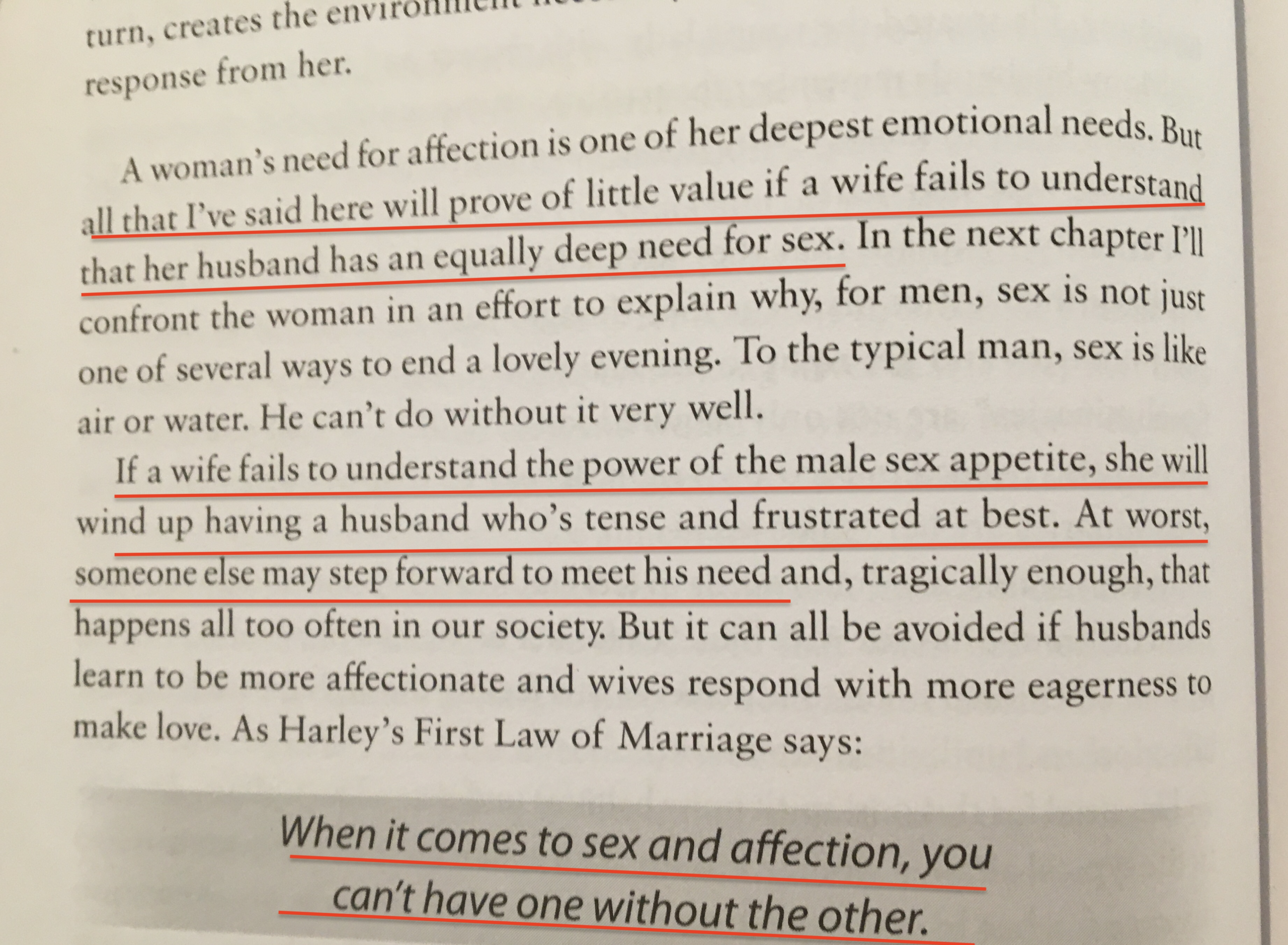
Page 46: Harley’s summary paragraph at the end of the affection chapter links a wife’s understanding of male sexual appetite to the risk that “someone else may step forward to meet his need.” This is why I read the passage as a quasi-threat aimed at wives, not merely a neutral description.That sentence is extraordinarily revealing. Even when Harley acknowledges a husband’s duty to show affection, the final system still places the wife’s sexual responsiveness inside the mechanism that keeps him faithful.
The wife is not merely being asked to build intimacy and mutual sexual joy; she is being taught to feel like the only thing standing between her husband and sexual sin. And it is the only thing keeping him from tension and frustration.
Affair-proofing language can turn the faithful spouse into the “Cheater Risk Management Department,” asking whether she was affectionate, sexual, admiring, attractive, domestic, or recreational enough.
3. Harley describes the unfaithful husband’s rationalization in a way that gives it force
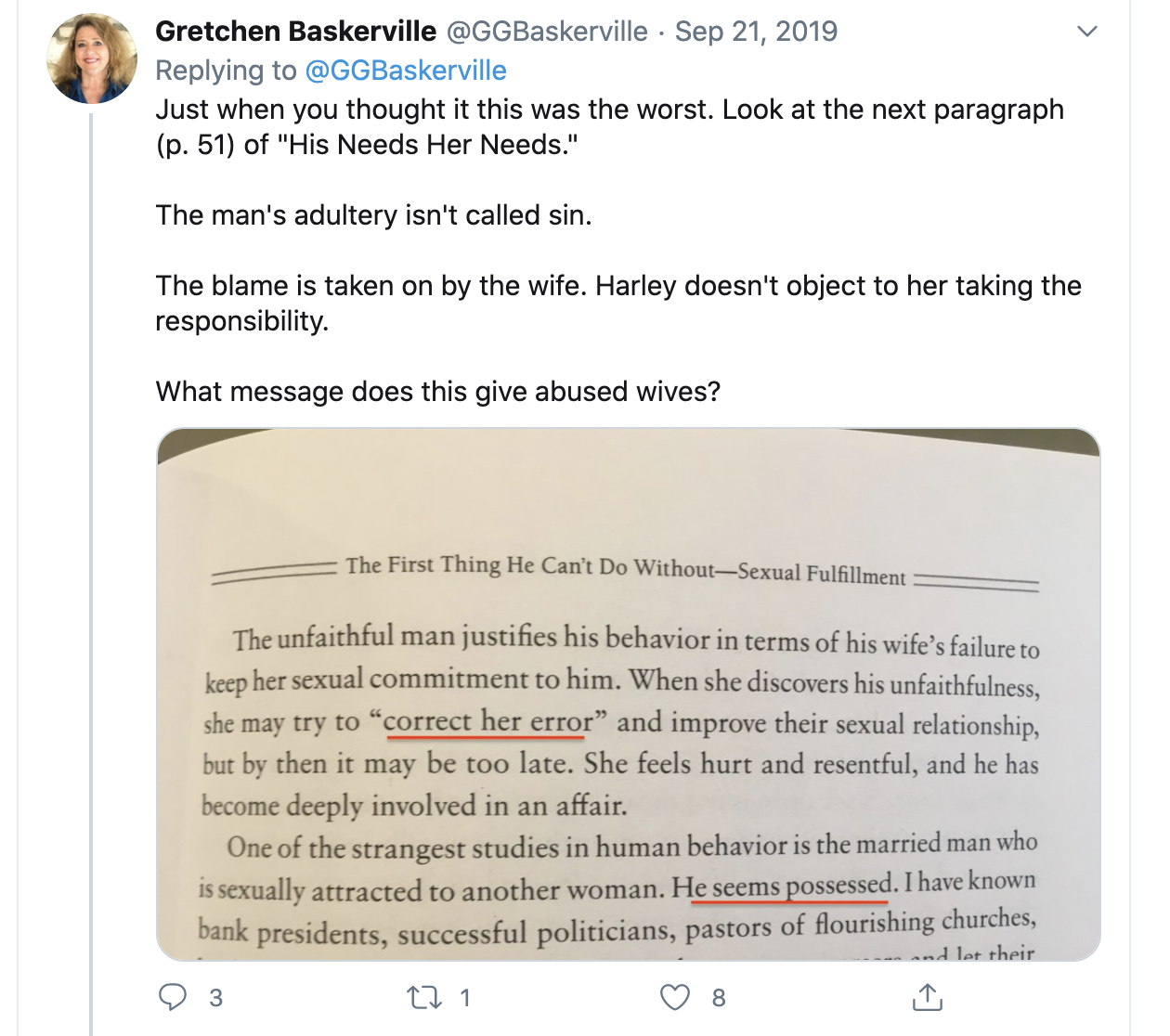
On p. 50, Harley says that many husbands feel “cheated” when they are limited to “a wife who is unwilling to meet that vital need,” and then adds: “Some husbands tough it out, but many cannot. They find sex elsewhere.” He immediately notes that the unfaithful husband justifies himself in terms of “his wife’s failure to keep her sexual commitment to him.” (pp. 51)
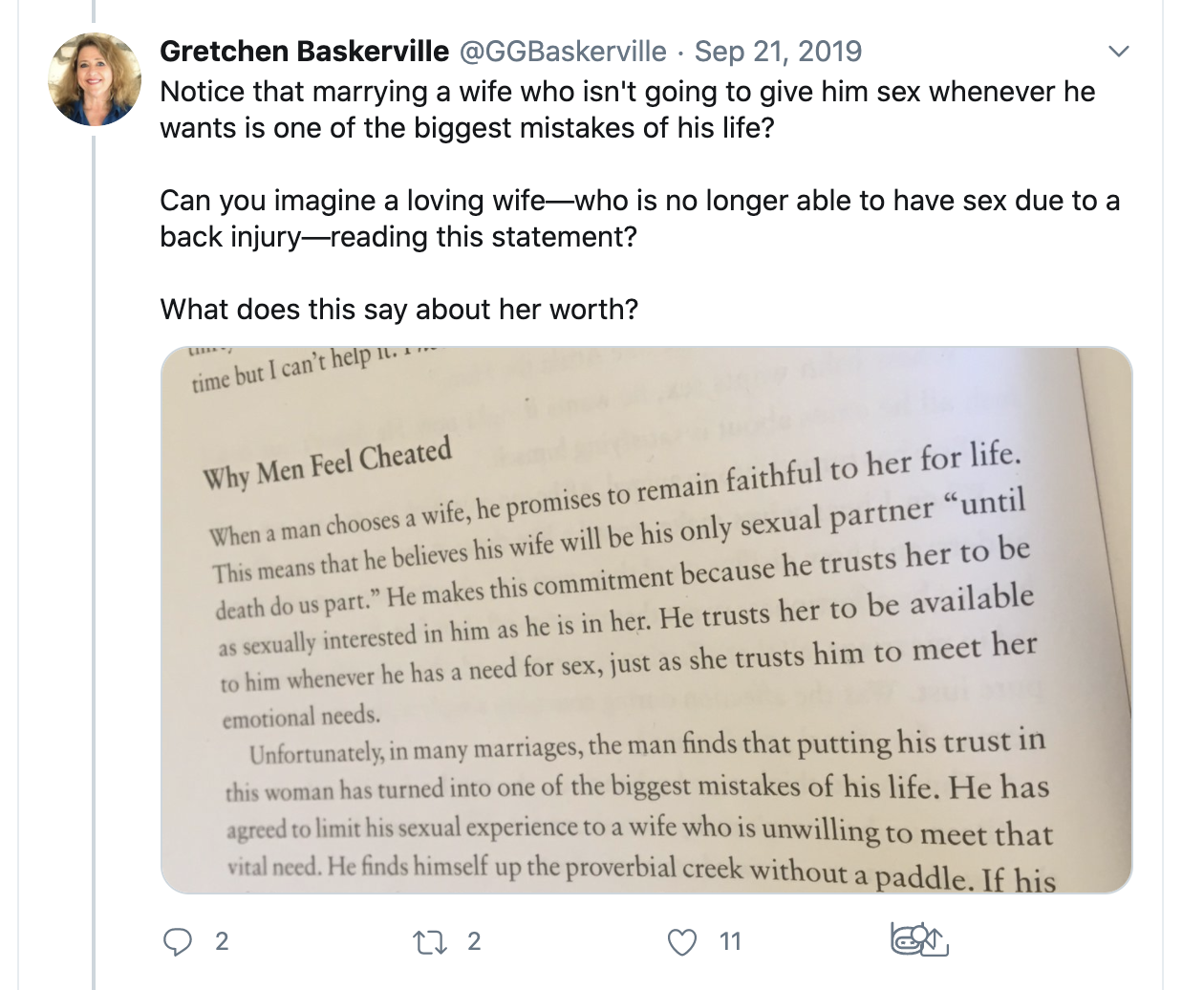
That is not just a description of male rationalization. It is part of the book’s overall explanatory structure. The wife is taught to see unmet sex as one of the main conditions under which a husband may betray her.
To his credit, Harley criticizes selfish sex. He says a man interested only in satisfying his hunger “molests his wife more than anything else,” because he uses her body for his own pleasure while she becomes infuriated. (pp. 63–64) That is one of the book’s better and more important lines.
Harley also writes, “When a man learns to be affectionate, his lovemaking will become very different.” (p. 64) Harley likely intends to say that when a husband becomes more affectionate, sex can become more mutually pleasurable. That is true. But in the larger framework of the book, many wives will hear the reverse: if she becomes more sexually responsive, perhaps he will finally become more affectionate. That is the dangerous reversal.
Drawing on her research with more than 20,000 ever-married Christian women, Sheila Wray Gregoire has shown that sexual pressure does not nurture desire; it often trains the body to shut desire down. A wife should not have to buy tenderness with sexual availability. Affection is not the prize she earns after meeting his needs. It is part of the soil in which mutual desire can grow.
But Harley’s condemnation of selfish sex sits beside a far more dangerous claim: women need to learn to enjoy meeting a husband’s “compelling need for sex,” and Harley encourages wives “not only to make their bodies available to their husband on a more regular basis” but also to learn to enjoy sex as much as their husband does. (p. 64)
This is a complicated passage. Harley says a wife should not merely sacrifice her body, and he says the husband must help her enjoy sex. But the pressure remains: her husband has a compelling need; she should make her body available more regularly; she should learn to enjoy it.
The question is not merely whether she can learn to enjoy sex; the question is whether she is free to want, free to refuse, free to be heard, and free from the fear that his sin will be blamed on her.
For women in coercive marriages, that is dangerous.
4. His affair examples can shift causal responsibility onto the betrayed spouse
Harley says people should worry that their spouse may have an affair if basic needs go unmet. In one passage, after describing John’s affair with Noreen, Harley asks, “Should I be concerned that my spouse will have an affair if I don’t meet her needs? Should my spouse fear that I might have an affair if my needs are not being met?” His answer: “yes.” (p. 33)
That is the book’s affair-proofing logic in miniature.
It gets worse in the domestic-support affair example involving Phil and Charlene. Harley says Charlene did not want to assume responsibility for caring for the home and children, and her demands that Phil share the load were overwhelming to him because he was working long hours. Then: “That motivated him” to begin a relationship with Janet. (pp. 145)
To be fair, Harley calls Phil’s affair “the worst decision of his life.” But the explanatory structure still makes Charlene’s domestic performance part of the causal chain. The betrayed wife is taught to ask whether her husband’s betrayal happened because she failed to provide sufficient domestic support.
This is one of the places where Harley’s needs framework becomes especially painful for wives.
Domestic support is not merely an emotional need. It is also labor. It is childcare, dishes, laundry, groceries, schedules, school forms, appointments, meals, sick days, birthdays, and the thousand invisible tasks that keep a family functioning.
So when a husband’s affair is explained partly through his wife’s alleged failure to create the right home environment, the wife is burdened twice. First she carries the domestic load. Then she is invited to carry responsibility for his betrayal unless she does every one of those things well. Exhausted women may hear “you must be perfect in every way, or he’s justified in cheating.”
We need marriage books that refuse to treat serious breaches—affairs, porn use, lying, addiction—as ordinary marital rifts. Major betrayals must be named as betrayals before restoration is possible. The offender must admit the depth of the hurt, make a repair plan, and follow through before trust can be rebuilt.
Both spouses may need to work toward a healthier marriage; but porn use or betrayal still begins with the offender’s choice. A healthy sex life cannot be rebuilt while porn use continues, and turning to porn is still a sin that she did not cause.
That is the order Harley’s framework blurs.
The betrayed spouse does not repair the marriage by performing better. That is not neutral counseling language. That is burden-shifting. The betrayer repairs the marriage by repenting.
5. “Affair-proofing” makes the faithful spouse responsible for managing another adult’s integrity
One of the deepest problems with His Needs, Her Needs is not merely that Harley talks about affairs. It is that he sells the idea of “affair-proofing” a marriage by meeting another adult’s needs.
But you cannot affair-proof a marriage by becoming more useful, sexual, attractive, domestic, recreational, admiring, or compliant. You can be a loving spouse. You can communicate. You can cook dinner, have sex, look fabulous, go fishing, admire him, keep the house peaceful, and still be cheated on.
The problem is not that the betrayed spouse failed to provide enough need-meeting.
The problem is that the unfaithful spouse chose deception.
That is where Harley’s framework becomes so dangerous. He condemns affairs, yes. But his larger theory gives cheaters a ready-made blame-shifting script:
“My affair was wrong, but you didn’t meet my needs.”
The “but” is the problem.
A faithful spouse with unmet needs has options: honest conversation, counseling, boundaries, ethical separation, divorce, prayer, friendship, self-control, grief, even sexual frustration. A cheater chooses a secret life. Infidelity is not a bodily function. It is not the inevitable result of deprivation. It is a choice.
This is why the book’s “affair-proofing” language is so troubling. It can turn the faithful spouse into the Cheater Risk Management Department. The wife is taught to ask: Was I affectionate enough? Sexual enough? Admiring enough? Attractive enough? Domestic enough? Recreational enough? Did I fail to keep him faithful?
Those are the wrong questions.
The better question is: Is this relationship honest, safe, faithful, and acceptable? Is my spouse faithful to me?
6. The affair can become the thing that “improves” the marriage
In the affair-recovery chapter, Harley says the only way to survive an affair is for the couple to turn the marriage into something “passionate and fulfilling.” He says that unless spouses have a better marriage than before, they do not stay together. (pp. 189)
Harley uses similar pressure in his discussion of new parenthood. He says affairs are “extremely common” after a couple’s first child and that the cause is usually the couple’s failure to meet each other’s basic needs. He describes a wife being “transformed from a lover into a mother,” while the husband experiences the loss of sexual fulfillment and recreational companionship. (p. 168) This is very immature and self-centered.
To a postpartum wife it can land like a warning: don’t let motherhood interfere with sex and romance, or your husband may stray. A woman recovering from birth, nursing, bleeding, sleep-deprived, anxious, or overwhelmed does not need affair-risk lectures. She needs tenderness, rest, practical help, and protection from pressure. A husband’s faithfulness should not depend on whether his exhausted wife can keep performing “lover” while becoming a mother. His job is to provide, protect, and care for her. If there was ever a time for a loving husband to sacrifice for his wife, this is it.
When a book says the marriage must become better than ever after an affair, a wife may hear:
- His affair is now my assignment. I have to become his unpaid probation officer.
- His betrayal means I must become more sexual, more admiring, more attractive, more companionable, more cheerful, and more available than before.
- If the marriage does not survive, maybe I failed the recovery process.
That is backwards.
Some cheaters are repeaters. They are attracted to the chase, the secrecy, the triangle, the drama, the ego stroking. They may be excellent at tears, promises, romance, and regret. They may know exactly how to perform devastation. But they are lousy at sustained faithfulness.
And for the betrayed partner, the reason may not matter.
Maybe they cannot stop. Maybe they will not stop. Maybe they are addicted, entitled, immature, avoidant, narcissistic, wounded, or just very fond of having a committed partner and a secret side life. The practical result is the same: continued deception, continued risk, continued injury, continued chaos.
The betrayed partner does not have to diagnose the machinery before stepping out of the blades.
This is where many recovery programs become dangerous. They treat the relationship as the patient and assign the faithful partner to the treatment team. Communicate better. Rebuild passion. Meet needs. Create Relationship 2.0.
Yes, a marriage that survives betrayal will need to become healthier. But the affair should not become the traumatic event that finally forces the betrayed spouse into better performance. A wife should not have to be devastated into becoming more sexually responsive. She should not have to be betrayed into becoming more attentive.
The first question after betrayal is not, “How can we make the marriage passionate again?”
The first question is, “Has the betraying spouse become safe?”
Not sad. No tearful. Not temporarily saying the right things because consequences are unpleasant. Safe.
If they cannot or will not produce sustained truth, no contact, accountability, repentance in action, and respect for your free choice, then recovery is just another stage for the performance.
Affairs do not create intimacy. Remorse does not equal repair. Tears are not character. And hope is not a safety plan.
7. The cheater’s pain becomes the center of the story — and the affair partner is praised
Near the end of the book, Harley’s affair-recovery framework takes an even darker turn. He explains that the affair partner is seldom “totally irresistible,” because in most affairs the lover meets only “one or two” of the straying spouse’s basic needs, while the betrayed spouse still meets “the other three or four.” The result, he says, is that the unfaithful spouse feels a strong need for both people: “the spouse left at home and the lover.” (pp. 197–198)
That phrase—“the spouse left at home”—is revealing. The betrayed spouse is not centered as the person who has been deceived, sexually betrayed, humiliated, exposed to risk, and robbed of reality. She is described as just one source of need-meeting, while the lover is another. The cheater’s crisis becomes the emotional center: he wants both.
Harley does this earlier, too. In the John/Mary/Noreen example, he writes that John wants to end the affair because of “the growing pressure at home,” Mary wants him to get rid of the other woman because “it drives her crazy,” and the affair partner has grown tired of being “noble and patient.” (p. 32) That framing is astonishing. The betrayed wife is reduced to pressure at home and emotional instability, while the affair partner is described in almost sympathetic terms.
But Mary is not “crazy.” She has been betrayed. And the affair partner is not noble. She is participating in another woman’s betrayal. Another story gives the affair partner a self-sacrificing line followed by the cheating husband’s praise: “Heather, you’re a jewel” (p. 187). The effect is disturbing: affair partners treated with tenderness, while the betrayed wife is is described as “pressure at home” or “driven crazy.”
Harley then says that when a straying husband chooses to return to his wife, he may feel he has made “some great sacrifice for his family,” because he has been “forced to give up a satisfying sexual relationship—perhaps the first he has ever known in his life.” (p. 198)
The reader is invited to feel sorry for the poor cheater.
The unfaithful spouse’s anguish is narrated at length, while the betrayed spouse becomes scenery: “the spouse left at home.” Harley’s emotional camera lingers on the cheater’s grief over losing a satisfying sexual relationship, but not on the faithful spouse’s grief over being deceived, exposed, humiliated, and betrayed.
Then the framing gets even worse. Harley writes that, in his experience, the cheating spouse who is “trapped in an affair” comes through relatively healthy when he or she chooses to “resolve incompatibility at home and rebuild the marriage.” But cheating spouses who “abandoned their marriage in favor of the affair,” he says, suffer relentless guilt; if they marry the affair partner, the same problems often appear in the new marriage, and they realize they could have saved the first one. (p. 199)
Notice where the sympathy goes.
The offender is “trapped.” The offender suffers. The offender sacrifices. The offender feels guilt, shame, grief, pain, depression, and resentment.
But the faithful spouse is barely visible. That is where the DARVO pattern becomes especially clear. It seems the author is explaining to us why we should feel sorry for the cheater.
Where is the betrayed spouse’s reality? Where is the shock, humiliation, loss due to financial deception, sexual risk, lost consent, shattered trust, and grief? Where is the possibility that the faithful spouse may choose divorce—not as wreckage, not as revenge, but as truth-telling, protection, and refusal to keep living inside betrayal?
The cheater’s guilt is not the same thing as repentance. The cheater’s regret is not the same thing as restoration. And the cheater’s decision to return home is not the same thing as a safe marriage.
The wife is criticized by implication for choosing divorce, while the cheater is treated as the tragic figure caught between needs.
A better affair-recovery framework would begin somewhere else: with the betrayed spouse’s reality, agency, safety, health, and freedom to choose. The unfaithful spouse’s grief over losing the affair partner may be real, but it should not become the moral center of the story.
The question is not, “How painful is it for the cheater to give up the lover?”
The question is, “Has the betrayer fully owned the deception, ended the affair, told the truth, acknowledged the harm they’ve done, accepted consequences, and become safe?”
Thus far, I’ve been rather restrained in my critique of this book. But this section is so remarkably bad that I need to speak plainly: this lands as Harley’s argument for cheaters everywhere.
Harley claims:
- The cheater is “caught in the web.”
- The cheater feels pain.
- The cheater made a “great sacrifice” in returning to his wife.
- The cheater is grieving the loss of the affair partner.
- The betrayed spouse is asked to understand how hard this is for the adulterer who lied to them.
But no one is “caught in the web” of an affair. They spun the web.
Harley’s language makes the cheater sound like a tragic hero trapped between two overpowering loves. But a more accurate description is this: the cheater wanted the benefits of both women and resented being forced to stop exploiting one of them.
The most outrageous sentence is probably this:
“When a straying husband chooses to return to his wife, he probably feels that he has made some great sacrifice for his family.”
A great sacrifice? Sir, you gave up your secret sex buffet. Let us not alert the Nobel committee.
That line centers the cheater’s loss instead of the betrayed spouse’s reality. The faithful spouse lost truth, consent, sexual safety, emotional safety, time, dignity, health, and reality about the life and marriage they thought they had. But the book pauses to mourn the cheater’s “satisfying sexual relationship” with the affair partner. That is not affair recovery. That is cheater support.
And the “irresistible” language is dangerous. Adults are not helpless before attraction. “Irresistible” is romance-novel fog-machine language for I liked it and didn’t want consequences. The truth is that cheaters cheat because they feel entitled to cheat, and betrayed spouses should not accept responsibility for that choice.
8. The safety exception appears late in the book
I’ve been concerned about this book for years, and spent some time in 2019 on social media going back and forth with Willard Harley’s fans.
Harley defenders can rightly point out that he condemns affairs near the end of the book. In chapter 13, he calls an affair “the most hurtful and selfish act that one spouse can inflict on the other” and “the ultimate betrayal,” and he says affair recovery begins when the unfaithful spouse “ceases all contact” with the lover and “never sees or talks to that person again” (pp. 189–190). That’s good and that matters.
But the problem begins much earlier with dramatic claims in the first 100 pages.
- In chapter 1, Harley writes that when a man agrees to sexual exclusivity, “he depends on her to meet his sexual need,” and if that need goes unmet, “his commitment to an exclusive sexual relationship with his wife has left him with the choice of sexual frustration or infidelity” (p. 17).
- In the sexual-fulfillment chapter, he says the husband trusts his wife “to be available to him whenever he has a need for sex,” and that in many marriages this trust has become “one of the biggest mistakes of his life” (p. 49).
- Then he writes that some husbands “tough it out, but many cannot. They find sex elsewhere” (p. 50).
- Most troublingly, Harley says, “The unfaithful man justifies his behavior in terms of his wife’s failure to keep her sexual commitment to him,” and when she discovers the affair, “she may try to ‘correct her error’” (p. 51).
Even if Harley intends to describe the husband’s rationalization rather than endorse it, he does not sufficiently dismantle that rationalization. The wife is still taught to see unmet sex as one of the conditions under which her husband may betray her.
Harley is not absolutist about divorce. Near the end of the book, in chapter 14, he allows that divorce may be “the better of two evils” in exceptional cases such as severe alcoholism, child and wife abuse, insanity, and similar situations. But this comes very late: chapter 14 begins on page 197, just before the appendices. (pp. 197–198)
That placement matters. The book’s early architecture is built around saving marriages by restoring romantic love and meeting emotional needs. The reader has already absorbed the whole needs-and-reconciliation system before the safety exception appears.
And the exception is thin. Harley briefly names abuse as an exception, but he does not build a safety framework around it. He does not teach readers how to recognize coercive control, assess danger, protect children, seek legal help, resist church pressure, document abuse, involve advocates, or know when reconciliation should not be pursued.
The absence is astonishing. This is a book about affairs that never gives betrayed spouses a clear divorce exit for affairs. Harley tells the faithful spouse how to help prevent betrayal, how to respond after betrayal, and how to rebuild romantic love after betrayal. But he does not clearly tell the betrayed spouse: “You are free to leave if your spouse has committed adultery.”
That matters because without that sentence, affair recovery becomes the default assignment. The cheater’s job is to stop cheating. The betrayed spouse’s job is to help rebuild the marriage. But adultery is not merely a marriage problem to repair. It is a covenant violation. A faithful spouse should not have to earn the right to leave by proving abuse, insanity, or severe alcoholism on top of betrayal.
In a book subtitled Building an Affair-Proof Marriage, Harley does not appear to tell betrayed spouses that Jesus permitted divorce for adultery. He gives readers detailed steps for affair recovery, but not the obvious biblical permission that would protect the betrayed spouse’s agency: adultery may be grounds for divorce. That omission matters.
9. The book is weak-to-silent on abuse and coercive control
This is the central safety problem.
His Needs, Her Needs is weak to silent on abuse, coercive control, intimidation, child protection, spiritual pressure, and situations where separation or divorce may be necessary for safety. Its “meet your spouse’s needs” framework may help two honest, non-abusive spouses become more attentive to each other; in a coercive or dangerous marriage, the same framework could make escape, truth-telling, outside help, and protective action harder. For example, the book teaches wives that a husband will be “tense and frustrated” as a result of not getting enough sex. That may signal to women that any outbursts or anger are also her responsibility.
The book’s danger lies less in overtly pro-abuse teaching than in its lack of guardrails.
10. Reconciliation is recommended without sufficient abuse screening
Harley gives detailed instructions for affair recovery: end the affair, cut off contact, expose it to family and church, rebuild trust, practice honesty, and take extraordinary precautions. (pp. 183–196)
But he does not pair this with robust abuse screening. That is a major problem because affairs do not always happen in otherwise ordinary marriages. Sometimes infidelity is part of a broader pattern of coercion, sexual entitlement, financial betrayal, disease exposure, degradation, manipulation, or danger.
Sheila and Keith Gregoire give the missing safety framework here. In The Marriage You Want, they write that in cases of abuse, separation and even divorce is usually warranted, and that the focus must be “on healing and repentance, not on reconciliation.” They also say that if someone violates the marriage covenant through infidelity, abuse, or chronic dangerous behavior they refuse to address, they are the one who has abandoned the marriage. Separation or divorce simply makes visible what the offender has already done.
That is the guardrail Harley’s book needed.
Without it, a betrayed or abused wife may read the entire book as one long assignment:
- Meet his need for sex.
- Meet his need for admiration.
- Meet his need for domestic refuge.
- Meet his need for recreational companionship.
- Meet his need for physical attractiveness.
- Then, if he betrays you, rebuild the romantic love bank.
But if the marriage is unsafe, the wife does not need a better love-bank strategy. She needs truth, protection, support, and freedom.
A betrayed spouse in that situation does not merely need a marriage-repair plan. They need safety, truth, agency, and outside support.
11. Harley overstates the “divorce devastates children” claim
On page 198, Harley’s claim about children and divorce is especially reckless because he says it in the middle of an affair-recovery discussion. He acknowledges that divorce may be “the better of two evils” in exceptional cases such as severe alcoholism, child and wife abuse, or insanity, but then immediately says that in “the vast majority” of cases he has witnessed, divorce devastates children and that saying otherwise is “stupid” and “cruel.” It’s interesting that he doesn’t include “adultery” or “affairs” in his list of times when divorce might be the better of two evils.
But the research is more complicated than that. Paul Amato, Laura Loomis, and Alan Booth found that the long-term effects of divorce depended partly on the level of marital conflict before the divorce. Adult children who experienced high levels of parental conflict followed by divorce had psychological and marital well-being comparable to those from low-conflict nondivorced families.
Booth and Amato later replicated and extended this point: the dissolution of low-conflict marriages appeared to have negative effects on offspring, while the dissolution of high-conflict marriages appeared to have beneficial effects.
That distinction matters. Divorce can harm children, especially when a low-conflict marriage dissolves and children experience the breakup as destabilizing and inexplicable. But children are also harmed by chronic conflict, fear, betrayal, deception, coercion, abuse, and the emotional atmosphere of a home where one parent is continually being degraded or deceived. The question is not, “Does divorce hurt children?” The better question is, “What are the children being asked to live inside if the marriage stays together?”
For children, sometimes divorce disrupts stability. Sometimes divorce is what makes that stability possible.
Other books that handle these issues better
Amazon affiliate disclosure: The book-title links below are Amazon affiliate links. As an Amazon Associate, Life-Saving Divorce may earn from qualifying purchases.
If you’re the victim of your spouse’s affairs, you may enjoy the wickedly funny book by Tracy Schorn, Leave a Cheater, Gain a Life.
Books on Making Marriage Work
The Marriage You Want — Sheila Wray Gregoire and Dr. Keith Gregoire
This is the cleanest direct substitute for people of faith. Where Harley centers “meeting needs,” the Gregoires center balance, affection, responsibility, emotional connection, teamwork, fairness, and mutuality. Their stated goal is not merely a marriage that lasts, but “a marriage you love.”
The Seven Principles for Making Marriage Work — John Gottman and Nan Silver
Useful for shared power, friendship, conflict, repair, and evidence-informed relationship practices. This is a secular book.
For sex, libido, and obligation-sex recovery from a Christian perspective:
The Great Sex Rescue — Sheila Wray Gregoire, Rebecca Gregoire Lindenbach, and Joanna Sawatsky
The Good Girl’s Guide to Great Sex — Sheila Wray Gregoire
The Good Guy’s Guide to Great Sex — Sheila Wray Gregoire and Keith Ronald Gregoire
Come As You Are — Emily Nagoski
For betrayal, porn, and unwanted sexual behavior:
Leave a Cheater, Gain a Life. — Tracy Schorn (secular book, funny, irreverent)
Unwanted — Jay Stringer
Surfing for God — Michael John Cusick
The Sexually Healthy Man — Andrew J. Bauman
Non-Toxic Masculinity — Zachary Wagner
For emotional health and trauma:
The Deep-Rooted Marriage — Dan Allender and Steve Call
Try Softer — Aundi Kolber
The Wisdom of Your Body — Hillary McBride
For mutuality instead of hierarchy:
The Making of Biblical Womanhood — Beth Allison Barr
Recovering from Biblical Manhood and Womanhood — Aimee Byrd
The Bible vs. Biblical Womanhood — Philip B. Payne
Rediscovering Scripture’s Vision for Women — Lucy Peppiatt
How God Sees Women — Terran Williams
For unsafe or destructive marriages:
The Emotionally Destructive Marriage — Leslie Vernick
Is It Me? — Natalie Hoffman
Why Does He Do That? — Lundy Bancroft
#Ad
Basic information
Harley presents himself as a clinical psychologist and marriage counselor, and the book’s authority rests heavily on his counseling experience. He says he taught a thirteen-week church course on marriage in 1978, used the tapes in counseling, and eventually published the material as His Needs, Her Needs in 1986. (pp. 9–10)
His stated purpose is simple: teach spouses to identify and meet each other’s most important emotional needs so they can sustain romantic love and avoid affairs. He writes that when spouses meet each other’s needs, they “create and sustain a feeling of love,” which he calls “romantic love.” (pp. 15–16)
 :
:
 :
: Buy PDF