
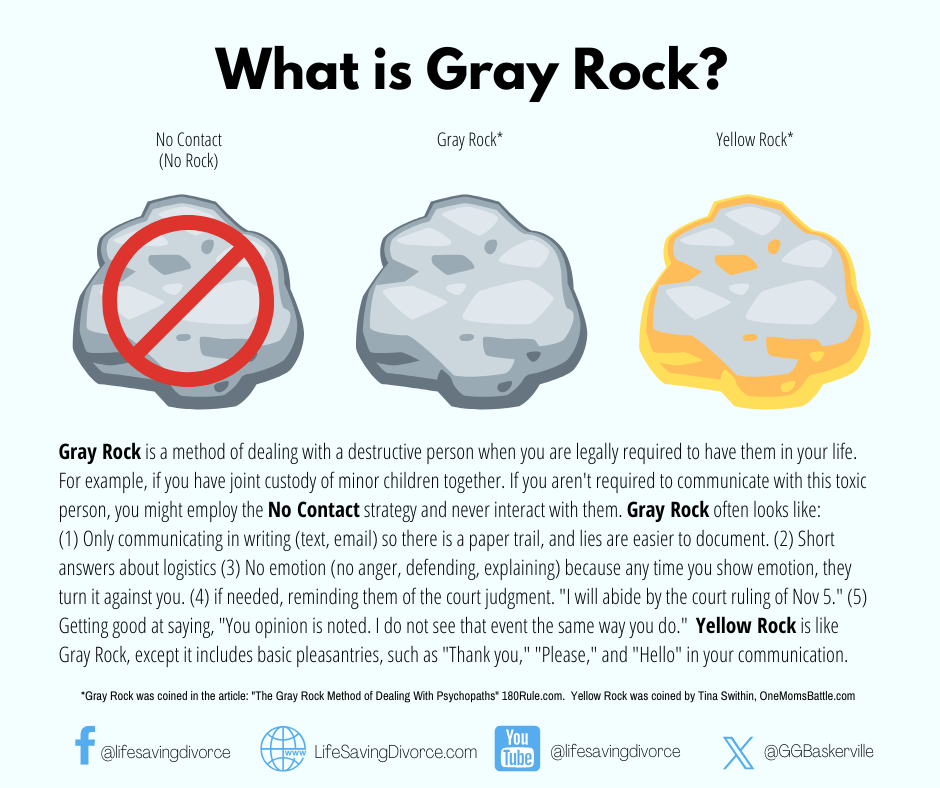
What Is Gray Rock? A Strategy for Handling a Destructive Person
When cutting off contact is not possible, Gray Rock can be a practical way to protect your peace while keeping necessary communication brief, calm, and boring.
If you share minor children with a destructive ex, you may be legally required to communicate. In those situations, Gray Rock can help. Gray Rock is not for healthy relationships — it is for destructive or abusive dynamics.
Gray Rock is a method of dealing with a toxic or high-conflict person by becoming emotionally uninteresting. The term was coined in the article “The Gray Rock Method of Dealing With Psychopaths” (180Rule.com). The idea is simple: give them nothing to feed on.
You are not trying to win. You are trying to disengage.
What Gray Rock Looks Like
Gray Rock often includes:
- Communicating only in writing (text or email) to create a paper trail.
- Short, factual responses about logistics only.
- No emotion. No anger. No defending. No over-explaining.
- Referring to court orders when needed. (“I will abide by the court ruling of Nov. 5.”)
- Calm boundary statements like:
“Your opinion is noted. I do not see that event the same way you do.”
If you must communicate, keep it brief and boring. No defending, explaining, or justifying.
Yellow Rock: Gray Rock With Basic Courtesy
Tina Swithin later coined Yellow Rock, which adds basic pleasantries—“Hello,” “Please,” “Thank you”—while still remaining neutral and non-reactive.
It is Gray Rock with polish.
How BIFF Fits In
Bill Eddy’s BIFF method works beautifully alongside Gray Rock. BIFF stands for:
- Brief — Keep it short.
- Informative — Stick to facts.
- Friendly — Neutral tone.
- Firm — End the exchange without inviting more conflict.
Example:
Instead of: “You always do this! You’re impossible.”
BIFF: “Pickup is at 5:00 pm at the usual location. Thank you.”
Gray Rock is not about being rude. It is about refusing to participate in chaos. Bill Eddy has a book on BIFF for Co-Parenting
Gray Rock vs. The Silent Treatment
Some people worry that Gray Rock is just the silent treatment. It is not.
The difference is motive.
The Silent Treatment Is Punishment
As Caroline McKuen explains:
“When someone gives the silent treatment, they actually WANT that person to reach out, beg for a conversation, etc. Someone going no-contact does not. They genuinely want to be left alone.”
She contrasts it this way:
- Silent Treatment: “So you miss me now, right?”
- No Contact: “Go away. My life is 100% better when I don’t talk to you.”
The silent treatment is meant to control, intimidate, or force pursuit.
No Contact and Gray Rock Are Protection
No Contact is not punishment. It is safety.
Another member in my private group explains:
“The silent treatment is what my ex would employ to avoid uncomfortable conversations or to punish me. No contact is the boundary I’ve established to protect myself from abuse.”
Another survivor adds:
“The silent treatment is like a punishment… You don’t exist until I’m ready to acknowledge you. No contact is for my safety.”
And another summarizes it simply:
“The silent treatment is punishment. No contact is for my safety.”
Gray Rock belongs in the same category as No Contact. It is not about control. It is about survival when contact is unavoidable.
A Biblical Perspective
Scripture repeatedly instructs believers to avoid foolish quarrels and unnecessary conflict (Proverbs 26:4; Titus 3:9). Refusing to engage in endless arguments is not unchristian. It is wise.
Jesus Himself did not answer every accusation.
- You can be civil without being vulnerable.
- You can be calm without being compliant.
- You can protect your peace without violating your faith.
Gray Rock is not about hardness of heart. It is about safety and sanity.
Gray Rock at Weddings, Funerals, Medical Crises
Sometimes you cannot avoid being in the same place as your ex. Weddings, funerals, graduations, hospitalizations, and family milestone events can put you in close proximity for hours, often in emotionally loaded settings where leaving immediately may not be possible. In those moments, Gray Rock can help you stay steady, protect your peace, and avoid becoming the center of an unnecessary conflict.
The goal is simple: be civil, brief, and unrewarding to engage with.
You are not there to process the relationship, settle old disputes, revisit the divorce, or defend your choices. You are there for the event.
At a wedding, the focus is the couple.
At a funeral, the focus is honoring the person who died and supporting loved ones.
In a medical crisis, the focus is the patient.
That focus can become your anchor.
What Gray Rock looks like at a family event
Gray Rock in these settings means:
-
keeping your tone neutral
-
giving short, polite answers
-
avoiding emotional reactions
-
not correcting every jab, bait, or passive-aggressive comment
-
refusing invitations into private side conversations
-
exiting gracefully when needed
You do not have to be warm.
You do not have to be cold.
You do not have to perform closeness for other people’s comfort.
You only need to be composed.
Have a “broken record” phrase ready
Pick one or two neutral lines and use them on repeat. For example:
-
“Today is about them.”
-
“I’m here to support the family.” Or, “I’m here to support our child.”
-
“This isn’t the time to discuss that.”
-
“Let’s keep the focus on the event.”
-
“I’m not getting into that here.”
-
“Please email me later if it’s important.”
The more emotional the setting, the more helpful it is to keep your words short.
Under stress, a script is easier than improvising.
Weddings: how to stay grounded
Weddings can invite awkward mingling, alcohol, old family dynamics, and pressure to “just be nice.” Gray Rock can help you avoid getting pulled into performance or conflict.
Helpful strategies:
-
Arrive with a plan for where you will sit, stand, and exit.
-
Stay near safe people.
-
Keep conversations light and event-focused.
-
Avoid being cornered near bars, parking lots, or quiet hallways.
-
Do not discuss custody, money, dating, the divorce, or family disputes.
-
If your ex tries to start something, say, “Today is about the couple,” and disengage.
-
Give yourself permission to leave early if your presence is no longer necessary.
A wedding is not the place to hash things out just because everyone is dressed up and on good behavior.
Funerals: how to protect your peace without creating a scene
Funerals are especially hard because grief lowers everyone’s emotional reserve. People may be raw, nostalgic, guilty, angry, or intrusive. An ex may use the event to force contact, act sentimental, or test old emotional access.
Gray Rock at a funeral may sound like:
-
“I’m here to pay my respects.”
-
“This is not the time.”
-
“Please excuse me.”
-
“I’d like to keep the focus on the family today.”
Helpful strategies:
-
Sit with supportive people.
-
Keep interactions public.
-
Use practical tasks as a shield: greeting people, helping with food, checking on family, stepping outside briefly.
-
Take breaks in the restroom, lobby, or outside if you feel flooded.
-
Leave as soon as your presence has served its purpose if staying longer increases risk.
Funerals often come with pressure to be emotionally available. You are allowed to be respectful without becoming accessible.
A good rule: do not go off alone
If there is a history of intimidation, manipulation, or verbal ambushes, avoid private access. That means:
-
no private car conversations
-
no hallway “quick talks”
-
no stepping outside together
-
no accepting “Can we just talk for a minute?”
A minute is often all a difficult person needs to destabilize you.
Gray Rock works best when there are witnesses, structure, and an easy exit.
Think ahead about logistics
A lot of peace comes from reducing decision-making in the moment. Before the event, think through:
-
where you will park
-
who you will sit with
-
whether you need a support person
-
what you will say if approached
-
how long you plan to stay
-
how you will leave if things escalate
Planning is not paranoia. It is self-protection.
Stay focused on the purpose of the event
One of the easiest ways to get pulled off center is to make the ex the main event in your mind. Gray Rock helps you return to the actual purpose of the day.
Ask yourself:
-
What am I here to honor?
-
What matters most in this room?
-
What do I want to feel proud of afterward?
That shift can keep you from spending the entire event in a silent argument inside your own head.
Gray Rock is not suppression. It is strategy.
Gray Rock does not mean you are unaffected. It means you are choosing not to show your internal reaction to someone who might use it against you. You can process your feelings later with safe people. During the event, your job is simply to stay regulated enough to get through it.

 :
:
 :
: Buy PDF