
What the Institute for Family Studies’ 5 Traits Miss About Character—and Abuse
On October 28, the Institute for Family Studies published an article by Freya India titled “Five Traits Marriage-Minded Young Women Should Look For in a Man.”
Here are the five traits IFS recommends:
- He’s clear about his intentions.
- He’s protective of you.
- He’s faithful, online and off.
- He encourages you to be a better person and shares your values.
- He believes marriage is for life.
The problem isn’t that IFS limited its recommendations to five traits. It’s which five traits it chose.
Of course, clear intentions, faithfulness, genuine protectiveness, shared values, and lifelong commitment can be wonderful qualities.
But what if a person only appears to possess them?
Christian women and men who have survived destructive marriages know that an abusive spouse can profess all five, sometimes quite convincingly.
That’s why I believe premarital advice should focus less on signs of virtue and more on demonstrated character.
What someone promises matters. But how they actually treat people matters much more.
These Traits May Signal Christian Commitment, But What About Character?
These character traits apply to both men and women who are marriage-minded:
- Law-abiding behavior: Behaves in line with social norms, the law, and the rights of others. Doesn’t say, “Rules don’t apply to me.”
- Honesty: Tells the truth rather than lying or manipulating people. Doesn’t get a kick out of deception.
- Self-control, not impulsivity: Thinks before acting and resists destructive impulses.
- Not irritable or spoiling for a fight: Handles frustration and anger without aggression, threats, or intimidation.
- Concern for self and others’ safety: Avoids reckless behavior that endangers himself or others. Believes your opinions matter.
- Responsibility: Keeps commitments, pays debts, and meets financial and family obligations.
- Remorse and accountability: Feels genuine regret when he hurts someone, admits wrongdoing, and makes amends.
And let’s add humility, kindness, empathy, respect for boundaries, and a willingness to accept NO for an answer.
These aren’t superficial dating preferences. They are fundamental character qualities.
Three More Qualities My Readers Emphasized
When I shared my critique of the IFS article on Facebook, readers added three especially important qualities:
- Respect for your personhood and independence: A trustworthy spouse sees you as a whole person with your own gifts, talents, goals, friendships, opinions, and capabilities. Marriage should not erase your individuality.
- Kindness toward people who have less power: Watch how someone treats restaurant employees, children, elderly people, and others who cannot do anything for them—especially when no one is watching. But beware of performative kindness, too! Some abusive people make an elaborate show of courtesy and generosity in public while humiliating or mistreating their spouse in private. In my popular article, “But He Never Hit Me: Divorce for Neglect, Emotional, and Financial Abuse,” Annette describes a husband who demanded exaggerated courtesy toward restaurant servers, then screamed at her afterward. Genuine kindness is consistent, not something performed for an audience.
- Emotional safety during difficult conversations: Can you raise concerns, disagree, share painful experiences, and express vulnerability without being mocked, intimidated, punished, or dismissed? Does your partner listen and take your concerns seriously?
These qualities help reveal how someone handles power, vulnerability, disagreement, and responsibility in an intimate relationship.
When Good Marriage Traits Become Warning Signs
The five IFS recommendations sound reassuring. But each has limitations worth discussing.
1. Clear Intentions Can Become Pressure to Marry Quickly
Someone who talks about marriage early may genuinely be serious about commitment. But rushing engagement or marriage can also prevent a partner from having enough time to recognize deception, incompatibility, or controlling behavior.
Watch for: Someone who pressures you to commit before you really know them and before you’re ready, discourages you from seeking advice, or treats your desire to slow down as a lack of love.
2. Protectiveness Can Become Possessiveness and Control
Genuine protectiveness respects your judgment and independence. False protectiveness may sound like, “I’m only doing this for your own good.”
It can become an excuse to control finances, friendships, employment, transportation, or access to information.
Watch for: Someone who increasingly makes decisions for you, restricts your choices, or presents controlling behavior as loving protection.
3. Faithfulness Can Be Professed While Infidelity Is Concealed
A person’s claims about sexual purity or fidelity aren’t proof of their actual behavior.
Some people maintain a convincing reputation while secretly engaging in pornography use, affairs, or other sexual behavior that violates the couple’s agreements.
Watch for: Repeated dishonesty, contradictory explanations, secrecy, and refusal to take responsibility when deception is discovered.
4. Shared Christian Values Don’t Necessarily Mean Shared Christian Character
An abusive person may attend church, quote Scripture, volunteer, and profess the same beliefs as a prospective spouse.
What matters is whether those beliefs are reflected in consistent honesty, kindness, self-control, humility, reliability, and respect.
Watch for: Someone whose public Christian reputation differs dramatically from how they treat people privately.
5. Believing Marriage Is for Life Can Become a Justification for Entrapment
Lifelong commitment is a beautiful ideal when both spouses are trustworthy and loving.
But someone who believes marriage gives them permanent ownership, authority, or access to another person may use that belief to excuse mistreatment.
Watch for: Someone who insists that you can never leave the marriage, no matter how badly you’re treated.
The question isn’t merely whether someone wants marriage to last. It’s whether they are willing to behave in ways that make marriage safe and loving.
Christian Women (and Men) Who Have Survived Destructive Marriages Could Tell IFS:
🆘 An Abusive or Unfaithful Person Can
- pursue you intensely (or eagerly welcome your attention),
- promise to protect you or be faithful to you,
- attend church with you,
- share your professed values, and
- insist that marriage is for life.
🚫 None of Those Things Guarantees That They Will Treat You Well.
In fact, a husband or wife who believes marriage is for life but refuses accountability can make that belief a trap.
Faithfulness and genuine protectiveness certainly matter. But faithfulness means more than avoiding pornography, and protectiveness means more than behaving like a gentleman.
The real test of character is how someone behaves when angry, disappointed, challenged, told NO, or asked to take responsibility for wrongdoing—and how they treat people who have less power.
But What If the Warning Signs Don’t Appear Until After Marriage?
Several readers of my original Facebook post raised an important question:
What if someone displays all the right qualities while dating, but becomes controlling, deceptive, or abusive after the wedding?
That’s a genuine problem.
Some abusive people conceal their destructive behavior during courtship. Others become more controlling after marriage, pregnancy, financial dependence, or other major life changes.
No dating checklist can guarantee that someone will remain trustworthy.
That’s why it’s unfair to blame victims for failing to recognize warning signs that weren’t visible or were deliberately concealed.
Premarital screening can help people identify risks. It cannot eliminate every risk.
And Christians need another equally important message:
If serious abuse, coercion, or betrayal emerges after marriage, your wedding vows do not obligate you to tolerate mistreatment indefinitely.
We need to teach young people how to choose wisely before marriage—and reassure married people that they are not trapped when a spouse becomes destructive.
A Deleted Facebook Comment Illustrates Exactly What I’m Talking About
Here’s a real-life example of why demonstrated character matters more than professed values.
When I shared about Institute for Family Studies on Facebook, one commenter accused me of building a business around breaking up marriages. By then, dozens of commenters had already shared their own experiences of abuse, deception, and betrayal.
I’ve spent nearly 30 years helping Christians navigate destructive marriages involving abuse, adultery, addiction, and severe neglect. Yet instead of engaging with my arguments, research, or the experiences readers were sharing, this person dismissed my work as an attack on pro-marriage voices.
The exchange illustrates something worth examining.
When someone strongly disagrees with you, what does their behavior reveal?
Consider these six character qualities:
- Respect: Do they engage with what you actually said, or dismiss and belittle your work?
- Honesty and accuracy: Do they represent your position fairly, or distort it into something easier to attack?
- Fairness: Do they address your evidence, or attack your motives?
- Humility: Are they willing to consider that they might not understand your experiences or perspective?
- Empathy: Do they show concern for people experiencing harm, even when they disagree about the solutions?
- Constructive disagreement: Can they challenge your ideas without resorting to personal accusations?
Now here’s the interesting part.
For all I know, this commenter could meet every one of the Institute for Family Studies’ five recommended marriage traits.
He might believe marriage is for life, share his spouse’s Christian values, promise to be protective, and consider himself faithful.
I have no way of knowing.
But I can evaluate the behavior he displayed in this particular exchange. He chose an accusation about my motives over a substantive discussion of my argument.
One Facebook comment doesn’t establish someone’s overall character. But patterns of behavior—especially how someone responds to disagreement, frustration, and criticism—can tell us a great deal. And it’s best to walk away (or block) immediately, if possible, before they can do any real damage.
Before marrying someone, pay attention to how they treat people they disagree with.
Because someday, that person will be you.
Christian Dating Advice Can Do Better
IFS is right that people should have high moral standards.
But why leave out so many of the character traits that help women and men recognize whether a person is actually safe to marry?
We should be teaching young people to recognize honesty, self-control, nonviolence, respect for boundaries, responsibility, empathy, and genuine accountability.
And we should warn them that even apparently admirable qualities can be used to disguise manipulation and control.
Good marriage advice shouldn’t merely help someone find a spouse who wants to stay married. It should help them recognize a spouse who is safe to stay married to.
Free Resources for Safer Dating and Marriage Decisions
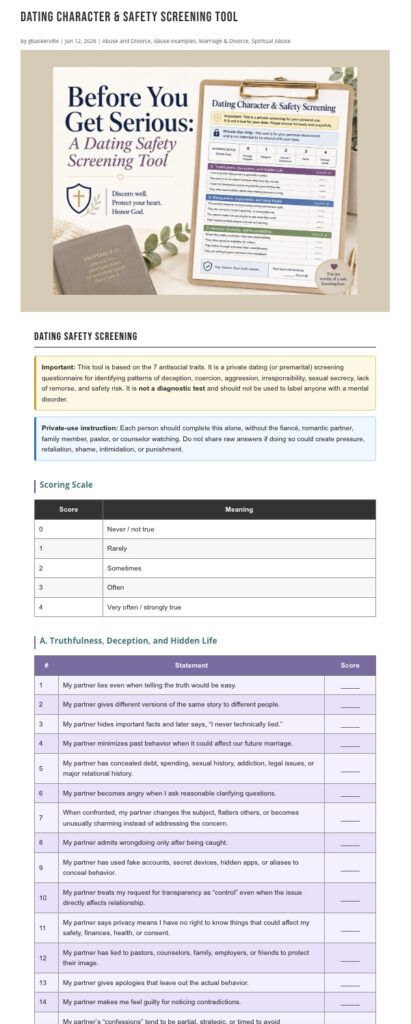
Click to enlarge or download the full checklist
If you’re a marriage-minded person, here’s a better dating safety screening checklist to use.
And if you’re married to a Christian who has been abusive, adulterous, addicted, or treated you with gross indifference or neglect, read this checklist to determine if the abuser or cheater has really changed.
 :

 :
 Buy PDF