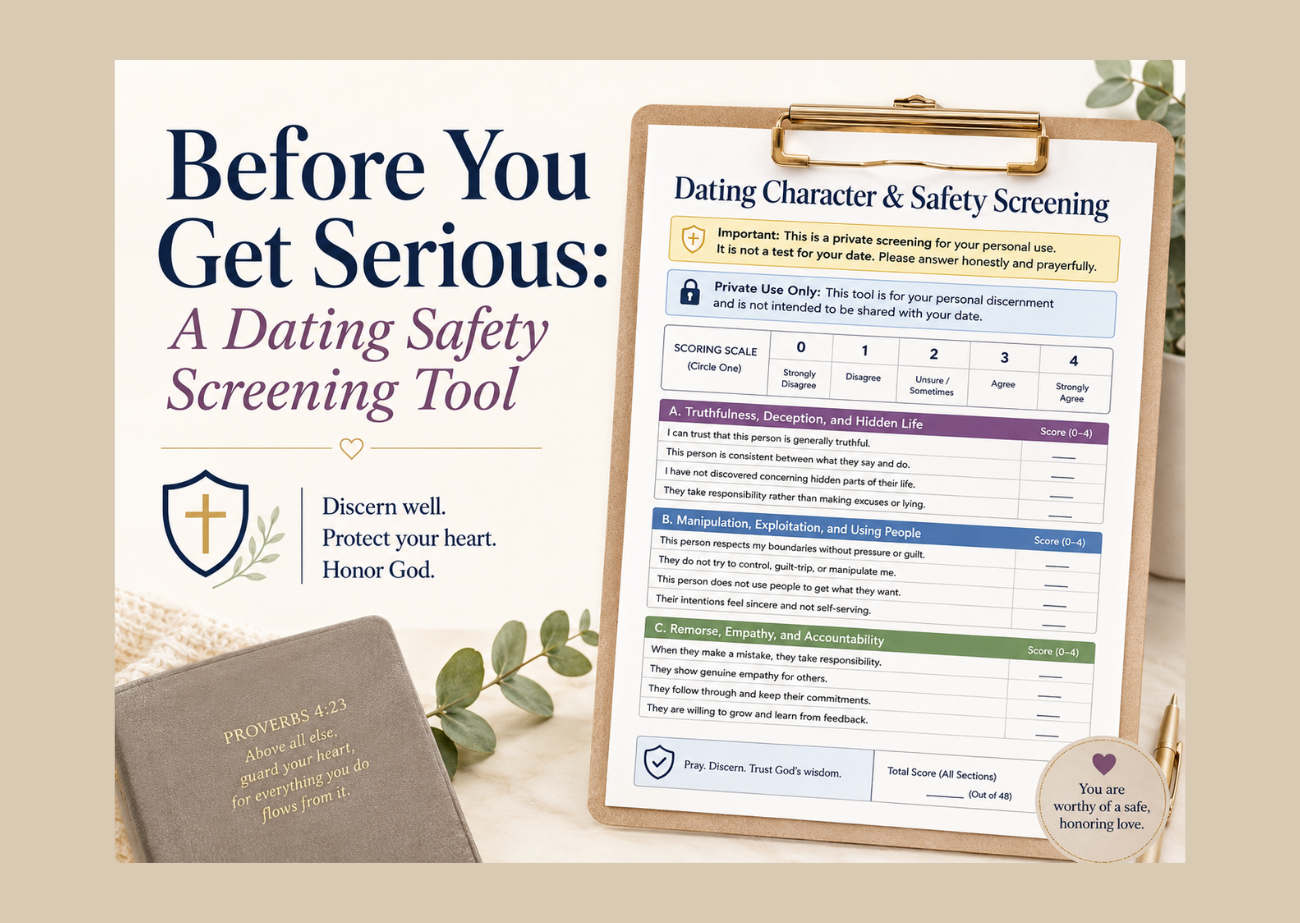
Dating Safety Screening
Important: This tool is based on the 7 antisocial traits. It is a private dating (or premarital) screening questionnaire for identifying patterns of deception, coercion, aggression, irresponsibility, sexual secrecy, lack of remorse, and safety risk. It is not a diagnostic test and should not be used to label anyone with a mental disorder.
Private-use instruction: Each person should complete this alone, without the fiancé, romantic partner, family member, pastor, or counselor watching. Do not share raw answers if doing so could create pressure, retaliation, shame, intimidation, or punishment.
Scoring Scale
| Score |
Meaning |
| 0 |
Never / not true |
| 1 |
Rarely |
| 2 |
Sometimes |
| 3 |
Often |
| 4 |
Very often / strongly true |
A. Truthfulness, Deception, and Hidden Life
| # |
Statement |
Score |
| 1 |
My partner lies even when telling the truth would be easy. |
_____ |
| 2 |
My partner gives different versions of the same story to different people. |
_____ |
| 3 |
My partner hides important facts and later says, “I never technically lied.” |
_____ |
| 4 |
My partner minimizes past behavior when it could affect our future marriage. |
_____ |
| 5 |
My partner has concealed debt, spending, sexual history, addiction, legal issues, or major relational history. |
_____ |
| 6 |
My partner becomes angry when I ask reasonable clarifying questions. |
_____ |
| 7 |
When confronted, my partner changes the subject, flatters others, or becomes unusually charming instead of addressing the concern. |
_____ |
| 8 |
My partner admits wrongdoing only after being caught. |
_____ |
| 9 |
My partner has used fake accounts, secret devices, hidden apps, or aliases to conceal behavior. |
_____ |
| 10 |
My partner treats my request for transparency as “control” even when the issue directly affects relationship. |
_____ |
| 11 |
My partner says privacy means I have no right to know things that could affect my safety, finances, health, or consent. |
_____ |
| 12 |
My partner has lied to pastors, counselors, family, employers, or friends to protect their image. |
_____ |
| 13 |
My partner gives apologies that leave out the actual behavior. |
_____ |
| 14 |
My partner makes me feel guilty for noticing contradictions. |
_____ |
| 15 |
My partner’s “confessions” tend to be partial, strategic, or timed to avoid consequences. |
_____ |
Section A Total: ______ / 60
B. Manipulation, Exploitation, and Using People
| # |
Statement |
Score |
| 16 |
My partner pressures people by using guilt, pity, anger, or spiritual language. |
_____ |
| 17 |
My partner uses people’s vulnerabilities against them later. |
_____ |
| 18 |
My partner presents themselves as the victim when they were the aggressor. |
_____ |
| 19 |
My partner tries to control how others perceive me. |
_____ |
| 20 |
My partner flatters people when they want something and devalues them afterward. |
_____ |
| 21 |
My partner is unusually skilled at winning over authority figures while mistreating people privately. |
_____ |
| 22 |
My partner expects special treatment but resents others’ needs. |
_____ |
| 23 |
My partner uses my compassion to avoid responsibility. |
_____ |
| 24 |
My partner has a pattern of borrowing, taking, or using things without fair repayment. |
_____ |
| 25 |
My partner makes promises to get compliance, then later changes the terms. |
_____ |
| 26 |
My partner treats boundaries as obstacles to overcome. |
_____ |
| 27 |
My partner believes rules are for other people. |
_____ |
| 28 |
My partner justifies manipulation if they believe the outcome is good. |
_____ |
| 29 |
My partner has exploited someone financially, sexually, emotionally, professionally, or spiritually. |
_____ |
| 30 |
My partner can quickly identify what people want to hear. |
_____ |
Section B Total: ______ / 60
C. Remorse, Empathy, and Accountability
| # |
Statement |
Score |
| 31 |
My partner shows more concern about being exposed than about the harm done. |
_____ |
| 32 |
My partner says “sorry” but repeats the same behavior. |
_____ |
| 33 |
My partner blames stress, trauma, temptation, alcohol, parents, me, or Satan for choices they made. |
_____ |
| 34 |
My partner becomes irritated when someone they hurt needs time to heal. |
_____ |
| 35 |
My partner wants forgiveness without disclosure, repair, or changed behavior. |
_____ |
| 36 |
My partner laughs at, enjoys, or makes fun of other people’s misfortunes, even when they are friends, neighbors, or vulnerable people |
_____ |
| 37 |
My partner says others are “too sensitive” when confronted with real harm. |
_____ |
| 38 |
My partner has difficulty naming the specific impact of their actions on others. |
_____ |
| 39 |
My partner acts generous in public but cold or cruel in private. |
_____ |
| 40 |
My partner thinks consequences are unfair even when the behavior is proven. |
_____ |
| 41 |
My partner claims repentance but avoids restitution. |
_____ |
| 42 |
My partner expects trust to be restored quickly after betrayal. |
_____ |
| 43 |
My partner has said things like “I only did that because you…” |
_____ |
| 44 |
My partner shows little concern for people who cannot benefit them. |
_____ |
| 45 |
My partner’s remorse disappears once the crisis passes. |
_____ |
Section C Total: ______ / 60
D. Aggression, Intimidation, and Punishment
| # |
Statement |
Score |
| 46 |
My partner uses volume, tone, posture, silence, driving, or physical presence to intimidate. |
_____ |
| 47 |
My partner has blocked exits, followed me, cornered me, or refused to let a conversation end. |
_____ |
| 48 |
My partner has punched walls, thrown objects, slammed doors, broken items, or driven dangerously during conflict. |
_____ |
| 49 |
My partner has threatened self-harm, exposure, abandonment, divorce, spiritual consequences, or retaliation to control me. |
_____ |
| 50 |
My partner uses sarcasm, contempt, or humiliation when upset. |
_____ |
| 51 |
My partner punishes disagreement with withdrawal, anger, coldness, or public embarrassment. |
_____ |
| 52 |
My partner’s anger feels disproportionate to the issue. |
_____ |
| 53 |
My partner says frightening things and later claims they were “just venting.” |
_____ |
| 54 |
My partner has been physically aggressive with me, an ex, a child, an animal, or another person. |
_____ |
| 55 |
My partner makes me plan conversations around their likely reaction. |
_____ |
| 56 |
My partner treats my fear as disrespect. |
_____ |
| 57 |
My partner has pressured me to reconcile before I felt safe. |
_____ |
| 58 |
My partner uses religious authority or gender roles to silence objections. |
_____ |
| 59 |
My partner retaliates when corrected. |
_____ |
| 60 |
I feel safer disagreeing with other people than with my partner. |
_____ |
Section D Total: ______ / 60
E. Recklessness and Disregard for Safety
| # |
Statement |
Score |
| 61 |
My partner takes risks that could endanger me, children, others, or themselves. |
_____ |
| 62 |
My partner drives, drinks, uses substances, handles weapons, or spends money in ways that make me feel unsafe. |
_____ |
| 63 |
My partner ignores medical, sexual, financial, or legal consequences. |
_____ |
| 64 |
My partner pressures me into situations I believe are unsafe. |
_____ |
| 65 |
My partner treats my safety concerns as nagging, fear, or lack of faith. |
_____ |
| 66 |
My partner has exposed me to health, sexual, financial, or legal risk without informed consent. |
_____ |
| 67 |
My partner acts first and expects others to clean up the damage. |
_____ |
| 68 |
My partner believes intense feelings justify reckless decisions. |
_____ |
| 69 |
My partner has a pattern of crises caused by their own choices. |
_____ |
| 70 |
My partner resists practical safety planning. |
_____ |
Section E Total: ______ / 40
F. Impulsivity, Instability, and Failure to Plan
| # |
Statement |
Score |
| 71 |
My partner makes major decisions suddenly and expects me to adapt. |
_____ |
| 72 |
My partner changes jobs, churches, friendships, goals, or commitments abruptly after conflict. |
_____ |
| 73 |
My partner struggles to delay gratification. |
_____ |
| 74 |
My partner spends, travels, quits, buys, texts, posts, or confronts impulsively. |
_____ |
| 75 |
My partner resents planning, budgeting, counseling, accountability, or wise counsel. |
_____ |
| 76 |
My partner creates urgency to prevent me from thinking clearly. |
_____ |
| 77 |
My partner pushes for quick commitment when I ask for time. |
_____ |
| 78 |
My partner treats caution as disloyalty. |
_____ |
| 79 |
My partner has a repeated pattern of unfinished commitments. |
_____ |
| 80 |
My partner expects marriage to solve problems they have not addressed. |
_____ |
Section F Total: ______ / 40
G. Responsibility, Work, Money, and Obligations
| # |
Statement |
Score |
| 81 |
My partner repeatedly fails to honor financial obligations. |
_____ |
| 82 |
My partner blames others for job, school, ministry, or financial instability. |
_____ |
| 83 |
My partner hides spending or debt. |
_____ |
| 84 |
My partner expects me, parents, church, or friends to rescue them from predictable consequences. |
_____ |
| 85 |
My partner is careless with shared resources. |
_____ |
| 86 |
My partner makes commitments they do not keep. |
_____ |
| 87 |
My partner avoids boring but necessary responsibilities. |
_____ |
| 88 |
My partner becomes defensive when asked for a realistic budget or plan. |
_____ |
| 89 |
My partner wants authority without equal responsibility. |
_____ |
| 90 |
My partner’s public image is more responsible than their private behavior. |
_____ |
Section G Total: ______ / 40
H. Relationship-Specific Coercion and Consent
| # |
Statement |
Score |
| 91 |
My partner pressures me sexually, emotionally, spiritually, or financially after I say no. |
_____ |
| 92 |
My partner treats my boundaries as rejection. |
_____ |
| 93 |
My partner uses Scripture, counseling language, forgiveness, submission, or “unity” to override my conscience. |
_____ |
| 94 |
My partner wants access to my phone, location, money, body, schedule, or friendships while resisting mutual transparency. |
_____ |
| 95 |
My partner isolates me from people who might challenge the relationship. |
_____ |
| 96 |
My partner has made me feel that leaving, delaying marriage, or seeking outside help would be betrayal. |
_____ |
| 97 |
My partner discourages me from speaking privately with a counselor, pastor, mentor, or trusted friend. |
_____ |
| 98 |
My partner tries to control what I disclose in premarital counseling. |
_____ |
| 99 |
My partner has said or implied that marriage will give them greater rights over me. |
_____ |
| 100 |
I am afraid of what would happen if I answered this questionnaire honestly and my partner found out. |
_____ |
Section H Total: ______ / 40
Sexual Integrity, Secrecy, and Child-Safety Add-On
| # |
Statement |
Score |
| S1 |
My partner has hidden pornography use, sexual messaging, sexual accounts, dating apps, OnlyFans-style content, or paid sexual content. |
_____ |
| S2 |
My partner has minimized sexual behavior by saying “everyone does it,” “it was just online,” “it did not count,” or “it was not physical.” |
_____ |
| S3 |
My partner has used secret browsers, deleted histories, hidden folders, second phones, private payment methods, or anonymous accounts for sexual activity. |
_____ |
| S4 |
My partner becomes angry, evasive, or spiritually defensive when asked about sexual integrity. |
_____ |
| S5 |
My partner has confessed sexual behavior only in fragments, with more details emerging later. |
_____ |
| S6 |
My partner has pressured me to avoid asking about pornography, masturbation, sexual fantasies, past partners, sexual purchases, or online sexual behavior. |
_____ |
| S7 |
My partner has sexualized people, situations, media, or conversations in ways that made me uncomfortable. |
_____ |
| S8 |
My partner has shown interest in sexual material that involves coercion, humiliation, incest themes, “barely legal” themes, minors, schoolgirl/schoolboy themes, family-role play, or non-consent. |
_____ |
| S9 |
My partner has made comments about children’s, teens’, or young people’s bodies that felt sexualized, lingering, or inappropriate. |
_____ |
| S10 |
My partner seems unusually interested in unrestricted or unsupervised access to children, teens, babysitting, mentoring, youth ministry, sleepovers, private tutoring, or one-on-one time with minors. |
_____ |
| S11 |
My partner resists reasonable child-safety boundaries, such as no private texting with minors, no closed-door one-on-one meetings, or no unsupervised overnight access. |
_____ |
| S12 |
My partner has described child-safety rules as paranoid, insulting, faithless, or unnecessary. |
_____ |
| S13 |
My partner has a pattern of befriending vulnerable, lonely, younger, dependent, or emotionally needy people. |
_____ |
| S14 |
My partner creates “special” secret relationships with people who are younger, dependent, or easier to influence. |
_____ |
| S15 |
My partner has asked me or others to keep secrets about sexual matters, inappropriate conversations, private meetings, gifts, messages, or physical contact. |
_____ |
| S16 |
My partner has crossed physical boundaries with me or others and then minimized it as affection, joking, playfulness, or misunderstanding. |
_____ |
| S17 |
My partner has ignored someone’s discomfort, hesitation, freezing, silence, or “no” in a sexual or physical situation. |
_____ |
| S18 |
My partner has blamed sexual sin, lust, pornography, or boundary violations on my appearance, sexual availability, modesty, refusal, or lack of forgiveness. |
_____ |
| S19 |
My partner has resisted professional help, accountability software, financial transparency, pastoral disclosure, or therapeutic assessment after sexual secrecy was discovered. |
_____ |
| S20 |
I would be afraid to leave my partner alone with children, teens, vulnerable adults, or someone who could be easily manipulated. |
_____ |
Sexual Integrity Add-On Total: ______ / 80
Tabulation Sheet
| Section |
Category |
Possible Score |
Your Score |
| A |
Truthfulness, Deception, and Hidden Life |
60 |
_____ |
| B |
Manipulation, Exploitation, and Using People |
60 |
_____ |
| C |
Remorse, Empathy, and Accountability |
60 |
_____ |
| D |
Aggression, Intimidation, and Punishment |
60 |
_____ |
| E |
Recklessness and Disregard for Safety |
40 |
_____ |
| F |
Impulsivity, Instability, and Failure to Plan |
40 |
_____ |
| G |
Responsibility, Work, Money, and Obligations |
40 |
_____ |
| H |
Relationship-Specific Coercion and Consent |
40 |
_____ |
| S |
Sexual Integrity, Secrecy, and Child-Safety Add-On |
80 |
_____ |
| Main Test Total |
400 |
_____ |
| Sexual Integrity Add-On Total |
80 |
_____ |
Main red-flag items scored 3 or 4: ______
Sexual integrity / child-safety red-flag items scored 3 or 4: ______
Main Test Legend
| Total Score |
Interpretation |
| 0–25 |
Low visible concern. This does not prove safety. It only means few warning signs were identified by this questionnaire. |
| 26–60 |
Caution zone. Do not rush. Review concerns privately with a wise, trauma-informed counselor, pastor, or mentor. |
| 61–100 |
Serious concern. Delay marriage. Require outside assessment, verifiable change, and time-tested accountability before proceeding. |
| 101–200 |
High danger / high coercion concern. Do not proceed toward marriage without specialized help. Avoid joint counseling if fear, intimidation, retaliation, or coercive control is present. |
| 201–400 |
Extreme concern. Prioritize safety, outside help, and protective planning. Marriage would likely make truth-telling, outside help, boundaries, and escape harder. |
Automatic Red Flags
Main Test: Regardless of total score, any score of 3 or 4 on questions 47, 48, 49, 54, 60, 66, 91, 95, 96, 97, 98, 99, or 100 should be treated as serious.
Sexual Integrity Add-On: Regardless of total score, any score of 3 or 4 on S8, S9, S10, S11, S14, S15, S17, or S20 should trigger an immediate pause in the marriage process and private consultation with a qualified professional.
Any known sexual interest in minors, sexual contact with minors, possession or seeking of child sexual abuse material, grooming behavior, or private sexualized communication with minors is not a premarital counseling issue. It is a safety and reporting issue.
Final Reflection
1. After taking this test, do I feel more free or less free to tell the truth about this relationship?
2. Would marriage to this person make it easier or harder for me to get outside help?
3. Would marriage to this person make it easier or harder for me to set boundaries?
4. Would marriage to this person make it easier or harder for me to leave safely if I needed to?
5. What is the strongest warning sign I should not ignore?
Note for churches, counselors, and mentors: This tool should not be used to pressure someone to disclose answers to a fiancé. If a person fears retaliation, punishment, spiritual pressure, sexual pressure, intimidation, or loss of freedom, the safest next step is usually private outside help, not a joint couple conversation.
Are you going through a life-saving divorce? I’d like to invite you to my private Facebook group, “Life-Saving Divorce for Separated or Divorced Christians.” Just click the link and ANSWER the 3 QUESTIONS. This is a group for women and men of faith who have walked this path, or are considering it. Allies and people helpers are also welcome. I’ve also written a book about spiritual abuse and divorce for Christians. You may also sign up for my email list below.

 :
:
 :
: Buy PDF