
Highly Religious U.S. Couples Were Not Protected From Intimate Partner Violence
How Common Is Abuse in Highly Religious Relationships?
Many people assume that deeply religious couples are protected from intimate partner violence. We expect churchgoing families to be safer, healthier, and more stable. But a 2019 report from the conservative, pro-marriage Institute for Family Studies found something important: In the United States, religiosity did not significantly reduce intimate partner violence.What the Research Found
The researchers studied heterosexual married and cohabiting couples in 11 countries, including the United States. The U.S. sample included 2,025 respondents and was nationally representative of Americans ages 18–50. (Correction: An earlier version described the 24% figure as applying specifically to highly religious U.S. marriages. The 24% figure comes from the pooled 11-country sample of married and cohabiting couples.)Based on men’s own reports, the predicted probabilities of perpetrating IPV were:
- 23% shared secular
- 21% less/mixed religious
- 24% highly religious
“The findings from the U.S. indicate no differences in IPV with respect to couple religiosity…” (p. 37)That’s the key finding for American churches: high religiosity did not provide a statistically detectable protection against intimate partner violence.
Why This Matters for the Church
This is not research produced by an organization hostile to marriage or religion. It comes from the Institute for Family Studies, a pro-family, pro-marriage think tank. And their conclusion is important: religious participation does not make intimate partner violence disappear. The researchers themselves wrote that religious couples “experience and commit IPV just as nonreligious couples do” and that religious participation does not safeguard people against IPV. That should matter to every pastor, church leader, counselor, and Christian family.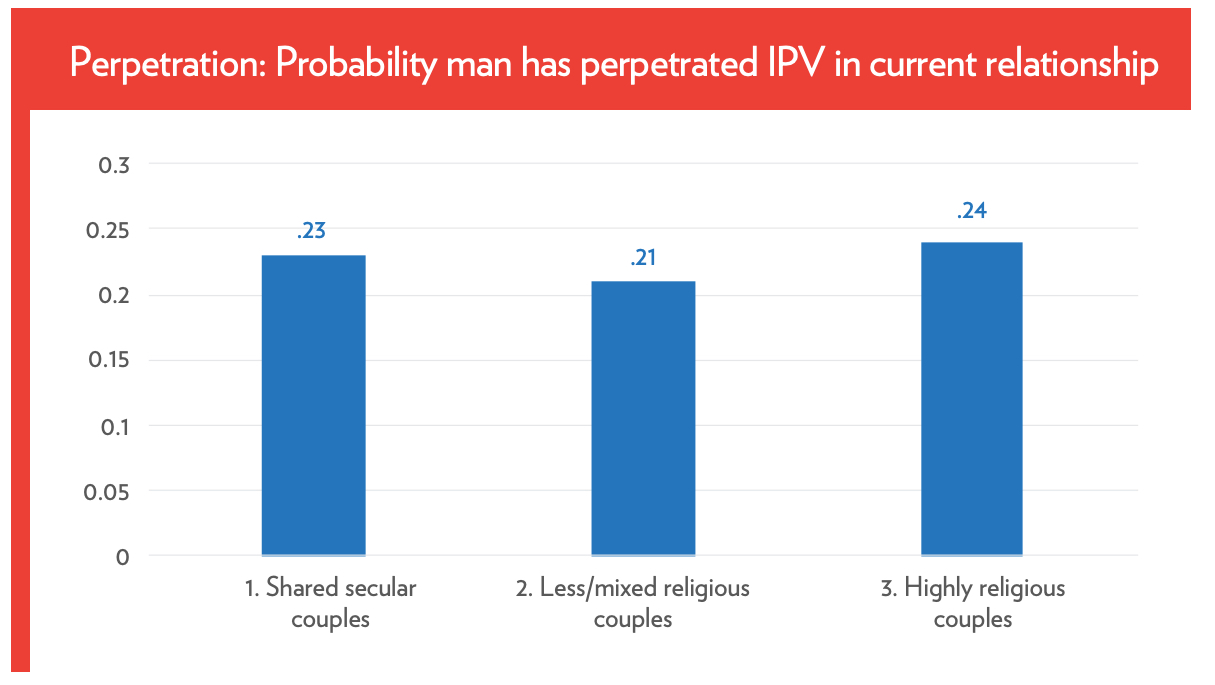
In the 11-country sample, predicted IPV perpetration was 23% among shared secular couples, 21% among less/mixed religious couples, and 24% among highly religious couples. The authors claim the differences were not statistically significant, but they never revealed the U.S. data. World Family Map 2019, pp. 35–36.
So What Was the U.S. IPV Rate?
Here’s an important limitation of the published report: although the researchers clearly analyzed the United States separately (yes, they know the number), they did not reveal in the U.S.-specific IPV percentages in this section. Instead, they simply reported:“The findings from the U.S. indicate no differences in IPV with respect to couple religiosity.”Interestingly, the very same paragraph gives exact U.S. percentages for infidelity. And the report’s U.S. country page gives exact figures for relationship quality and fertility—but not IPV. Why not? Could the U.S. IPV estimates be as high as, or higher than, the pooled figures? The authors know what it is, but their published report doesn’t let readers find out. So we should not substitute the pooled 24% figure for a U.S.-specific percentage. But neither should we miss what the researchers actually concluded about America: highly religious U.S. couples did not have lower IPV than less religious or secular couples in the U.S. And that was unusual compared to the 11-country group. In that group, religion was protective against IPV. The analysis also combines married and cohabiting relationships. The report does not tell us what percentage of the highly religious U.S. group was married versus cohabiting, so we cannot calculate a marriage-only IPV rate from the published figures. But, as stated before, highly religious couples are not very likely to cohabit.
What Counted as Intimate Partner Violence?
The IPV measure was based on only four questions. Men were asked:- How often do you physically hurt your partner?
- How often do you threaten your partner with harm?
- How often do you force your partner to have sex?
- How often do you withhold money from your partner?
- How often does your partner physically hurt you?
- How often does your partner threaten you with harm?
- How often does your partner force you to have sex?
- How often does your partner withhold money from you?
This May Be Just the Tip of the Iceberg
Here’s what struck me most about the study: just four questions identified a substantial amount of violence and coercion. But those four questions do not directly ask about many other abusive behaviors that can terrorize or control a spouse or partner. For example, the survey did not directly ask about:- a pattern of humiliation, degradation, name-calling, or verbal abuse,
- isolating a partner from family, friends, church, or other support,
- stalking or obsessive monitoring,
- tracking phones, email, passwords, vehicles, or location,
- destroying property, punching walls, or using objects to intimidate,
- threatening or harming pets,
- threatening to take the children or manipulate custody proceedings,
- reproductive coercion or sabotaging contraception,
- sexual coercion or pressure that falls short of overt physical force,
- preventing a partner from working, attending school, driving, or leaving the home,
- controlling bank accounts or forcing a spouse into debt, beyond simply withholding money,
- deliberately depriving a partner of sleep,
- interfering with medications or medical care,
- threatening suicide or self-harm as a way to control a partner,
- using immigration status as a threat,
- using children as messengers, spies, or weapons against the other parent,
- religious or spiritual abuse, including using Scripture, church authority, forgiveness, or “submission” teachings to coerce a spouse.
Religion Alone Does Not Make a Relationship Safe
The researchers’ overall conclusion is striking. Highly religious couples were not significantly more violent than secular couples — but neither were they significantly less violent. In other words, religiosity was not a protective shield against intimate partner violence. The authors themselves warned religious institutions to take the prevalence of abuse seriously. They noted that many victims may be suffering in silence and that many religious leaders remain poorly prepared to respond appropriately. That is exactly why churches cannot assume that a couple is safe simply because both spouses attend church, pray together, know Scripture, or describe themselves as highly religious. Abusers can be religious. Victims can be religious. And abuse can exist inside marriages that look deeply Christian from the outside.What Can Our Churches Do?
- Assume there are more abuse victims in your congregation than you know about. Abuse carries shame, fear, and enormous pressure to remain silent.
- Understand why victims don’t simply “tell someone.” Hear survivors explain why they stayed silent: Why Does She Stay?
- Train pastors, staff, elders, counselors, and volunteers to recognize abuse. Here is a free domestic-violence training resource for church staff: Domestic Violence Awareness Resources for Churches.
- Learn what abuse actually looks like. It is much broader than hitting: 130 Examples of Abuse.
- Listen to survivors describe what good pastoral care looks like — and what harmful pastoral care looks like. Good vs. Bad Pastoral Counsel in Marital Abuse.
- Put safety ahead of preserving the appearance of a marriage. A marriage certificate does not make violence, coercion, or terror holy.
- Do not send an abuse victim into ordinary couples counseling with the abuser. Domestic violence requires specialized assessment and safety planning.
Churchgoing Is Not a Substitute for Character
The Bible does not give husbands permission to dominate, frighten, exploit, or injure their wives. Quite the opposite.1 Peter 3:7 NLT: In the same way, you husbands must give honor to your wives. Treat your wife with understanding as you live together… Treat her as you should so your prayers will not be hindered.A church should never assume that religiosity proves a marriage is healthy. The Institute for Family Studies’ own research gives us good reason not to.
 :
:
 :
: Buy PDF