
Why Can’t Christian Publishers Give Us a Really Good Christian Premarital Workbook?
Before we got married, my boyfriend and I went through a Christian premarital workbook. Twenty years later, after an unwanted but much-needed divorce, I found that old workbook in a box in the garage.
I wondered, Did we answer the questions truthfully? Were my husband’s serious problems flagged as a hazard or considered a reason to postpone or cancel the wedding?
But the workbook we used never brought up serious problems. Some red flags were there before the wedding. Why didn’t this book warn me to pause, or stop, or call off the wedding?
The words adultery, lying, cheating, betrayal, gambling, pornography, and addiction did not appear at all. Neither did abuse, slap, hit, push, or violence. They don’t in today’s version either.
The only substance abuse example is a story of an alcoholic who quits cold turkey at a spouse’s request—as if that is the normal outcome. The far more common scenario—escalation, denial, job loss, volatility, arrests, and family devastation—was never addressed.
Christian publishers are very good at telling couples to get married, but they are terrible at giving even the most basic list of danger signs. (Many people in my private online Christian divorce recovery group say they were never taught anything about red flags in their church.)
These books are good on communication, but terrible on being realistic that serious issues such as infidelity, abuse, porn, attraction to kids, indifference, and drug/alcohol misuse have a greater-than-zero likelihood of destroying your marriage. About half of U.S. divorces today are for very serious reasons.
So I Bought the Top Christian Premarital Books and Rated Them All
After working through a stack of Christian premarital books and workbooks (see comparison chart below), I kept coming back to a basic question:
Where is the Christian premarital workbook that is actually willing to help someone decide not to get married?
Because that is part of premarital preparation too. Even Christian researchers say that premarital books should do this. But I found only two that did.
A genuinely good premarital resource should not simply ask, How can these two people build a successful marriage? It should first ask, Should these two people marry each other at all?
And if one of them is controlling, deceptive, sexually coercive, explosively angry, chronically degrading, addicted and dishonest about it, financially exploitative, threatening, or dangerous, the workbook should not quietly funnel the couple into better communication techniques.
It should sound an alarm.
That is the standard I have started using when I evaluate Christian marriage books:
Standard Questions for Each Book
If a reader in a coercive, deceitful, chronically degrading, or dangerous relationship applied this book’s counsel exactly as written, would it make truth-telling, outside help, and protective action (such as ending the relationship) easier—or harder?
My evaluation checklist asks whether a premarital book:
- names warning signs,
- distinguishes ordinary conflict from abuse or coercive control,
- encourages appropriate outside help,
- gives people protective options such as breaking up, separating or divorce, and
- explicitly permits a pastor to say, Do not proceed with this marriage right now.
That sounds like a rather modest standard.
Apparently it is not.
(Spoiler: I found only one Christian premarital book that got a high rating. And it was self-published. Hey, Christian publishers, do better!)
I used a 0–4 safety scale consistently throughout, with 4 = protective teaching and 0 = absent or actively hazardous teaching. For details, see the bottom of the post.
The maximum rating is 32 points. This is not a rating of the books’ overall quality. It is deliberately narrow: What happens if a person in a coercive, deceitful, degrading, sexually exploitative, addictive, or dangerous relationship follows this book exactly as written?
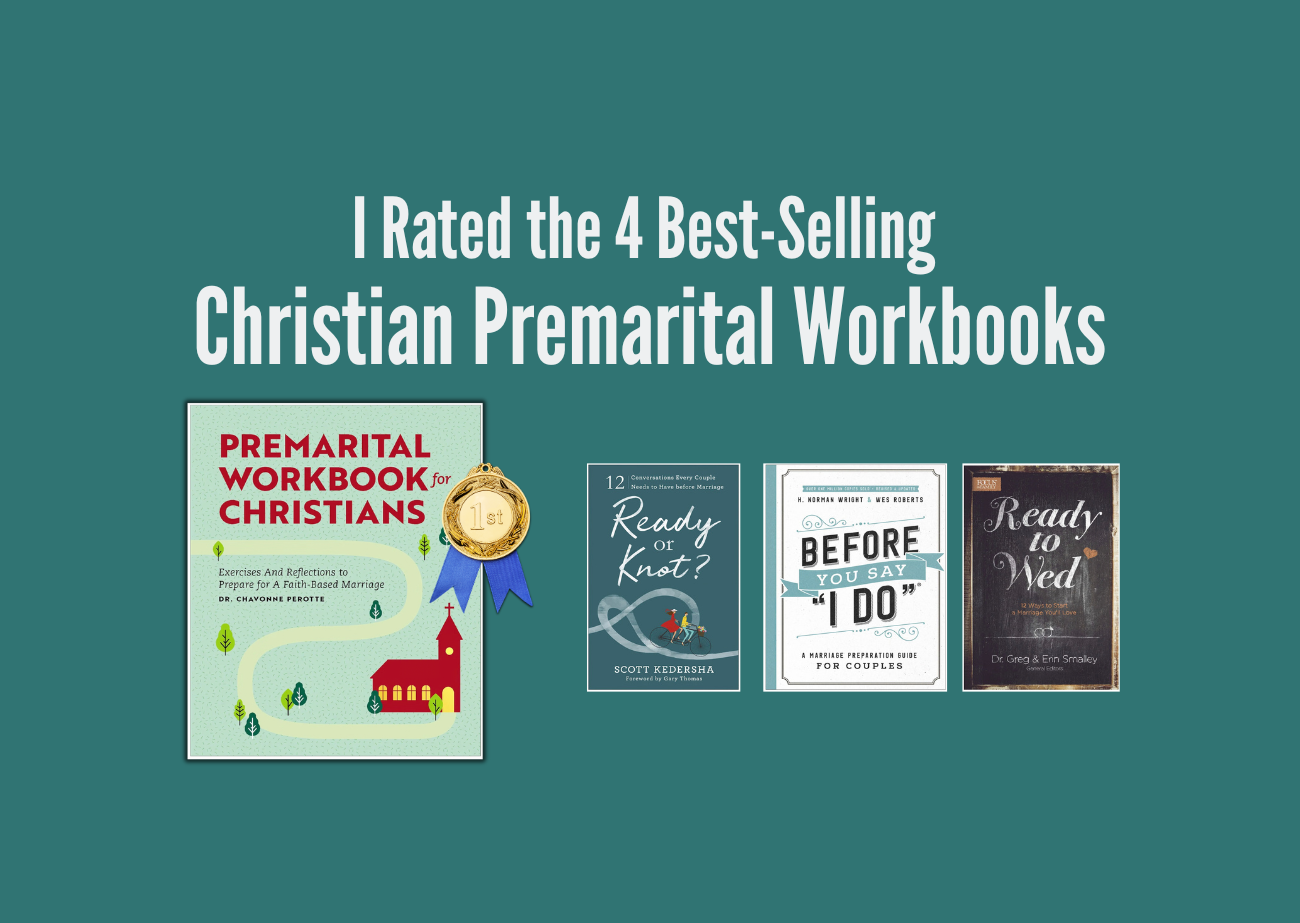
1. Best of the Group: Chavonne Perotte’s Premarital Workbook for Christians
| Safety question | Score | Comment |
|---|---|---|
| 1. Does it name warning signs before marriage? | 4/4 | Yes. Perotte explicitly identifies abuse and infidelity as deal-breakers and says they are boundaries that should not be crossed in a healthy marriage (pp. 12–13). Later exercises ask what the reader would do about emotional infidelity, sexual infidelity, yelling in anger, financial violations, and behavior considered “unsafe or harmful.” She also names sexual pressure and sexual demands as problematic. |
| 2. Does it distinguish ordinary conflict from abuse or coercive control? | 3/4 | Mostly. Ordinary communication breakdowns are treated as mutual problems to solve, while crossed boundaries, abuse, unsafe/harmful behavior, and threats to emotional, physical, or spiritual safety receive a different treatment centered on boundaries and self-protection. What is missing is an actual explanation of coercive control as a pattern—monitoring, intimidation, isolation, retaliation, domination, etc. |
| 3. Does it encourage appropriate outside help? | 3/4 | Yes. Significant disagreements can be taken to a trusted mentor or marriage professional, and the sexual material recommends professional counseling or coaching. But it doesn’t provide an abuse-specific pathway such as individual counseling, domestic-violence expertise, legal help, emergency help, or seeking help without the partner present. |
| 4. Does it give protective options? | 3/4 | Stronger than most. Perotte tells readers that forgiveness does not mean continuing to accept unacceptable treatment, explicitly refers to deal-breakers, and says a person may choose to spend time apart for physical or emotional safety. It repeatedly asks, in effect, “What will you do when this boundary is crossed?” But it never takes the final premarital step and plainly says: postpone or cancel the wedding. |
| 5. Does it explicitly permit a pastor/counselor to say, “Do not proceed with this marriage right now”? | 0/4 | I did not find this. Outside help is encouraged, but the professional or mentor is not explicitly authorized to conclude that the wedding should stop. |
| 6. Does it avoid presenting unilateral submission/headship as the Christian ideal—or provide concrete safety limits if it does? | 4/4 | Yes. This is a major strength. The book places partners on equal footing. Roles are negotiated according to what works for the couple; leadership changes by domain; the relationship is supposed to remain “fair and balanced”; and “roles are not rules.” There is no permanent male tie-breaker or divinely mandated authority structure. |
| 7. Does it refuse to make one partner responsible for the other’s sin or self-control? | 4/4 | Quite clearly. It says another person’s level of commitment “has nothing to do with you” but comes from that person’s own beliefs and experiences. Boundaries are explicitly not about controlling the partner, and apologizing does not mean taking blame that is not yours. |
| 8. When one partner is engaging in dangerous, coercive, degrading, deceptive, addictive, sexually exploitative, or chronically unfaithful behavior, does the book place the burden of change on that person—or imply that the other partner’s Christlike response can produce the needed change? | 3/4 | Generally protective. The boundaries chapter focuses on what the injured person can do to protect herself or himself, rather than on changing the offender; in the infidelity example, the unfaithful partner is the one expected to maintain appropriate boundaries. But some forgiveness language tells the injured reader to let God convict the partner and concentrate on healing, releasing resentment, and forgiving—even without an apology. That keeps it from a 4 because an abuse-specific accountability framework is missing. |
| TOTAL | 24/32 | 75% |
Safety takeaway
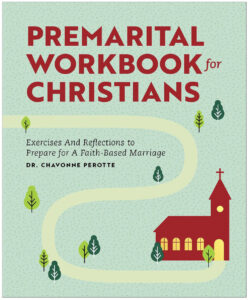 Perotte’s Premarital Workbook for Christians is substantially different from the others because the endangered partner is repeatedly treated as a person with boundaries, agency, deal-breakers, and a legitimate interest in self-protection.
The strongest line of thought in the book may actually be this: you cannot control your partner; you decide what you will do when a boundary is crossed.
Its largest omission is still glaringly premarital: it gives readers most of the conceptual tools for recognizing that something is unsafe, yet stops short of saying:
If these things are happening now, don’t marry this person.
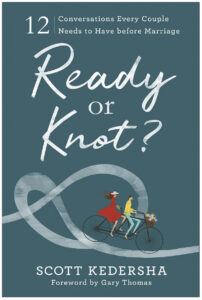
2. Scott Kedersha, Ready or Knot?
| Safety question | Score | Comment |
|---|---|---|
| 1. Does it name warning signs before marriage? | 2/4 | Some. Kedersha recognizes “unhealthy dynamics,” serious sin struggles, isolation, and refusal to accept outside input. Most memorably, he says that if the person you want to marry refuses outside counsel, he would “run from the altar” and calls that a “red light” (p. 190). But there is no systematic screen for coercion, intimidation, possessiveness, monitoring, sexual pressure, retaliation, chronic deception, or violence. |
| 2. Does it distinguish ordinary conflict from abuse or coercive control? | 0/4 | No meaningful distinction. One couple’s story includes a husband’s explosive communication and desire to “control everything,” but those behaviors are folded into a story about marital roles, mutual brokenness, an affair, and recovery. The reader is not taught that controlling or frightening behavior may require a fundamentally different response from ordinary conflict. |
| 3. Does it encourage appropriate outside help? | 4/4 | Strongly. Community is one of the book’s major strengths. Readers are repeatedly told not to isolate, to involve friends, mentors, pastors, and counselors, and to let outsiders speak into the relationship. Kedersha even describes friends urging him and Kristen to end their relationship when they saw unhealthy dynamics. |
| 4. Does it give protective options? | 4/4 | Explicitly. This is the book’s strongest safety feature. A section is actually headed “Sometimes the Best Outcome in Marriage Prep Is to Break Up or Pause.” Kedersha says some couples need to postpone the wedding and some should “call things off completely.” He describes doing so as brave and wise. |
| 5. Does it explicitly permit a pastor/counselor to say, “Do not proceed with this marriage right now”? | 2/4 | Partially. Pastors and mentors are specifically included among the people who should speak into the decision, premarital preparation can reveal that a couple is not ready, and friends are permitted to recommend ending a relationship. But I did not find the direct sentence that the pastor or counselor has responsibility to tell the couple, “Do not proceed.” |
| 6. Does it avoid presenting unilateral submission/headship as the Christian ideal—or provide concrete safety limits if it does? | 0/4 | No. Kedersha explicitly adopts a model in which the husband is leader and the wife submits. He grounds it in an analogy to hierarchy within the Trinity, says a biblical wife “joyfully submits,” and extends the pattern into dating and engagement, saying the woman should increasingly respect his leadership as the wedding approaches. He does not pair this with concrete safety exceptions for coercion or abuse. |
| 7. Does it refuse to make one partner responsible for the other’s sin or self-control? | 1/4 | This is substantially concerning. In one central marriage-role story, the wife has an affair. Her husband then says that although she had the affair, he takes responsibility for the “weak, broken condition” of their marriage and believes the story would have been different if he had loved her as Christ loved the church. He doesn’t explicitly say he caused her affair, but the story plainly invites a causal connection between one spouse’s deficient Christlike behavior and the other’s serious sin. |
| 8. When one partner is engaging in dangerous, coercive, degrading, deceptive, addictive, sexually exploitative, or chronically unfaithful behavior, does the book place the burden of change on that person—or imply that the other partner’s Christlike response can produce the needed change? | 1/4 | The same anecdote is especially important here: the husband believes better Christlike love from him could have changed the trajectory that included his wife’s affair. Elsewhere the book calls marriage a permanent, unconditional covenant and says a spouse’s commitment should not depend on the other spouse’s actions. Those claims have no abuse-specific firewall. The book is far better before the wedding, where it permits a breakup, than it is in explaining responsibility for marriage-endangering sin. |
| TOTAL | 14/32 | 44%, but note the theological content problem below |
Safety takeaway
Click to see buying options
Ready or Knot? is the most internally contradictory book in the set.
Kedersha does something remarkably good that most premarital books refuse to do:
He says not every premarital relationship should become a marriage.
But he also teaches engaged women to begin practicing submission to male leadership before the wedding, while never giving them an abuse-specific framework for knowing when that “leadership” has become domination.
And the Heather-and-Andy story exposes exactly the problem.
Heather’s affair is Heather’s action. Andy’s pornography, passivity, controlling behavior, and failures are Andy’s actions. Each may have affected the relationship enormously.
But when the moral lesson becomes if he had loved her more like Christ, perhaps her affair would not have happened, responsibility starts leaking across the marital boundary.
NOTE: There is also a significant theological problem buried in Kedersha’s marriage-role argument. He appeals to hierarchy within the Trinity to justify hierarchy within marriage. On pp. 104–105, he says that although Father, Son, and Spirit are equal, “the Father does not submit to the Son or Spirit” while “the Son and Spirit submit to the Father,” and then uses that pattern to explain why wives submit to husbands. This closely resembles the controversial doctrine often called Eternal Functional Subordination (EFS) or Eternal Submission of the Son (ESS). Many theologians—including complementarians—have argued that making eternal authority and submission part of the inner life of the Trinity conflicts with classical Nicene Trinitarian theology. So readers who assume this is simply ordinary historic Christian teaching about marriage may want to know that Kedersha’s argument depends on a deeply disputed doctrine of God.
3. Greg and Erin Smalley et al., Ready to Wed?
| Safety question | Score | Comment |
|---|---|---|
| 1. Does it name warning signs before marriage? | 2/4 | The introduction tells couples to take “concern or red flags” seriously, and elsewhere the book identifies pornography, flirting, infidelity, anger, and controlling/dominating leadership as problems. But it never gathers these into an actual premarital warning-sign screen or says which behaviors should stop the wedding. |
| 2. Does it distinguish ordinary conflict from abuse or coercive control? | 0/4 | Not adequately. It says a husband should not be controlling, dominating, or overpowering, which is useful, but it doesn’t define coercive control or tell readers that intimidation, degradation, retaliation, or sexual coercion require a different response from ordinary couple conflict. |
| 3. Does it encourage appropriate outside help? | 3/4 | Yes, quite strongly: mentor couples, pastors, counselors, and licensed counseling referrals are provided when “red flags” appear. But another section tells engaged people not to seek their parents as allies during conflict, and specifically labels parental responses such as “You deserve better,” “No one should have to put up with that,” and “He’s not going to change” as unhelpful. There is no abuse exception. In an ordinary disagreement, that advice may be intended to prevent triangulation; in a dangerous relationship, it can suppress exactly the outside disclosure the person needs. |
| 4. Does it give protective options? | 0/4 | I did not find explicit permission to postpone or cancel the wedding, separate for safety, or end the relationship because of serious warning signs. The response to red flags is essentially get help and work through them. |
| 5. Does it explicitly permit a pastor/counselor to say, “Do not proceed with this marriage right now”? | 0/4 | No. The pastor or counselor is brought in to help, but I did not find the next crucial sentence: the appropriate outcome of that help may be no wedding. |
| 6. Does it avoid presenting unilateral submission/headship as the Christian ideal—or provide concrete safety limits if it does? | 1/4 | The book explicitly says the man is the leader and the woman should serve, defer, and be “in sync” with him. It also says he must not control, dominate, or overpower her and should sacrificially serve and defer to her, which is an important qualification. But it still presents male leadership as God’s design and encourages women to learn to trust that leadership without giving a concrete safety framework for the case in which he is coercive or dangerous. |
| 7. Does it refuse to make one partner responsible for the other’s sin or self-control? | 2/4 | Mixed. The book understands personal responsibility in some contexts—for example, it tells readers they are not responsible for their parents’ emotions or actions. But its marriage material sometimes blurs responsibility. In the sexual chapter, pornography, flirting, rejection, and even infidelity are treated as “tests” of love, and whether these challenges strengthen or destroy love is said to depend substantially on how the reader responds. |
| 8. When one partner is engaging in dangerous, coercive, degrading, deceptive, addictive, sexually exploitative, or chronically unfaithful behavior, does the book place the burden of change on that person—or imply that the other partner’s Christlike response can produce the needed change? | 1/4 | This is the biggest problem revealed by the expanded rubric. The sexual chapter says Christian love has little to do with how one is being treated and is committed to the other’s well-being “no matter what.” Pornography and flirting are then described as tests of the reader’s love; the outcome is said to depend largely on how the reader responds; and even infidelity is included among storms that can ultimately draw spouses closer. Elsewhere the book says faith reminds couples “why it’s worth it to stay.” None of this is paired with a safety exception for coercion, abuse, or ongoing exploitation. |
| TOTAL | 9/32 | 28% |
Safety takeaway
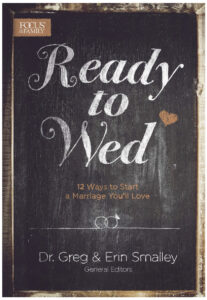 Ready to Wed? has real strengths: it encourages communication, teamwork, mentoring, and counseling when couples encounter “red flags.” But its safety problem is that it repeatedly treats serious individual misconduct as something the couple should work through together, rather than clearly identifying when one person’s behavior should stop the wedding.
Page 99 is the clearest example. In the discussion of pornography, engaged couples are told to begin seeing the struggle as “your problem as a couple,” even while being told they are not responsible for the other person’s purity. Those two messages pull in opposite directions. For a concerned fiancé or fiancée, “our problem” can easily become: I need to monitor, support, understand, forgive, or help manage this so we can still get married.
What the book does not plainly say is what a premarital resource most needs to say:
If pornography use (or other sexual behavior) is ongoing, secretive, minimized, compulsive, or accompanied by deception, you are allowed to postpone or cancel the wedding until there is sustained honesty and change.
That missing exit ramp matters because the book also strongly emphasizes “leave and cleave,” warns couples against recruiting parents as allies in conflict, and frames divorce as spiritually catastrophic before meaningfully discussing abuse, coercion, betrayal, or safety. In a healthy relationship, those teachings may support commitment. In an unsafe one, they can make outside help and protective action harder.
The problem is not that Ready to Wed? says couples should work through difficulties. The problem is that it does not clearly distinguish ordinary difficulties from disqualifying patterns.
A safe premarital book should tell readers not only how to fight for a marriage, but also when wisdom requires them not to enter one.
4. H. Norman Wright & Wes Roberts, Before You Say “I Do”
| Safety question | Score | Comment |
|---|---|---|
| 1. Does it name warning signs before marriage? | 2/4 | It doesn’t give an abuse checklist, but it does identify a surprisingly useful set of unhealthy reasons for marrying. These include marrying in order to be the fiancé’s therapist or counselor, being afraid to break up because of what may happen to the other person even though you know marriage is not the answer, rebound marriage, pregnancy, and other pressures. That is legitimate discernment material, but it doesn’t identify coercive-control behaviors. |
| 2. Does it distinguish ordinary conflict from abuse or coercive control? | 0/4 | No. In fact, the conflict chapter says that although a few conflicts may be one-sided, most involve contributions from both sides, and readers are instructed to identify their own contribution. That can be reasonable counsel in mutual conflict, but without an abuse exception it is exactly the wrong framework for unilateral coercion, intimidation, or violence. |
| 3. Does it encourage appropriate outside help? | 2/4 | It repeatedly assumes involvement of a “marriage advisor,” including when unhealthy motives for marriage appear. But it does not give the engaged reader a robust safety/referral structure involving abuse specialists, individual counseling, legal help, emergency help, etc. |
| 4. Does it give protective options? | 2/4 | Indirectly. It explicitly describes a situation in which someone fears hurting the fiancé by breaking up even though the person knows marriage is not the answer, and identifies that fear as an unhealthy reason to marry. That is meaningful permission not to proceed. But there is no clear section saying, “These are circumstances in which you should postpone or cancel the wedding.” |
| 5. Does it explicitly permit a pastor/counselor to say, “Do not proceed with this marriage right now”? | 0/4 | Not in this workbook. This omission is particularly interesting because Wright’s separate Premarital Counseling Handbook says ministers may need to delay a marriage, may rescind approval, and should be willing to stand behind a judgment that a couple is not ready—even if that means postponement or cancellation. The counselor gets this information; the engaged reader largely does not. |
| 6. Does it avoid presenting unilateral submission/headship as the Christian ideal—or provide concrete safety limits if it does? | 2/4 | Very mixed. The workbook asks for the word that summarizes the wife’s responsibility—submission—and speaks of the husband’s headship. But it also asks whether submission has limits, invokes mutual submission, says leadership should be assigned according to competence rather than sex in ordinary decisions, and explicitly says headship is not being “boss.” So this is much more qualified than Kedersha’s model—but it still lacks an abuse-specific safety explanation. |
| 7. Does it refuse to make one partner responsible for the other’s sin or self-control? | 2/4 | Mixed. Calling “being a therapist or counselor to your fiancé” an unhealthy reason to marry is excellent and directly pushes against fixer-responsibility. But the ordinary-conflict chapter then says most conflicts involve contributions by both sides and instructs readers to identify their contribution. With no abuse exception, a coercively controlled reader could apply that instruction to conduct for which the other person is solely responsible. |
| 8. When one partner is engaging in dangerous, coercive, degrading, deceptive, addictive, sexually exploitative, or chronically unfaithful behavior, does the book place the burden of change on that person—or imply that the other partner’s Christlike response can produce the needed change? | 3/4 | One of Wright’s better points is that you should not marry someone in order to be that person’s therapist or counselor. That directly rejects a rescuing/fixing model. I did not find the Kedersha/Smalley-style claim that sufficiently Christlike behavior from one partner will repair the other’s serious sin. The score stops at 3 because Wright never develops this into a specific doctrine of offender accountability for abuse, coercion, addiction, or chronic deceit. |
| TOTAL | 13/32 | 41% |
Safety takeaway
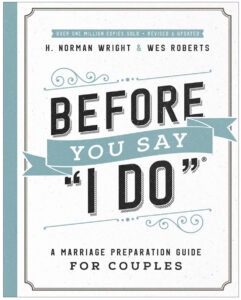
Before You Say “I Do” has a few genuinely useful moments. It warns against marrying someone in order to be their therapist, and it recognizes that fear of hurting your fiancé is not a good reason to marry when you already know marriage is not the answer.
But those moments are overwhelmed by what the workbook leaves out. It offers no meaningful screening for abuse, addiction, domestic violence, chronic deception, sexual misconduct, intimidation, or other serious marriage-endangering behavior. Even when it mentions domination, unfair anger, or controlling money, it does not sound an alarm, recommend professional help, or tell the couple to postpone or cancel the wedding.
Worse, it repeatedly treats relationship problems as things both partners should work on together. It tells readers that most conflicts involve contributions from both sides and says, “The best way to help another to change is to make changes in your own life.” Without an abuse exception, that can teach someone facing another person’s serious sin to look first at what they should change.
The workbook also calls marriage an “unconditional covenant” without adequately explaining that love does not require unlimited access to someone who is cheating, abusing, deceiving, or endangering you.
That is the central safety problem: this book prepares people to make a marriage work, but does very little to help them determine whether the marriage should happen at all.
In other words, it promotes marriage. It does not adequately promote safe marriage.
Side-by-Side Scorecard
| Safety question | Perotte Premarital Workbook for Christians |
Kedersha Ready or Knot? |
Smalley Ready to Wed |
Wright/Roberts Before You Say “I Do” |
|---|---|---|---|---|
| 1. Names warning signs | 4 | 2 | 2 | 2 |
| 2. Distinguishes normal couples conflict from abuse/coercive control | 3 | 0 | 0 | 0 |
| 3. Encourages appropriate outside help | 3 | 4 | 3 | 2 |
| 4. Gives protective/exit options | 3 | 4 | 0 | 2 |
| 5. Pastor can explicitly say “Do not proceed” | 0 | 2 | 0 | 0 |
| 6. Avoids unsafe unilateral submission/headship teaching | 4 | 0 | 1 | 2 |
| 7. Keeps responsibility for sin with the person doing it | 4 | 1 | 2 | 2 |
| 8. Doesn’t make Christlike behavior by the injured partner the cure for the other’s serious sin | 3 | 1 | 1 | 3 |
| TOTAL / 32 | 24 | 14 | 9 | 13 |
| Percentage | 75% | 44% | 28% | 41% |
The safety question isn’t merely whether a Christian premarital book acknowledges bad behavior. It is what the book tells the innocent partner to do about someone else’s bad behavior.
Does it say, “You cannot repent for another person. You cannot love someone out of coercion, addiction, deceit, or abuse. Their behavior is their responsibility, and you are free to protect yourself and not marry them”?
Or does it say, in effect, “Love better. Submit better. Forgive better. Meet their needs. Trust their leadership. Work on your contribution. And perhaps they will change”?
For a reader in a dangerous relationship, those are not minor theological differences. They point in opposite directions.
The Rating Scale
I used a 0–4 safety scale consistently throughout. 4 = protective teaching; 0 = absent or actively hazardous teaching.
| Score | Meaning |
|---|---|
| 4 | Explicitly protective: names limits, keeps responsibility with the person doing harm, and supports accountability/protective action. |
| 3 | Generally protective, but incomplete. |
| 2 | Mixed or ambiguous: useful material is offset by omissions or potentially harmful counsel. |
| 1 | Substantially concerning: counsel could encourage accommodation, submission, need-meeting, forgiveness, or better behavior by the injured person as the answer to serious misconduct. |
| 0 | Absent or actively hazardous in this respect. |
The maximum is 32 points. This is not a rating of the books’ overall quality. It is deliberately narrow: What happens if a person in a coercive, deceitful, degrading, sexually exploitative, addictive, or dangerous relationship follows this book exactly as written?
A Call To Christian Publishers (And Advice to Pastoral Counselors)
The pieces already exist.
Christian publishers just need to put them together.
Give us the Scripture.
Give us the theology.
Give us the communication exercises, the budget worksheets, the questions about sex, the personality inventories, the discussions about in-laws and children.
But also give us the page that says:
You are still allowed to tell the truth.
You are still allowed to ask for help.
You are still allowed to protect yourself.
And you do not have to marry someone simply because the invitations have been mailed.
That would be a Christian premarital workbook worth handing to every engaged couple in the church.
Pastoral Counselors Need to Ask
Does this person have a persistent pattern that makes honesty, safety, empathy, care, reliability, self-control, or accountability unreliable—and are they expecting marriage, Christian submission, forgiveness, or their fiancé’s love to solve it?
Here’s a basic behavioral screen:
Is there — or has there been — any of these behaviors/attitudes:
- violence, threats, intimidation, stalking, or coercive control;
- chronic lying, double lives, or serious financial/sexual deception;
- sexual coercion or sexual behavior involving nonconsenting people or children;
- severe untreated addiction accompanied by secrecy or repeated broken promises;
- explosive rage, destruction of property, or reckless disregard for others’ safety;
- extreme jealousy, surveillance, or unfounded accusations of infidelity;
- repeated exploitation with little empathy or remorse;
- chronic indifference to a partner’s distress, needs, safety, or well-being;
- severe or persistent neglect—emotional, financial, medical, parental, or practical—especially when the person shows little concern about the harm caused;
- threats of suicide or self-harm used to keep a partner from leaving;
- refusal to acknowledge the problem, seek appropriate treatment, accept accountability, or permit the fiancé to obtain independent advice.
Appendix: When Is Submission OK and When Is It a Problem?
We must ask:
Does the book teach that one spouse possesses God-given authority, leadership, or a final decision-making right over the other—and does following that teaching reduce the other spouse’s ability to disagree, exercise judgment, insist on accountability, or act on serious concerns?
I am not criticizing mutual humility, service, or yielding. I’m concerned about one-sided marital submission—the belief that husbands have God-given authority and the final or tie-breaking vote.
In Sheila Wray Gregoire’s new research involving about 7,000 people, including roughly 1,300 matched couples, teamwork clustered with healthier marriages, while hierarchy clustered with poorer outcomes. When wives believed husbands had the tie-breaking vote, they were 83% more likely to say their opinions mattered less. Hierarchy was also associated with poorer friendship, more passive-aggressive dynamics, and greater reported exhaustion and pain among women. These findings are correlational, not proof of simple causation, but the pattern is striking.
The problem is structural. If one spouse ultimately has the deciding authority, disagreement can become less about mutual understanding and more about deference. The lower-authority spouse may hesitate to challenge poor judgment, confront sin, or trust her own perceptions.
That becomes especially dangerous when the husband is controlling, deceptive, sexually coercive, addicted, chronically angry, or abusive. Submission teaching can create an internal question: Am I resisting his leadership? when the more important question may be: Is his behavior unsafe?
Research consistently finds that equal voice, mutual influence, friendship, shared responsibility, and teamwork are associated with healthier marriages.
For premarital counseling, the key question is therefore:
Does this book teach one spouse to live under the other—or teach both spouses to become equal, accountable teammates?
 :
:
 :
: Buy PDF