
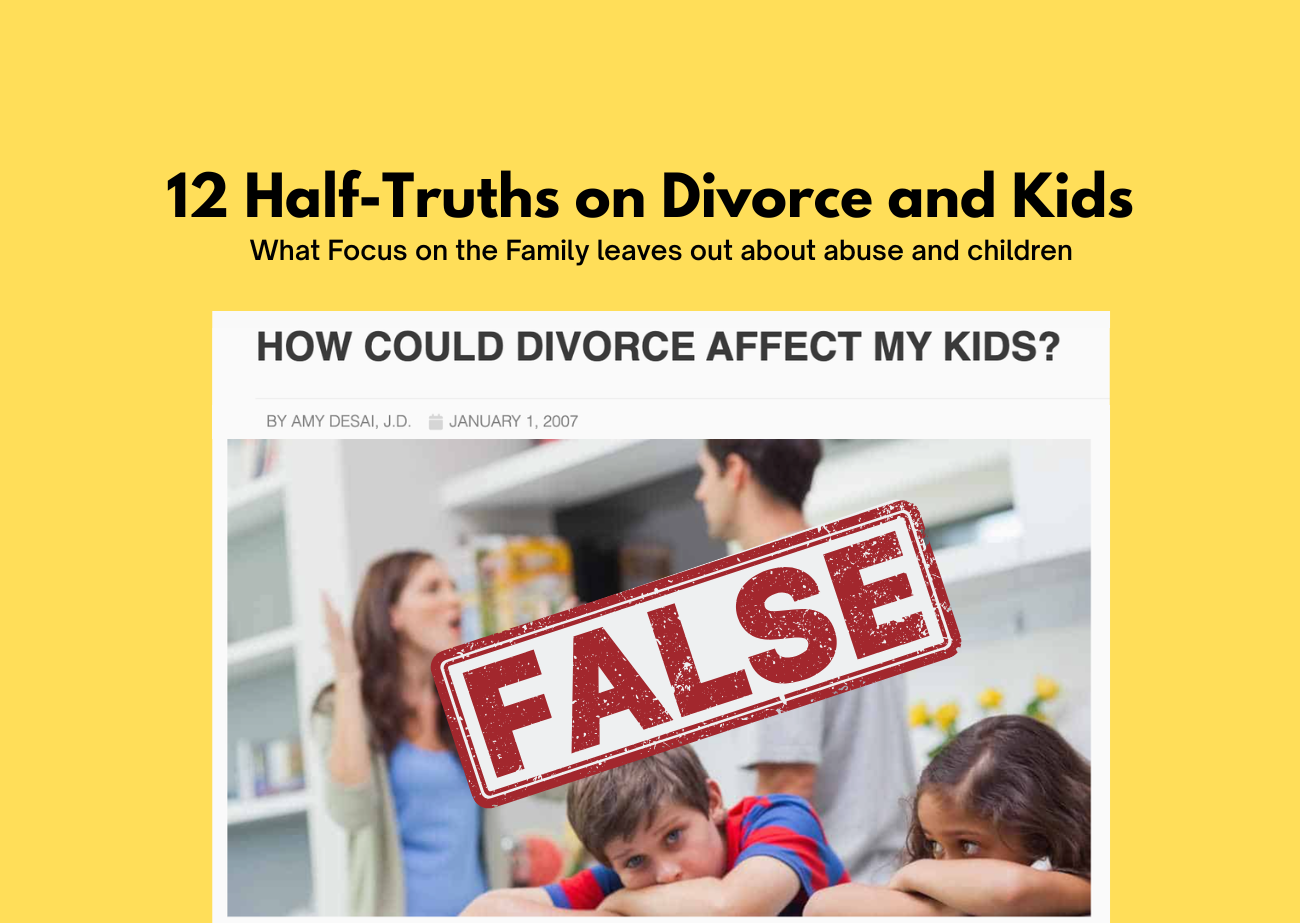
12 Half-Truths in Focus on the Family’s “How Could Divorce Affect My Kids?”
Focus on the Family should be ashamed of this article.
Why? Because it tells frightened parents that divorce harms children, but leaves out the most important truth: in abusive, violent, high-conflict, or severely destructive homes, many of the very researchers it cites said children do better after divorce than by staying.
That is not a small omission. It is a dangerous one.
I am not saying divorce is painless. I never do. Divorce is hard on children, hard on parents, and often heartbreaking. But the real question is not, Does divorce hurt? The real question is: Compared to what?
Compared to a peaceful, loving, low-conflict marriage, divorce is usually harder on children. But compared to a home filled with fear, coercion, volatility, addiction, chronic betrayal, emotional abuse or neglect, or violence, staying married is often worse for the children.
That is exactly where Focus on the Family misleads people.
What Focus leaves out
In this article, Focus presents divorce as though it is basically the result of selfish adults taking the easy way out. It does not seriously discuss domestic violence, child abuse, chronic emotional abuse, abandonment, sexual betrayal, addiction, or other severe reasons marriages break apart. That silence matters.
Many readers who land on a Focus article are desperate, frightened, and trying to do the right thing before God. Some are being harmed behind closed doors. And yet Focus frames divorce as though the main danger is leaving, rather than the possibility that the home itself is dangerous.
That is shameful.
What the researchers actually found
What makes this worse is that the article uses the names of major researchers in a way that gives readers the impression those scholars believed divorce is universally destructive to children. They did not.
Researchers such as Paul Amato, Andrew Cherlin, Judith Wallerstein, Sara McLanahan, Ross, and Mirowsky all acknowledged an important distinction: children in highly conflicted or destructive homes may be better off if the parents separate than if they remain together.
For more on that, see Is it Always Best to “Stay for the Kids”? No, Not If the Home is Toxic.
That is why this article matters. The problem is not merely that Focus on the Family is pro-marriage. I value marriage too. The problem is that it tells only one side of the story, and tells it in a way that can load guilt onto the very people who are already carrying too much. And the advice can endanger lives.
It can pressure abused spouses to stay longer. It can pressure pastors to shame divorcees. It can frighten parents into believing that leaving a destructive marriage will ruin their children, when in some homes leaving may be the beginning of safety and healing.
Why this matters for Christian families
If you are in a safe, loving, emotionally-healthy, low-conflict marriage, then yes, protect it, nurture it, and fight for it. But if your home is ruled by intimidation, addiction, sexual betrayal, chronic chaos, or fear, you need better counsel than “divorce hurts kids.”
Of course it hurts.
But abuse hurts too. Terror in the home hurts too. Watching one parent demean, control, deceive, or frighten the other hurts too. Children are shaped not only by divorce, but by the marriage they were living in before the divorce.
That is the truth Focus on the Family keeps leaving out.
If you are trying to think clearly about abuse, faith, and divorce, these may help:
- Can I Divorce for Abuse? Can Christians Divorce for Abuse?
- Adultery, Abuse, Abandonment are Biblical Grounds for Divorce
- Marriage Counseling in Abusive Situations is Unethical
- Will the Kids and I Ever Be Happy Again After Divorce? Studies Say Most People Are!
I have also written a much longer documented critique with the screenshots, charts, quotes, and source analysis. This shorter article is the overview: the plain-English version of why that Focus on the Family piece is not merely incomplete, but unsafe.
Bottom line: divorce is not universally destructive to children. In some homes, it is the lesser harm. In some homes, it is the path out of harm. Christian families deserve the full truth, not fear-based half-truths dressed up as research.
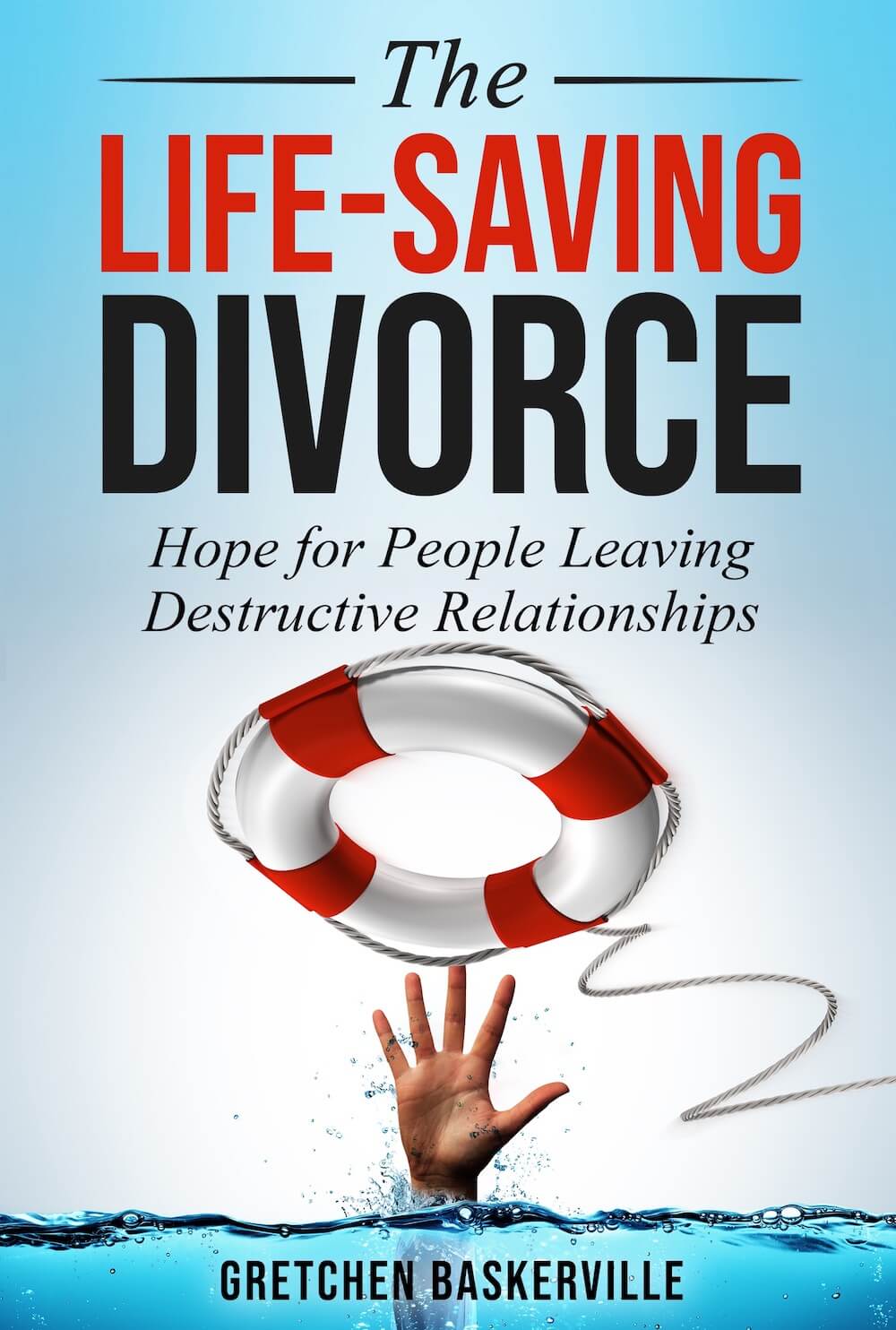
 :
:
 :
: Buy PDF