
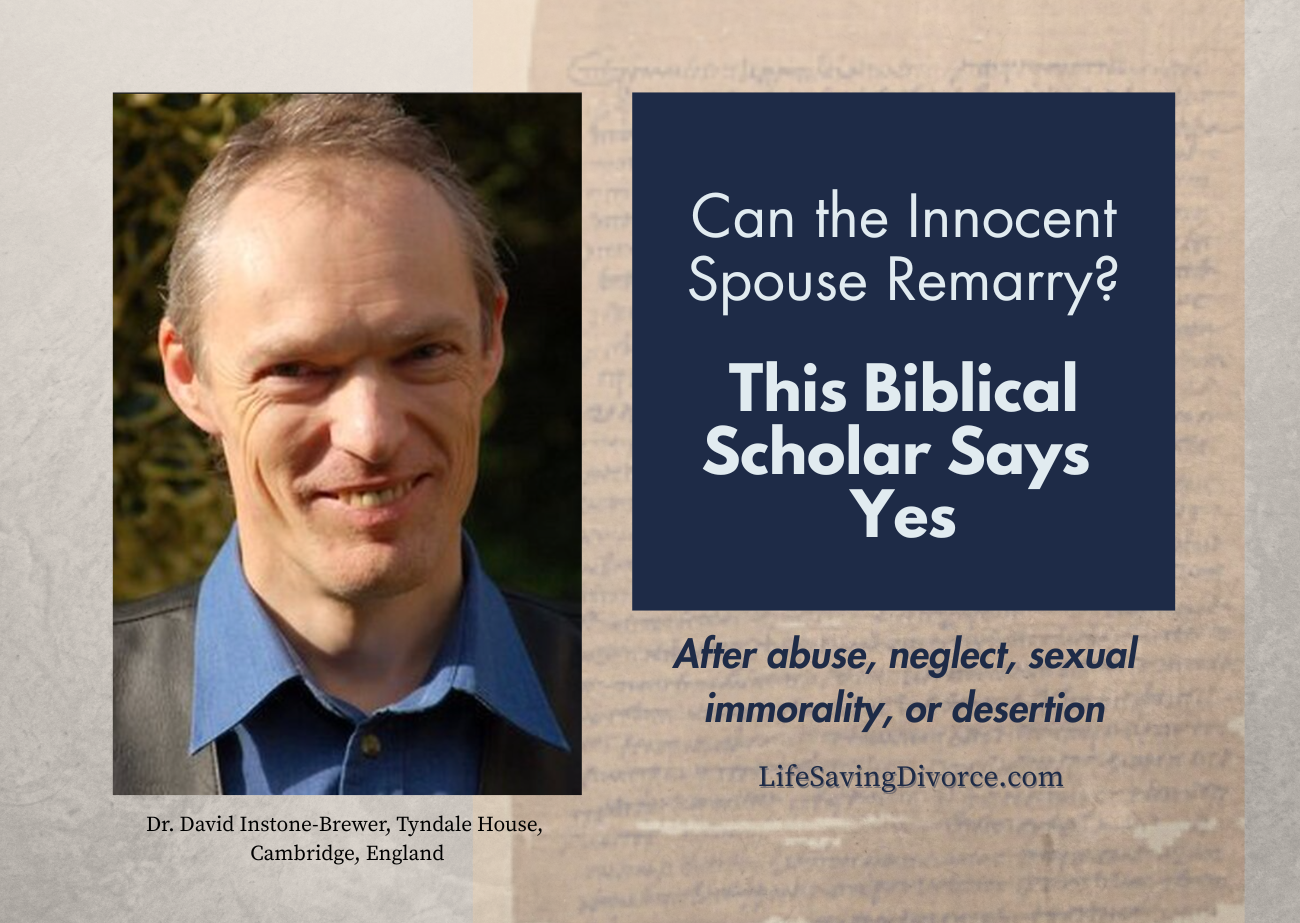
Can the Innocent Spouse Remarry? What Jesus Meant in Matthew 19 and Mark 10
Why Dr. David Instone-Brewer believes Jesus condemned invalid divorce—not every remarriage.
Many Christians can accept that Scripture allows divorce for serious covenant-breaking—adultery, abandonment, neglect, or abuse—but still struggle with the remarriage question:
“I know I had biblical grounds to divorce,
but do I have biblical grounds to remarry if my former spouse is still living?”
That is a serious question. It is not legalistic to want to obey Jesus. The issue is not whether we should follow Christ’s commands. The issue is what Jesus meant when He spoke about divorce and remarriage in Matthew 19 and Mark 10.
Dr. David Instone-Brewer argues that Jesus was answering a specific first-century Jewish debate about “Any Cause” divorce. In that context, Jesus condemned invalid divorce and remarriage after invalid divorce—not every remarriage after every divorce.
Note:
- DRB = Divorce and Remarriage in the Bible by Dr. David Instone-Brewer
- DRC = Divorce and Remarriage in the Church by Dr. David Instone-Brewer. Also see selected passages online.
Two Separate Questions
We need to separate two questions that often get blended together:
- What are the biblical grounds for divorce?
- After a valid divorce, may the innocent spouse remarry?
Instone-Brewer answers both questions.
Question 1: What Are the Biblical Grounds for Divorce?
Instone-Brewer states his position very directly: “Four Grounds Are Affirmed in the New Testament.” He names them as:
- Adultery (Matthew 19:9)
- Desertion by an unbeliever (1 Corinthians 7:15)
- Emotional neglect (including emotional abuse, Exodus 21:10–11)
- Material neglect (including physical abuse, Exodus 21:10–11)
He roots the last two in Exodus 21:10–11, where a spouse is owed food, clothing, and marital love. If these are withheld, the wife is to “go free.” Divorce and Remarriage in the Bible, p. 275.
“If he marries another woman, he must not deprive the first one of her food, clothing and marital rights. If he does not provide her with these three things, she is to go free, without any payment of money.”
Instone-Brewer argues that Paul alludes to those same obligations in 1 Corinthians 7, treating them as real marital duties, not optional acts of kindness. Divorce and Remarriage in the Bible, pp. 193–194.
He later summarizes Paul’s teaching this way: when a spouse is deserted against his or her will, that desertion counts as neglect of marriage obligations; and when reconciliation fails, the abandoned believer is free to accept that the marriage has ended and is, by implication, free to remarry. Divorce and Remarriage in the Bible, p. 212.
What About Desertion by a Believer?
Instone-Brewer argues that Paul clearly says believers must not desert their spouses. If a nonbeliever deserts a believer and will not return, the deserted believer is “no longer bound.”
He then extends that logic to a professing believer who deserts and refuses to obey Christ’s command to reconcile. In that case, the church would eventually have to treat that person as outside the faith. So his conclusion is that 1 Corinthians 7:15 applies to any desertion that cannot be reversed, whether by an unbeliever or by someone who claims to be a believer but persists in desertion. Divorce and Remarriage in the Bible, pp. 281–282.
Question 2: May the Innocent Spouse Remarry?
Instone-Brewer says yes. Remarriage after a valid divorce is permitted.
In his pastoral conclusion, he writes that divorce is allowed only when marriage vows have been broken, that the injured party must make that decision, and that “if divorce does happen, remarriage is permitted.” Divorce and Remarriage in the Bible, pp. 313–314.
That is why his view matters pastorally. He believes the innocent spouse is not automatically chained for life to a covenant already destroyed by serious betrayal, abandonment, abuse, or neglect.
He believes the injured spouse is generally called to forgive, especially where there is repentance. Divorce and Remarriage in the Church, pp. 63–65. But in the end, only the wronged spouse can decide when “enough is enough.” Divorce and Remarriage in the Church, p. 18; pp. 42–43. In pastoral practice, Instone-Brewer says that decision belongs to the partner who has been betrayed, neglected, or abused. Divorce and Remarriage in the Bible, p. 311.
Jesus and The Pharisees: The Question About the Meaning of “A Matter of Indecency”
The religious leaders sought to trap Jesus. So they asked him a polarizing question about the meaning of a phrase in Deuteronomy 24:1. This debate was the real issue behind the Pharisees’ question to Jesus in Matthew 19 and Mark 10. They were not asking whether divorce was ever permissible. Everyone at knew it was, based on Ex 21:10-11. In Jesus’ day, there were two views of Deuteronomy 24:1, represented by two rabbis, Shammai and Hillel. The followers of Shammai and Hillel accepted divorce for serious violations of the marriage covenant, such as neglect. The controversy was whether the phrase “a matter of indecency” in Deuteronomy 24:1 allowed a divorce for any and every reason. By asking, “Is it lawful for a man to divorce his wife for any cause?” (Matt. 19:3), the Pharisees were asking Jesus to choose sides in the most famous divorce debate of first-century Judaism. Jesus rejected Hillel’s broad “Any Cause” interpretation and sided with Shammai’s narrower reading of Deuteronomy 24:1, while leaving the other biblical grounds for divorce (neglect / abuse) untouched. (Video explanation; also see chapter 6 in The Life-Saving Divorce.)
| Category | Rabbi Shammai or House of Shammai (Shammaites) |
Rabbi Hillel or House of Hillel (Hillelites) |
|---|---|---|
| Lived | 50 BC – AD 30 | 110 BC – AD 10 |
| Followers | Only worthy students could study the Bible | Everyone can study the Bible |
| Viewpoint | Usually a strict interpretation of the Bible | Usually a less strict interpretation of the Bible |
| Interpretation of Deut. 24:1–4 phrase “matter of indecency” | A prohibited sexual relation | An unseemly matter or a prohibited sexual relation (either was a valid reason) |
| Meaning | Adultery | Adultery or “any cause” (any unseemly matter), including the wife ruining a meal or a man finding another woman more attractive |
| Other reasons for a valid divorce | Breaking the marriage contract in Ex 21:10-11, the ketubah: food, clothing, marital rights (meaning neglect, and by extension, abuse) | Breaking the marriage contract in Ex 21:10-11, the ketubah: food, clothing, marital rights (meaning neglect, and by extension, abuse) |
| Comments | In Matthew 19:3, we see Jesus sides with Shammai in his reply to the Pharisees. | Hillel’s grandson is mentioned in Acts 5:33–40 as an honored Pharisee and teacher of the law. He saved the lives of Peter and the other disciples. |
| History | Shammai’s school declined when Jerusalem was destroyed by the Romans in AD 70. | Hillel’s views became the majority view. His followers persuaded the Romans to allow them to establish a community at Jamnia. |
But What About Jesus’ Hard Words?
This is where Instone-Brewer’s argument becomes especially important.
Jesus was answering a specific first-century Jewish debate, not the broad modern question, “Is every divorce always sinful?”
In Divorce and Remarriage in the Church, Instone-Brewer explains that the Pharisees were asking about “Any Cause” divorce—a loose reading of Deuteronomy 24:1 that allowed a man to dismiss his wife for almost any reason.
Jesus rejected that view.
Instone-Brewer says Jesus’ answer matched the stricter Shammaite position on Deuteronomy 24:1: divorce for sexual immorality was valid, but divorce for “Any Cause” was not. Divorce and Remarriage in the Church, pp. 97–98.
So when Jesus says remarriage after divorce can be adultery, Instone-Brewer says He is speaking about remarriage after an invalid divorce—not every remarriage without exception.
So Did Jesus Forbid Remarriage After Divorce?
This is the question that terrifies many innocent spouses.
Jesus said:
“Whoever divorces his wife, except for sexual immorality, and marries another commits adultery.”
Mark 10 sounds even stronger because it gives no exception clause.
But Instone-Brewer argues that Jesus was not condemning every remarriage after every divorce. He was condemning remarriage after an invalid divorce—specifically the popular “Any Cause” divorce.
Why would remarriage after an invalid divorce be adultery?
Because an invalid divorce does not end the marriage. If a man used a fake, groundless, or loophole-based divorce to get rid of his wife and marry another woman, Jesus says that is not righteousness. It is adultery dressed up in legal paperwork.
This protects the discarded spouse rather than condemning her.
Jesus was confronting men who used religious loopholes to abandon wives. He was not telling betrayed, abused, neglected, or abandoned spouses that they are chained for life to someone who destroyed the marriage covenant.
Instone-Brewer argues that in Jesus’ day, remarriage was assumed to be part of divorce. A divorce certificate existed precisely to free the divorced person to marry again. The key wording of the Jewish divorce certificate was: “You are allowed to marry any man you wish.” Divorce and Remarriage in the Bible, p. 288.
So if Jesus had intended to abolish remarriage after valid divorce, He would have had to say so clearly. He did not.
Paul also does not prohibit remarriage after divorce. Instone-Brewer argues that Paul’s words “not bound” in 1 Corinthians 7:15 refer to freedom from the marriage, including freedom to remarry. Divorce and Remarriage in the Bible, pp. 212, 288–289.
Instone-Brewer’s conclusion is that remarriage after a valid divorce is permitted. The New Testament condemns groundless divorce and remarriage after invalid divorce. It does not condemn the innocent spouse who remarries after a divorce based on biblical grounds. Divorce and Remarriage in the Bible, pp. 274–286, 313–314; Divorce and Remarriage in the Church, pp. 66–68, 200–201.
Common Objection #1: “Then Jesus Allowed Divorce Only for Adultery.”
Instone-Brewer says no.
When Shammai limited divorce in Deuteronomy 24:1 to sexual immorality, that did not mean Shammai rejected every other biblical ground for divorce.
Instone-Brewer says we have records of debates between Hillelites and Shammaites about neglect—food, clothing, and conjugal love—which shows both schools accepted neglect as a valid category. Divorce and Remarriage in the Church, pp. 97–98.
That is one of his biggest points: Jesus rejected invalid divorce under Deuteronomy 24; He did not erase the other grounds already present in Exodus 21.
“So if Jesus believed that neglect and abuse were valid grounds for divorce, why didn’t he say something about them? The most likely answer is that he did not need to say anything—or he did say something, but the Gospel writers did not think it was necessary to record it—because the principle was so universally accepted that there was no dispute about it.” Divorce and Remarriage in the Church, pp. 96–97.
Jesus was answering the question He was asked. He was not giving a complete encyclopedia of every divorce text in the Bible.
Common Objection #2: “But Jesus Said Whoever Marries a Divorced Woman Commits Adultery.”
This objection deserves respect because it comes straight from Jesus’ words.
In Matthew 5:32, Jesus says:
“Anyone who marries a divorced woman commits adultery.”
In Mark 10:11–12, He says:
“Whoever divorces his wife and marries another commits adultery against her; and if she divorces her husband and marries another, she commits adultery.”
These are serious words.
But again, the question is not whether we should obey Jesus. The question is what situation Jesus was addressing.
Instone-Brewer argues that Jesus was condemning the abuse of divorce to obtain another partner. A man could not use an invalid “Any Cause” divorce to discard his wife, marry another woman, and pretend he had obeyed God.
That is why Jesus calls it adultery.
But that is not the same as saying that every divorced woman is forbidden to remarry, even if her marriage ended because of adultery, abandonment, abuse, or neglect.
Jesus was exposing covenant-breakers, not binding victims to covenant-breakers for life.
Common Objection #3: “The Disciples Were Shocked. Doesn’t That Prove Jesus Was Forbidding Remarriage?”
After Jesus rejected “Any Cause” divorce, the disciples said:
“If this is the situation between a husband and wife, it is better not to marry.”
Some people argue that this proves Jesus must have been teaching something extremely restrictive, such as lifelong celibacy after divorce.
But the disciples’ shock makes sense even if Jesus was “only” rejecting “Any Cause” divorce.
Why?
Because Jesus had just removed the easy escape hatch.
Before Jesus’ answer, many men assumed they could leave a marriage whenever they wanted by using an “Any Cause” divorce. If the marriage became unpleasant, disappointing, difficult, or inconvenient, they could dismiss the wife and marry someone else.
Jesus says no.
Marriage is not casual. Marriage is not disposable. A husband cannot throw away his wife because he is tired of her. God’s design from the beginning was lifelong faithfulness.
That would have sounded very strict to men who had grown accustomed to easy divorce.
So the disciples react:
“If marriage is that serious, maybe it is better not to marry.”
Notice what they do not ask:
“What about abuse?”
“What about neglect?”
“What about Exodus 21?”
“What about abandonment?”
Those were not the topic under debate.
The disciples were reacting to Jesus’ rejection of easy, groundless divorce—not asking Him to settle every future question about valid divorce and remarriage.
Common Objection #4: “Why Did Jesus Talk About Eunuchs?”
This is another good question.
After the disciples say it may be better not to marry, Jesus talks about eunuchs:
“For there are eunuchs who were born that way, and there are eunuchs who have been made eunuchs by others—and there are those who choose to live like eunuchs for the sake of the kingdom of heaven.”
Some people read this to mean that divorced people must remain celibate for life.
But that is not what Jesus says.
Jesus is answering the disciples’ statement that marriage may be too difficult. His answer is that marriage is not compulsory. Some people do not marry. Some cannot marry. Some choose not to marry for the sake of the kingdom.
In other words, Jesus is saying:
“If lifelong faithfulness in marriage sounds too hard, then do not marry.”
He is not saying:
“Everyone who has a valid divorce must become a eunuch.”
That would conflict with the rest of Scripture, where valid divorce includes freedom from the marriage. Deuteronomy 24 assumes remarriage after divorce. Exodus 21 frees the neglected wife. Paul says the abandoned believer is “not bound.” And in first-century Jewish and Roman culture, remarriage after divorce was the normal assumption. Divorce and Remarriage in the Bible, pp. 286, 288–289, 299.
So why does Jesus mention eunuchs?
Because He has just raised the standard for marriage. He has said marriage is serious, sacred, and not to be dissolved casually. The disciples respond, “Then maybe it is better not to marry.” Jesus answers, in effect, “For some people, yes. Singleness is a valid calling.”
That is not a command that every innocent divorced person must remain unmarried while the former spouse is alive.
Common Objection #5: “But the New Testament Never Plainly Says, ‘A Divorced Person May Remarry.’”
Instone-Brewer admits the New Testament does not say that in one neat sentence.
But he says that is because first-century Jews did not need it spelled out.
Remarriage after a valid divorce was already the universal assumption of the culture, so Jesus’ silence on that point is best read as agreement, not prohibition. Divorce and Remarriage in the Bible, p. 286.
He makes the same point when discussing Paul: first-century readers would have understood “not bound” as freedom that included remarriage. Divorce and Remarriage in the Bible, p. 212.
Instone-Brewer says the silence is actually significant. Jesus debated the Pharisees about divorce certificates, but He never said, “You may no longer use a divorce certificate to remarry.” Paul wrote to Greco-Roman Christians in a culture where remarriage after divorce was assumed, and he never said, “Christians are forbidden to remarry after divorce.” Divorce and Remarriage in the Bible, pp. 288–289.
If Jesus or Paul had intended to overturn the entire Jewish and Roman understanding of divorce, they would have needed to say so clearly.
Why Does Mark 10 Sound Stricter Than Matthew 19?
Many Christians notice that Matthew includes the exception for sexual immorality, while Mark 10 appears to give no exception at all.
Matthew 19:3, 9 (WEB)
3 Pharisees came to him, testing him, and saying, “Is it lawful for a man to divorce his wife for any reason?”
9 “I tell you that whoever divorces his wife, except for sexual immorality, and marries another, commits adultery; and he who marries her when she is divorced commits adultery.”
Mark 10:2, 11–12 (WEB)
2 Pharisees came to him testing him, and asked him, “Is it lawful for a man to divorce his wife?”
11 He said to them, “Whoever divorces his wife and marries another commits adultery against her.
12 If a woman herself divorces her husband and marries another, she commits adultery.”
At first glance, Mark sounds as if Jesus prohibited every remarriage after every divorce.
Instone-Brewer argues that this difference is explained by the historical setting.
Matthew records the Pharisees asking, “Is it lawful for a man to divorce his wife for any cause?” (Matthew 19:3). That phrase is not incidental. It was the technical jargon for the famous debate between the schools of Hillel and Shammai over Deuteronomy 24:1.
The Hillelite position on Deut. 24:1 allowed a man to divorce his wife for virtually any reason. The Shammaite position argued that Deuteronomy 24:1 referred only to sexual immorality. Instone-Brewer says these two phrases—“for any cause” and “except for sexual immorality”—would have been instantly recognized by first-century Jewish listeners because they summarized that entire debate. Divorce and Remarriage in the Bible, pp. 133–160, especially p. 134.
Mark’s Gospel is more abbreviated. Instone-Brewer argues that Mark leaves out the technical phrases because the original audience would have understood the debate without them. Matthew spells them out. Divorce and Remarriage in the Church, pp. 66–68.
In other words, Mark assumes the debate; Matthew explains it.
That means Jesus was not answering the broad question, “Is every divorce always sinful?” He was answering the narrower question: “Is Hillel’s ‘Any Cause’ divorce valid?”
His answer was no.
Jesus was not saying:
“Every divorced person who remarries commits adultery.”
He was saying:
“A man who throws away his wife with an invalid ‘Any Cause’ divorce and marries someone else is committing adultery.”
That is a very different claim.
It Is Not Legalistic to Want to Obey Jesus
Some divorced Christians are told they are being “legalistic” because they are afraid to remarry.
I do not think that is fair.
It is not legalism to want to obey Jesus. It is not legalism to study Scripture carefully. It is not legalism to say, “I do not want to sin.”
That desire should be honored.
But the question is not whether we should obey Jesus. The question is whether we are correctly understanding what Jesus commanded.
Every major Christian position on divorce claims to obey Jesus.
The disagreement is over interpretation.
Did Jesus intend Matthew 19 and Mark 10 to answer every possible question about divorce and remarriage? Or was He answering the Pharisees’ specific question about the validity of “Any Cause” divorce?
Instone-Brewer argues that Jesus was answering the specific debate in front of Him.
That means we should take Jesus’ words seriously—but we should also take His historical setting seriously.
Why This Matters
Instone-Brewer is not soft on sin.
He is hard on frivolous divorce, hard on covenant breaking, and hard on any reading of Jesus that turns marriage into something casual.
But he is equally unwilling to tell the innocent spouse that Scripture requires lifelong bondage to adultery, abandonment, abuse, or crushing neglect.
His bottom line is simple:
Divorce is never good, but some divorces are valid—and remarriage after a valid divorce is permitted.
Divorce and Remarriage in the Bible, pp. 274, 285, 288–289, 313–314; Divorce and Remarriage in the Church, pp. 66–68, 97–98, 200–201.
About Dr. David Instone-Brewer
Dr. David Instone-Brewer was a senior researcher at Tyndale House, Cambridge, England, for 25 years before he retired. He’s not only an expert in ancient biblical languages, he has also collected and studied all available Greek, Latin, and Aramaic marriage and divorce papyri, hundreds of documents, spanning roughly the fourth century BCE to the fourth century CE.
That means his conclusions are grounded in the best of both worlds: not only in extensive understanding of the Bible, but in real life examples of how the biblical laws were carried out at the time. He built his understanding of marriage and divorce in biblical times from real documents, not modern assumptions about what marriage and divorce “must have meant” 2,000 years ago.
That is why his argument deserves attention.
For Further Reading
“Let No Man Separate” Doesn’t Mean No Divorce for Any Reason — Matthew 19:6
1 Corinthians 7:10 Explained: What Paul Meant About Separation and Remarriage
• Video explanation of the Four Causes for Divorce in the Bible
 :
:
 :
: Buy PDF