
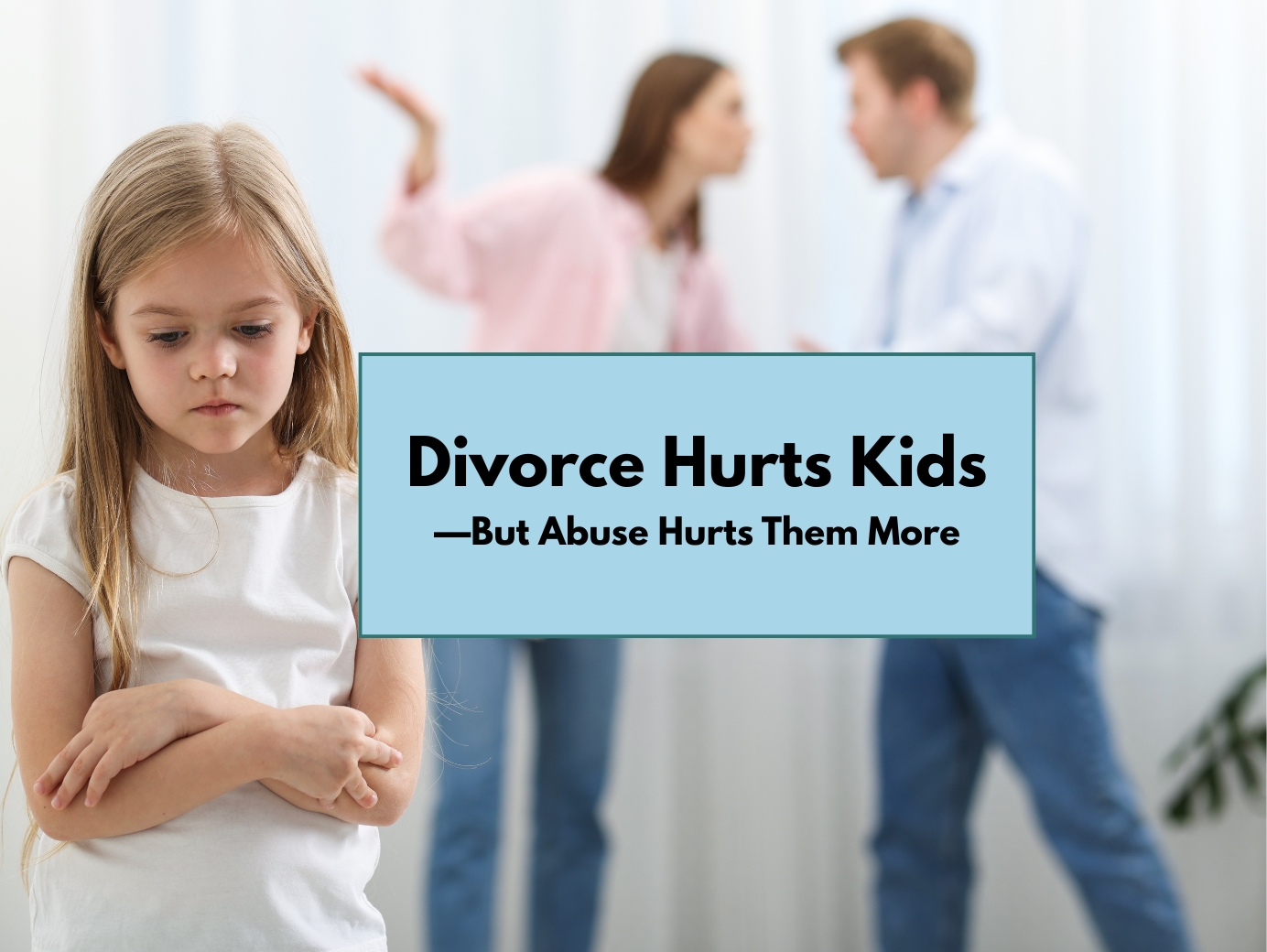
Divorce Hurts Kids—But Abuse Hurts Them More
(A Response to the #GreaterThan Campaign’s Divorce Pivot.)
This post responds to the campaign’s claim that “divorce hurts kids” by examining what the research actually compares—and what it leaves out.
The #GreaterThan campaign has begun emphasizing that “divorce hurts kids.” And yes—divorce can be painful for children.
But that truth is incomplete without another one:
The real comparison is not a stable home vs. divorce.
It is a high-distress or abusive home vs. divorce.
The best research does not compare healthy marriages with divorce. It compares divorce with homes already marked by chronic conflict, cruelty, addiction, betrayal, and fear.
Sociologist Paul Amato has shown that in high-distress marriages, children do better on average when parents separate. Staying together is not automatically the best outcome when the home is unsafe.
Academic source: Amato, “Reconciling Divergent Perspectives…”
Paywall-free summary here: My Amato summary on high-distress homes
Sociologist Andrew Cherlin also found that much of what people blame on divorce was already happening before divorce—because of ongoing conflict, substance abuse, or violence. The harm for children often begins years earlier.
Cherlin et al., “Effects of Divorce on Mental Health Through the Life Course”
And research by Sara R. Jaffee and colleagues adds that children can be better off with reduced exposure to violent or antisocial parents. In other words, “father presence” is not automatically beneficial when the father is dangerous.
Jaffee, Moffitt, Caspi & Taylor (2003), Child Development
My analysis of Jaffee here:
Life-Saving Divorce summary of Jaffee
Katy Faust, the face of the #GreaterThan campaign, admires and cites Dr. Judith Wallerstein in her book. But even Wallerstein rejected the idea that divorce is always the worst outcome for children.
“I don’t know of any research, mine included, that says divorce is universally detrimental to children.”
—Judith S. Wallerstein, The Unexpected Legacy of Divorce (2000), p. xxxix
“Divorce is often the only rational solution to a bad marriage… children turn out less well-adjusted when exposed to open conflict, where parents terrorize or strike one another, than do children from divorced families.”
—Judith S. Wallerstein, Second Chances (1989), pp. 321–322
Divorce is never painless. But in destructive marriages, it can be a rescue, not a tragedy.
If we want to protect children, we must tell the whole story—not just about divorce, but about the harm of staying.
Related posts and insights:
- Is It Best to “Stay for the Kids”? What Decades of Research Actually Show (includes 8 more quotations from Wallerstein)
- Is it Always Best to “Stay for the Kids”? No, Not If the Home is Toxic
- Note: The campaign’s message also appears to have limited public traction. As of May 11, 2026, the flagship #GreaterThan YouTube launch video had only 6,910 views after more than three months online, despite support from numerous large organizations and influencers.
 :
:
 :
: Buy PDF