
When Parent–Adult Child Reconciliation Fails
Why the Focus on the Family Series on Parent-Adult Child Estrangement Miss It
For audio summary in multiple languages
If you watched the Focus on the Family series with Dr. John Townsend and were frustrated because the three reasons they gave for estrangement didn’t include your situation, you are not alone.
As a grown adult (and perhaps a parent yourself), perhaps you had to step back from a parent whose false accusations, deception, or ongoing undermining caused real harm.
Not because you were angry one day.
Not because of a minor misunderstanding.
But because every attempt at honesty, repair, or boundary-setting only escalated the damage.
When a mature, independent adult discovers that continued relationship with a parent reliably leads to false accusations, denial of obvious facts, or attacks on their integrity, distance is sometimes the only way to stop ongoing harm. In these cases, stepping back is not driven by bitterness or rebellion, but by a parent’s persistent refusal to face reality and accept responsibility for their words and actions.
Where Moral Failure and Value Differences Get Blurred
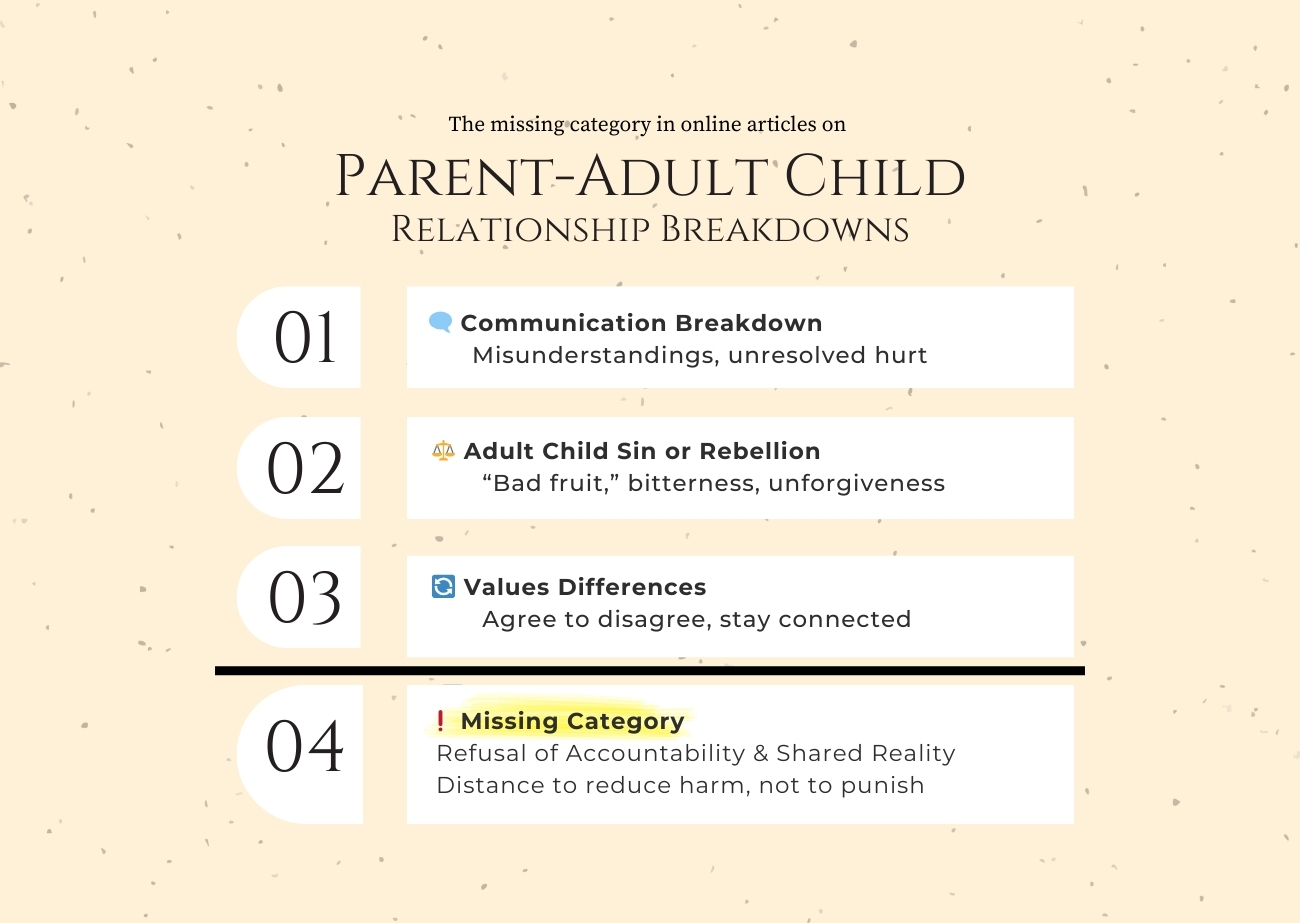
In the Focus on the Family conversation, adult child distance is sometimes framed as a matter of sin: rebellion, “bad fruit,” or living outside God’s principles. At other times, it is framed as a difference in values—something adults can simply “agree to disagree” about while remaining connected.
On their own, these are three very different categories.
-
Communication Breakdown due to misunderstandings and unresolved hurt
-
Sin implies moral failure and the need for repentance.
-
Values differences imply legitimate disagreement between adults with freedom of conscience.
The problem is that these categories are not clearly distinguished. Moral language and values language are blended together, often within the same discussion.
As a result, in this series, adult children are viewed with moral suspicion whenever reconciliation fails.
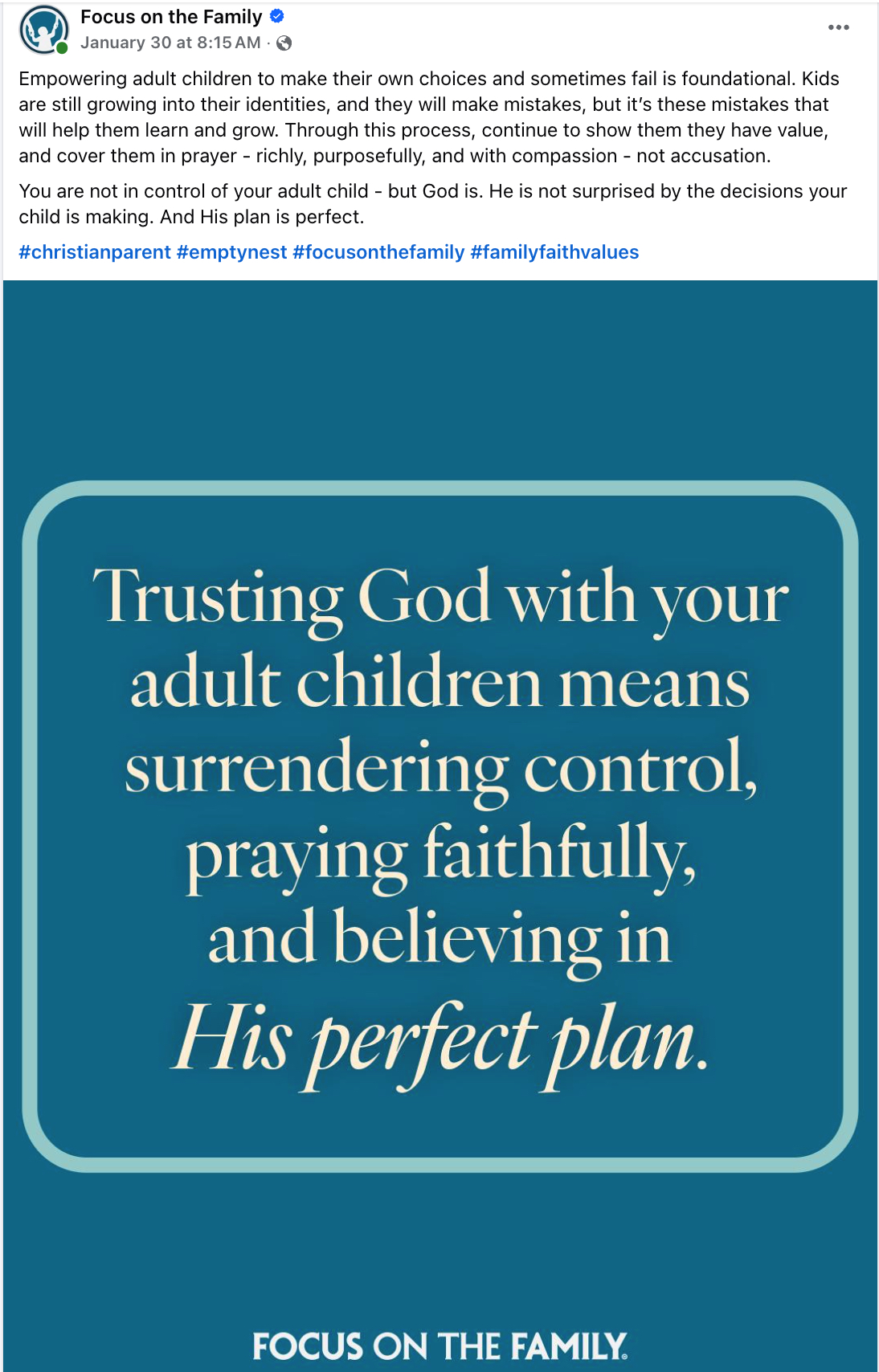
Click to enlarge: A Focus on the Family message encouraging parents to surrender control over adult children—while leaving key questions of accountability unaddressed.
This Focus on the Family social media post urges parents of adult children to surrender control, pray faithfully, and trust God’s perfect plan.
While the message emphasizes compassion and prayer, it does not address situations where adult children create distance due to their parents’ false accusations, denial of reality, or a parent’s refusal to accept responsibility. When accountability is omitted, spiritual language can unintentionally obscure the reasons some adult children step back to reduce ongoing harm.
This post is about that missing category.
For clarity: this discussion does not concern minor children being turned against a parent during custody disputes or co-parenting conflicts. For parental estrangement due to divorce, see 9 Types of Estrangement, and look at Type 3.
The Unexamined Assumption Behind Reconciliation Frameworks
Most reconciliation frameworks—pastoral and therapeutic alike—rest on an unspoken assumption: moral reciprocity.
That assumption looks like this:
If both parties listen long enough and humbly enough, recognition and repair will eventually follow.
This presumes:
-
that both parties can accept accountability for their behavior,
-
that actions are allowed to have consequences,
-
and that a shared reality is possible.
But what happens when accountability itself is refused?
What happens when one party listens but does not recognize harm, hears explanations but disqualifies them, and demands repair without accepting responsibility?
The Fourth Possibility That Goes Unnamed
What is missing from both the “sin” frame and the “values difference” frame is a fourth possibility:
The adult child is responding not to disagreement or rebellion,
but to a parent’s refusal of accountability for their own behavior and shared reality.
When this category is absent, estrangement discussions default—quietly but powerfully—to treating the adult child as the problem.
When Do Adult Children Feel Caught Between Honor and Safety?
Adult children do not experience deep moral and spiritual self-doubt at the beginning of conflict.
They experience it after sustained, good-faith efforts to communicate have failed.
Specifically, it emerges after a pattern like this:
1. They try to explain, not attack
They communicate calmly and concretely:
-
what happened,
-
why trust was damaged,
-
and what would need to change for relationship to continue.
They are not retaliatory. They are trying to be understood.
2. Their explanations are repeatedly dismissed
They are met with responses like:
-
“That’s not what happened.”
-
“You’re too sensitive.”
-
“That can’t be the reason.”
-
“You’re holding a grudge.”
-
“You’ve been influenced.”
Listening may occur—but recognition does not.
3. Repair is demanded without accountability
The adult children are urged to:
-
“move on,”
-
“forgive,”
-
“restore relationship,”
-
“stop punishing,”
without:
-
acknowledgment of harm the parent has caused,
-
ownership of actions,
-
or changes in in the parents’ behavior.
This is the turning point.
4. Moral language about guilt and obligation enters the conversation
Often through:
-
religious framing,
-
appeals to honor or forgiveness,
-
references to “bitterness,” “disrespect,” or “unforgiveness.”
At this stage, the adult child’s character becomes the focus—not the original harm.
5. The internal bind appears
Only then do adult children begin asking themselves:
-
Am I setting a boundary—or rejecting God’s principles?
-
Am I exercising discernment—or being unforgiving?
-
Am I responding to harm—or demonstrating “bad fruit”?
These questions do not arise from immaturity.
They arise from prolonged exposure to denial plus moral pressure.
When the Problem Isn’t Relational, but Moral
In some families, the problem is not a breakdown in communication. The parent listens, but they do not acknowledge the hurt. When the parent asks why the relationship has broken down, explanations are offered—but dismissed as implausible or an overreaction. Reconciliation is demanded by the parent, while accountability is avoided.
The sentence “That can’t be the reason for the estrangement” marks the point where reconciliation becomes impossible.
It signals:
-
a refusal to acknowledge cause and effect,
-
a refusal to accept responsibility,
-
and a refusal to share reality.
The adult child may explain clearly, calmly, and repeatedly why trust collapsed—only to be met with steady denial.
This sentence matters.
It marks the point where repair fails not because of anger or unforgiveness, but because reality itself is rejected.
Relational techniques cannot repair a moral refusal.
Why Distance Becomes Necessary
Continued contact under these conditions produces moral injury—where telling the truth leads to accusation and maintaining integrity becomes a liability. Distance is not punishment; it is containment.
The Focus on the Family series warns adult children not to “withdraw relationship as punishment.” That warning is important—when withdrawal is used as leverage.
But there is a crucial difference between:
-
withdrawal used to control another person, and
-
withdrawal used to preserve one’s own integrity.
In some families, continued closeness carries a predictable cost:
-
every interaction risks a new accusation,
-
intentions are reinterpreted as malicious,
-
explanations are treated as implausible,
-
and integrity itself becomes a liability.
In that context, distance is not hardness of heart.
It is containment.
Why Adult Children Are Blamed Instead
When reconciliation models fail, responsibility is often shifted onto the adult child. They are described as:
-
unforgiving,
-
influenced by therapy,
-
embittered,
-
rebellious,
-
or mentally ill.
These explanations protect the framework by preserving the belief that reconciliation is always possible—if only the adult child would try harder.
But they miss a simpler truth:
Some estrangements persist not because love fails, but because parental accountability is refused.
Over time, distance restores clarity and self-trust to the adult child—revealing that proximity was the problem.
This is not an argument against reconciliation.
It is an argument against coerced reconciliation.
Moral Injury: The Invisible Wound
This kind of estrangement produces moral injury, not just grief.
Moral injury occurs when a person is repeatedly placed in situations where:
-
doing the right thing results in punishment,
-
telling the truth leads to accusation or erasure,
-
and maintaining integrity threatens belonging.
Over time, the adult child begins to doubt:
-
their memory,
-
their judgment,
-
and their right to set boundaries at all.
When distance finally restores clarity, calm, and self-trust, that outcome tells us something important:
Proximity was the problem.
Power Does Not End at Adulthood
Pastoral frameworks often underestimate the enduring power differential between parent and child—even when the child is an adult.
Parents often retain:
-
narrative authority (“that’s not how it happened”),
-
moral authority (“honor your parents”),
-
and community credibility (“everyone believes me”).
When that power is combined with a refusal of accountability, reconciliation language can become a tool of pressure rather than healing.
What a More Adequate Framework Would Acknowledge
A framework capable of addressing these cases would need to recognize that:
-
accountability is a prerequisite for reconciliation,
-
listening without recognition is insufficient,
-
repentance does not guarantee restored access,
-
and distance can be an act of integrity, not punishment.
And most importantly:
Some losses occur not because love fails, but because truth is refused.
A Final Word
This is not an argument against reconciliation.
It is an argument against coerced reconciliation.
It is not a rejection of compassion.
It is a refusal to equate compassion with erasing self-respect and taking on guilt that isn’t yours.
For some adult children, estrangement is not rebellion.
It is the last remaining way to live in reality.
 :
:
 :
: Buy PDF