
Parent-Adult Child Estrangement: 9 Types
Who pulled away—and what happened first?
Estrangement is the painful breakdown or distancing of a family relationship, and it can happen suddenly or develop over many years for many different reasons. Some adult children pull back justly or unjustly. Some parents withdraw in disapproval or under outside influence. Some parents and children go “no contact.” Others maintain “low contact” but still interact. Some ruptures are mutual, and some are shaped by toxic behavior, manipulation, or abuse.
Before assigning blame, I suggest asking four questions:
- Who originally made the relationship unsafe or unsustainable?
- Who finally reduced or ended contact?
- What attempts at repair came first?
- Was outside involvement coercive—or genuinely helpful?
The person who finally says “no contact” is not necessarily the person who caused the estrangement.
See the case studies at the bottom for examples of all nine types.
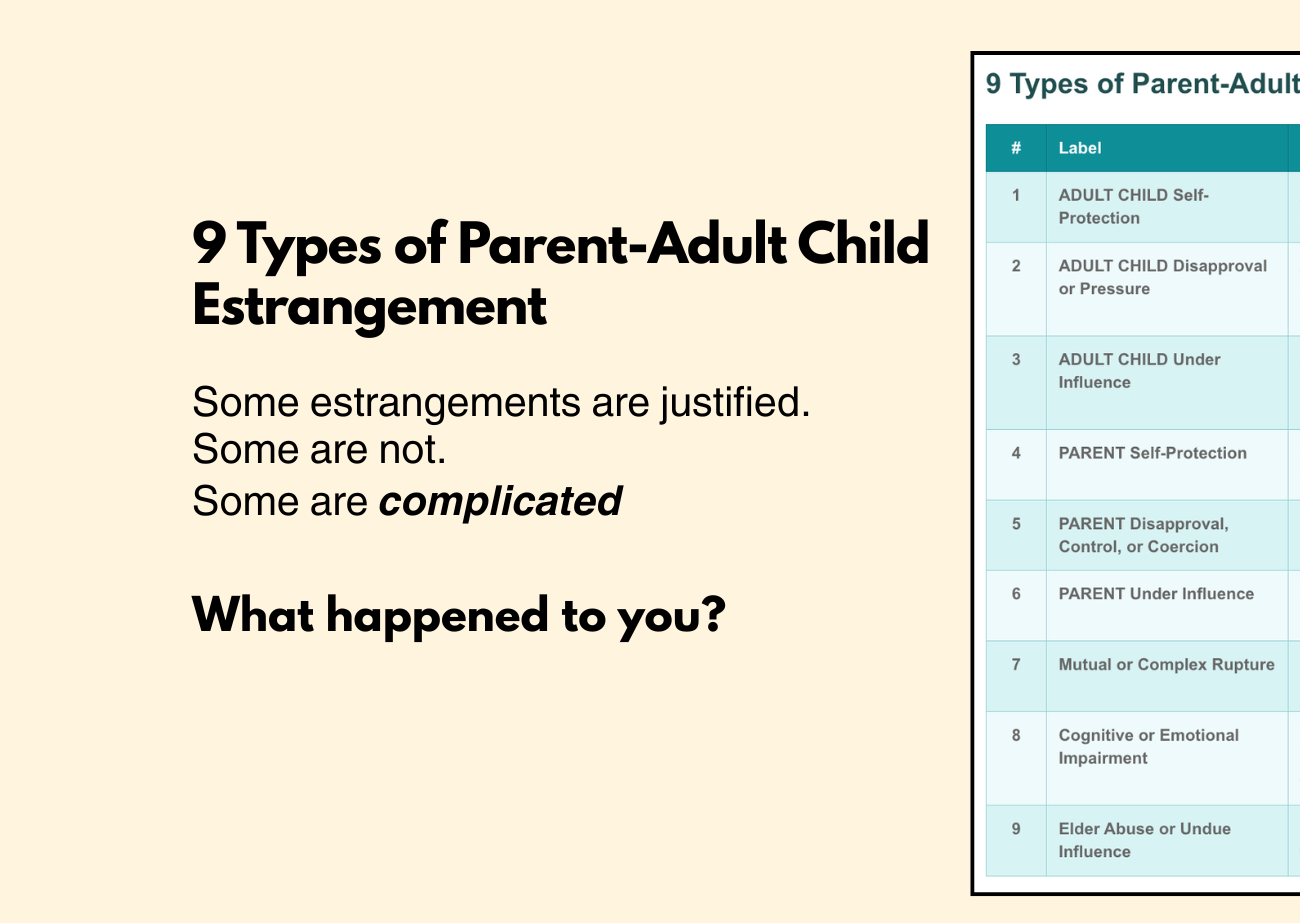
9 Types of Parent-Adult Child Estrangement
| # | Type | Meaning |
|---|---|---|
| 1 | ADULT CHILD Self-Protection | The adult child withdraws from abuse, coercion, chronic humiliation, false accusations, intrusive control, or repeated boundary violations. Protection may also include safeguarding a spouse or children. |
| 2 | ADULT CHILD Disapproval or Pressure | The adult child withdraws to punish, shame, gain leverage, or pressure the parent to adopt particular moral, religious, political, or lifestyle views. |
| 3 | ADULT CHILD Under Influence | The adult child withdraws under coercive influence from a spouse, high-control religion, online ideology, therapist, or alienating parent. Receiving healthy support or therapy is not automatically undue influence. |
| 4 | PARENT Self-Protection | The parent limits contact because of violence, intimidation, theft, exploitation, addiction-driven chaos, or persistent false accusations by an adult child. |
| 5 | PARENT Abandonment, Disapproval, or Control | The parent deserts, neglects, replaces, rejects, punishes, shames, or pressures the child. The parent may demand conformity or simply refuse to maintain a meaningful relationship. |
| 6 | PARENT Under Influence | The parent withdraws because a new spouse, relative, religious authority, advisor, caregiver, or other person distorts the parent’s view of the adult child. |
| 7 | MUTUAL or Complex Rupture | Both sides contribute through escalation, triangulation, untreated addiction, shame, avoidance, emotional immaturity, instability, or unresolved conflict. |
| 8 | Cognitive or Emotional Impairment | Dementia, cognitive decline, paranoia, distorted reality, or severe emotional instability changes behavior, judgment, and relationship safety. |
| 9 | Elder Abuse or Undue Influence | A vulnerable parent is isolated, manipulated, financially exploited, or prevented from communicating freely with trusted family members. |
Not Every Estrangement Looks the Same
Estrangement may involve low contact, supervised contact, an agreed temporary pause, emotional distance while remaining civil, indefinite no contact, or permanent separation. Reconciliation does not always mean restoring unrestricted access or returning to the former relationship.
What Happened When Repair Was Attempted?
This may be the most revealing question. Did someone listen, acknowledge harm, respect boundaries, apologize, and change? Or did they deny events, rewrite history, retaliate, recruit allies, or insist that the injured person was the real problem?
Healthy repair requires more than love or good intentions. It requires truth, safety, accountability, freedom from coercion, and trustworthy behavior over time. Sometimes reconciliation becomes possible. Sometimes safer, limited contact is the healthiest outcome. And sometimes distance remains necessary.
One important example of Type 1: Adult Child Self-Protection is estrangement that follows harsh, authoritarian religious parenting. In Focus on the Family and Estrangement: Did James Dobson’s Parenting Advice Help Cause It?, I document Dobson’s teachings about first-time obedience, “willful defiance,” parental control, and “breaking the will”—and ask whether those teachings helped damage some of the very relationships Focus now urges parents to repair.
Four Questions Before You Judge an Estrangement
- Who originally made the relationship unsafe or unsustainable?
- Who finally reduced or ended contact?
- What attempts at repair happened first?
- Is the relationship unsafe because of abuse, or simply painful because of ordinary conflict?
Illustrative Case Studies of the 9 Types
Rachel, age 52: adult son caught in drugs, lying. Parent needs self-protection
At 52, Rachel loves her 27-year-old son deeply, but over the past several years his life has become increasingly chaotic. He lies easily, disappears for days, asks for money under false pretenses, and blames others when confronted. More than once, he has stolen from family members and then denied it. Rachel has tried compassion, second chances, rides to appointments, and practical help, but the pattern continues. Eventually, she limits contact and stops giving him access to her home and finances for self-protection (Type 4). At the same time, her son also pulls away, not from healthy independence but from addiction, shame, and avoidance, creating a more complex pattern (Type 7). Addiction often produces shame and avoidance, which is why both parties may gradually withdraw. Relationship repair would require sobriety, honesty, accountability, treatment engagement, and safer boundaries. Love may remain strong, but trust cannot be rebuilt on denial.
Elaine, age 62: “Leave and Cleave” used to justify cutting off a loving mother
At 62, Elaine never expected to become estranged from her 35-year-old son. She had been a loving, steady mother through his childhood and into adulthood. She welcomed his wife warmly, tried to be respectful of their marriage, and made real efforts not to interfere. But after they joined a church that strongly emphasized a distorted version of the “leave and cleave” doctrine, things began to change. Her son and daughter-in-law started treating ordinary contact with Elaine as disloyalty to the marriage. Invitations were declined, phone calls grew tense, and normal maternal interest was recast as intrusion. Over time, they cut her off almost entirely, convinced that closeness with his mother threatened his spiritual duty to “cleave” to his wife. This kind of estrangement fits adult child under influence (Type 3), because the rupture was shaped less by Elaine’s actual behavior and more by outside religious teaching and marital pressure. Relationship repair would require freedom from that false spiritual framework, clearer boundaries that distinguish love from interference, and a more mature understanding that healthy marriage does not require rejecting a loving parent. Sometimes churches and Christian books teach adult children to cut ties with parents when they marry, a misunderstanding of the “leave and cleave” doctrine.
For more, see
-
- When “Leave and Cleave” Causes Estrangement and a graph that shows the surprising growth of the topic
- When Divorce Doctrine Causes Estrangement in Multiple Generations, and
- When Divorce for Adultery, Abuse, Abandonment Causes Estrangement in Highly Religious Families
Marisa, age 50: parental alienation, trauma, and estrangement after divorce
At 50, Marisa finalized a divorce she never wanted but needed. Soon she faced estrangement on several fronts. Her adult son cut contact for self-protection (Type 1) after years of tension, chaos, and feeling caught in the middle. Her daughter pulled back under influence (Type 3) from the other parent’s alienation efforts and loyalty demands during the divorce. Marisa also stepped back from her own mother for self-protection (Type 1) because of manipulation, guilt, and false accusations. In some relationships, the rupture was simply complex (Type 7)—hurt, mistrust, and years of unresolved conflict on both sides. Relationship repair usually requires truth, safety, and change: honest naming of harm, respect for boundaries, freedom from outside pressure, repentance where needed, and a pattern of trustworthy behavior over time. Not every estrangement should end quickly—or at all.
Sarah, age 41: repeated failed repair attempts before “no contact”
At 41, Sarah had spent nearly twenty years trying to improve her relationship with her mother. She explained how criticism and public humiliation affected her, suggested counseling, wrote letters, and repeatedly asked for simple boundaries. Each conversation ended the same way. Her mother denied events, accused Sarah of being oversensitive, reminded her of everything she had sacrificed, and insisted Sarah was the real problem, maybe even mentally ill. Eventually Sarah stopped trying. She limited contact and later chose no contact for self-protection (Type 1) after repeated repair attempts failed. Her mother described the estrangement as cruel abandonment and a refusal to “honor your parents,” while Sarah experienced it as the last remaining way to protect her emotional health. Relationship repair would require genuine accountability, respect for boundaries, acknowledgment of past harm, and consistent behavioral change over time.
Lena age 45: domestic violence and caretaker parentification
At 45, Lena lives with disabilities caused by years of wife battering. Now divorced, she loves her two daughters deeply, but trauma has strained every bond. Her youngest, forced into a caregiving role since age 10, now pulls away from exhaustion and self-protection (Type 1). Her oldest, married and long out of the house, keeps her distance too, shaped by old family chaos and perhaps disapproval (Type 2) that her mother hadn’t left earlier. Meanwhile, Lena’s own abusive mother has cut her out of the inheritance, using estrangement as disapproval or control (Type 5) and punishment. Relationship repair with the daughters would require relief from parentification, outside support, honest grief work, accountability where harm occurred, and safe, realistic boundaries. Love helps, but love alone does not repair damaged trust.
James age 47: parent with Alzheimers, elder undue influence
At 47, James had always been close to his mother. For years, she was one of the safest people in his life. But when his mother developed Alzheimer’s, the relationship changed. She became angry, suspicious, and began making false accusations against him. Outside the neurologist’s office, she often presented so well that other people did not see the decline. Instead, she gained “friends” who fed her paranoia, repeated her suspicions, and even urged her to remove her son from her HIPAA and legal documents. James felt crushed, because the mother he loved seemed to be slipping away while outsiders treated him like the threat. This kind of estrangement is shaped by cognitive or emotional impairment (Type 8) and can overlap with undue influence (Type 9) when vulnerable adults are manipulated. Relationship repair would require clear medical documentation, trustworthy third-party oversight, protection from exploitation, and safer ways to stay connected where possible.
Patricia, age 74: widowed mother pulled away under the influence of a new husband
At 74, Patricia had been widowed for several years when she remarried. Her adult daughter, now 43, had been loving, involved, and practically helpful through her mother’s widowhood—checking in regularly, helping with appointments, and assisting with paperwork when needed. But after the new marriage, the relationship changed. Patricia’s new husband began telling her that her daughter was too involved, too opinionated, and “just after the money.” Ordinary concern was reframed as control. Questions about finances were treated as greed. Offers to help were recast as manipulation. Over time, Patricia began repeating his language, growing suspicious of her daughter’s motives and pulling away emotionally and practically. This kind of estrangement fits parent under influence (Type 6), because the rupture was shaped largely by the new spouse’s narrative control rather than the daughter’s actual behavior. It can also overlap with elder abuse or undue influence (Type 9) if the husband is isolating Patricia, gatekeeping access, or steering financial and legal decisions for his own benefit. Relationship repair would require clearer outside perspective, careful attention to possible exploitation, trustworthy third-party oversight where needed, and renewed space for direct, reality-based contact between mother and daughter.
 :
:
 :
: Buy PDF