
J.A.D.E., Gray Rock, and How to Stop Feeding a Toxic Person’s Need for Conflict
Toxic people crave arguments. They love to challenge you, attack you, and pull you into endless back-and-forth—because it keeps them at the center of attention. They don’t care if it’s negative attention. If they can get you upset, defensive, or explaining yourself for an hour, they consider it a win. Seeing you lose your composure can feel like triumph to them. That’s why two simple tools can be lifesaving in high-conflict relationships: JADE and Gray Rock.What Is JADE?
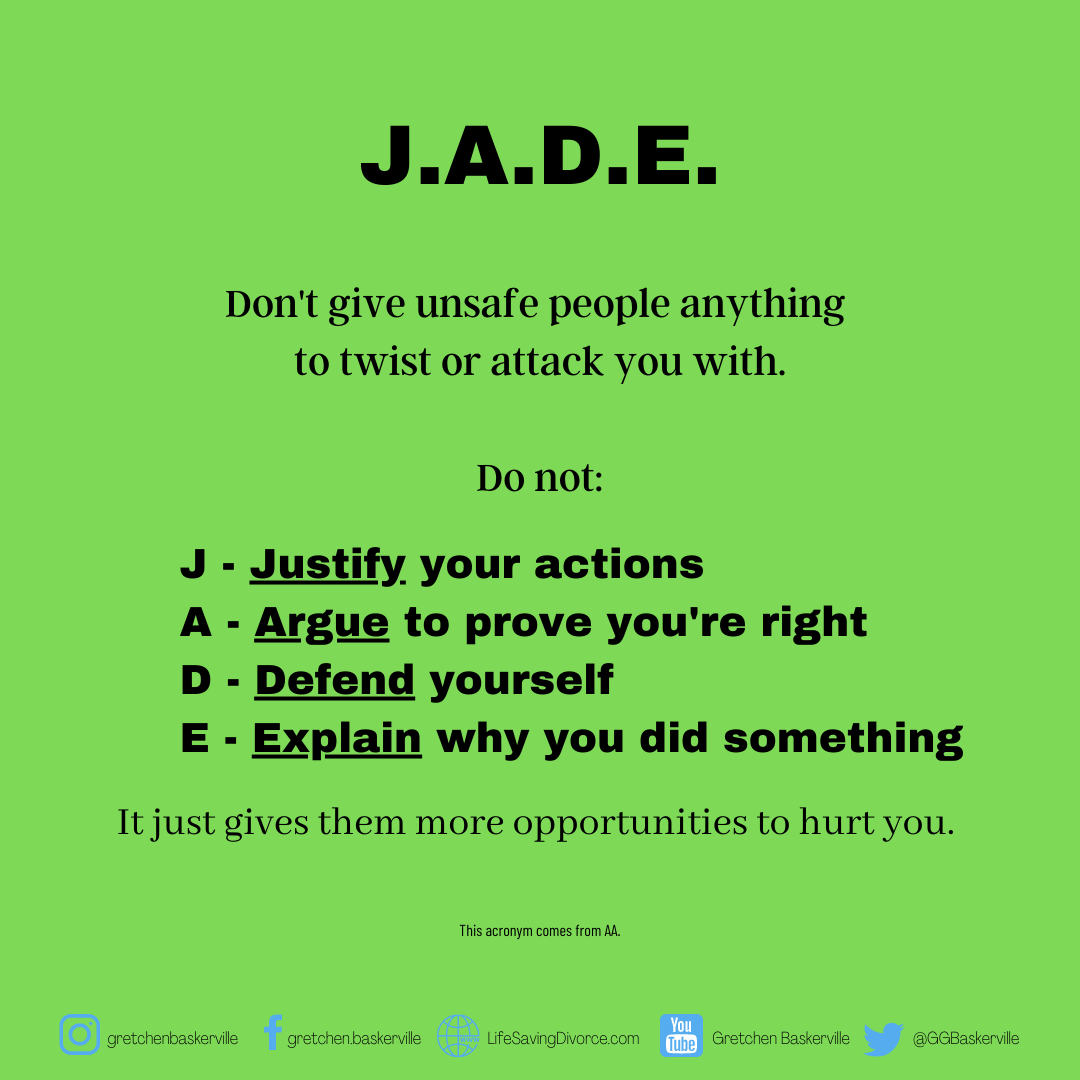
JADE is an acronym to remind you not to give unsafe people anything to twist or attack you with. Do not:- J — Justify your actions
- A — Argue to prove you’re right
- D — Defend yourself
- E — Explain why you did something
How Unsafe People Snare You
Sometimes toxic people make false accusations simply to pull you into conflict. That’s the point: to provoke you, hook your emotions, and get you defending yourself.
If you are not legally required to communicate with them, the wisest response is often no response at all. You do not have to attend every argument you’re invited to. You can block them, unfollow them, change your number, and protect your peace.
Silence can be wisdom when you are safe and free to disengage.
But What If You Must Respond Legally?
Many survivors are not free to cut off communication completely. If you share minor children with a destructive ex-spouse, the court may require some level of contact.
This is where BIFF communication can help. Attorney and conflict-resolution expert Bill Eddy recommends keeping responses:
- Brief
- Informative
- Friendly
- Firm
The goal is not emotional connection. The goal is documentation, clarity, and reducing conflict.
For example, imagine your ex falsely claims you failed to pick up your child from school. This is a specific parental responsibility and it is best to answer. A BIFF-style response might look like this:
“What you describe did not occur. I picked up Jordan from school at 3:05 p.m.”
That’s it.
No long explanations. No defending your character. No counterattacks. No trying to convince the other person you are a good parent.
An unsafe ex might send a message attacking your motives. Attacks on motives can be ignored.“You only want more parenting time so you can get more child support and make me suffer.”You do not have to answer these. You can just ignore it. But a BIFF-style response could be:
“I disagree with your characterization. My focus is Jordan’s wellbeing and maintaining a consistent parenting schedule.”Short. Calm. No defending. No counterattacking. No emotional spiral.
Unsafe people often thrive on JADE-ing: getting you to justify, argue, defend, and explain. The more emotional your response becomes, the more material they may use against you later.
Instead, keep your communication calm, factual, and court-friendly.
If a judge, mediator, parenting evaluator, or attorney later needs additional details, that information can be provided through the proper channels. Save your evidence and documentation for the people who actually matter legally.
This is one reason many attorneys and parenting professionals encourage parents to use co-parenting apps that preserve written communication and timestamps. In Parenting Plan Idea Workbook, Lisa Wilson and I strongly recommend using co-parenting apps because they help document conversations and reduce disputes over what was said or received.
One Mom’s Battle has also provided excellent examples of short, neutral “canned responses” that model this kind of communication well.
Your goal is not to persuade the toxic person to suddenly become reasonable.
Your goal is to:
- communicate clearly,
- document appropriately,
- protect your credibility,
- and then move forward with your life in peace.
What Is Gray Rock?
Gray Rock is a strategy for dealing with a toxic or high-conflict person by becoming emotionally uninteresting. It’s most useful when contact is unavoidable (for example, shared custody). Gray Rock often looks like:- Only communicating in writing (text/email) so there’s a paper trail.
- Short answers about logistics (no commentary).
- No emotion—no anger, defending, explaining, or “setting the record straight” in a long message.
- If needed, referencing the court order: “I will abide by the court ruling of Nov. 5.”
- Practicing calm, neutral phrases like: “Your opinion is noted. I do not see that event the same way you do.”
Yellow Rock: Gray Rock With Basic Courtesy
Yellow Rock is like Gray Rock, except it adds basic pleasantries—“Hello,” “Please,” “Thank you”—while still staying neutral and non-reactive. It can help you look reasonable to outsiders while still protecting your emotional boundaries.JADE: What Do You Do in Court or With a Mediator?
One woman in my private Facebook group asked whether she should avoid JADE in court. My response was this:This is important. When you are around your ex-spouse—or around people who are on your ex’s side—it is often best to follow JADE. Do not justify, argue, defend, or explain your actions if you think they will use it against you. Get some distance. They may not be safe right now.
BUT WHEN YOU ARE IN COURT, in front of a neutral person like a mediator or a judge, you need to stand up for yourself, show your evidence, defend your decisions, and explain your answer to accusations. Do this with composure and self-control—no emotional spiraling. Just the facts.That’s why documentation matters. If you’re in a high-conflict divorce, see: 12 Ways to Document and Protect Yourself in a High-Conflict Divorce.
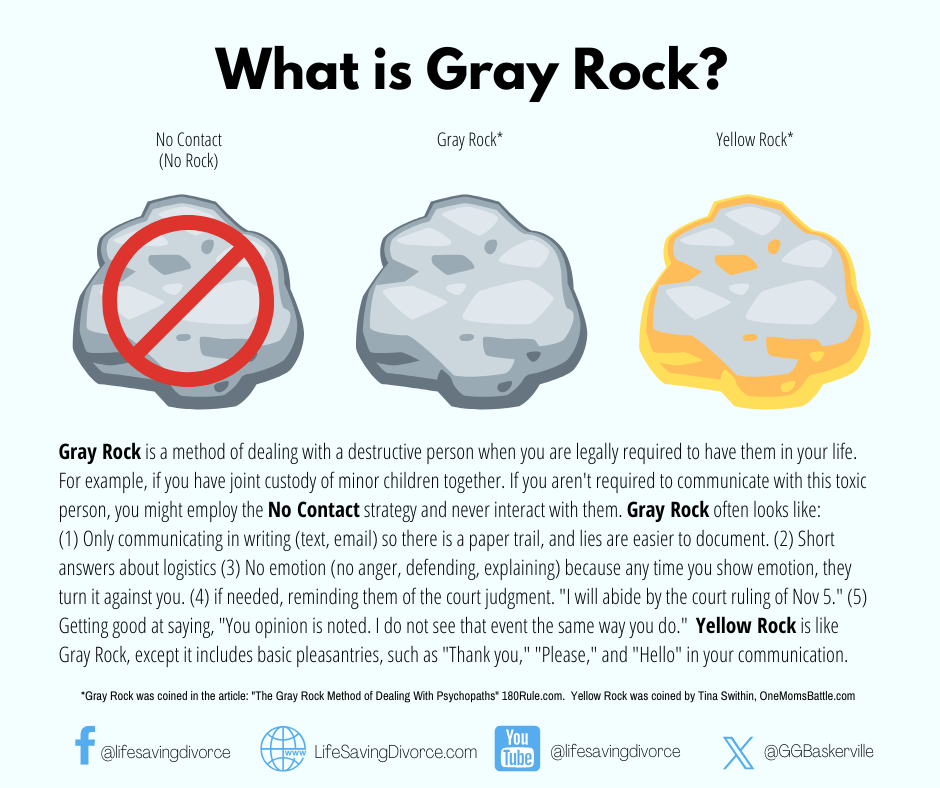
Gray Rock helps reduce conflict when contact is unavoidable. No Contact protects through separation. Yellow Rock adds courtesy to neutral communication.
 :
:
 :
: Buy PDF