

Will I Find Love Again After Divorce? Remarry or Stay Single
If you type “will I find…” into Google, the first suggestion is “love.” Many divorced people aren’t just asking if they’ll feel better. They’re asking if they’ll ever love again.
Wanting love and belonging is deeply human. But getting married again? Not as much. Some people want to remarry; some do not. (footnote 1)

Myth #1: Everyone Wants to Remarry
Not true. Some people want to remarry; others do not. Many people—especially those divorcing later in life—don’t want to run the risk of another bad marriage and prefer the freedom to make their own plans. (footnote 2)
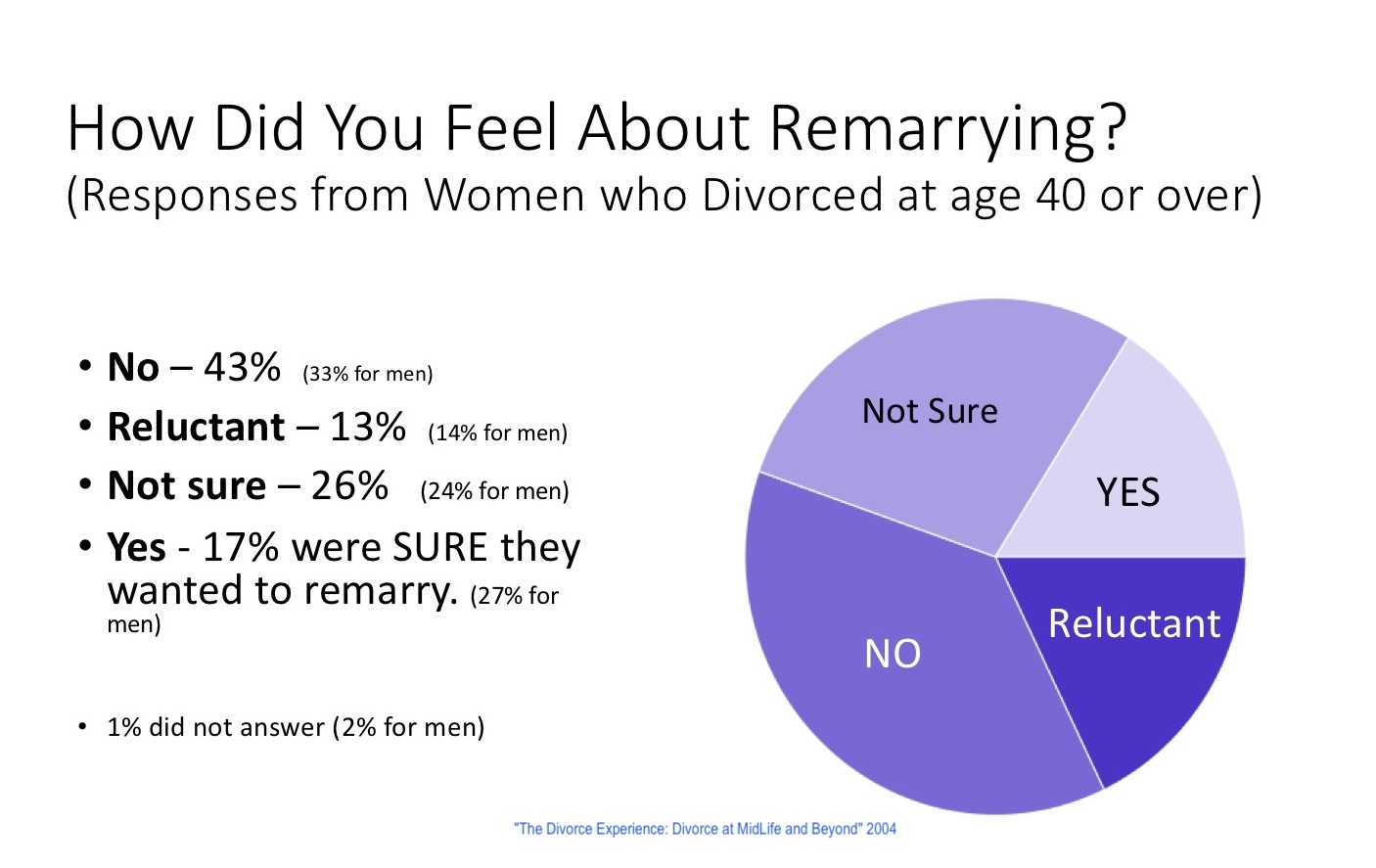
For people who divorced when they were age forty or over, many prefer to stay single (footnote 3)
Nearly half of women in this age group do not want to remarry. Men are much more motivated to find a new spouse than women are: 27% were sure they wanted to remarry (compared to only 17% of women who said the same). As a group, women are very wary (“once burned, twice shy”), and so it’s not surprising that we find that the men’s remarriage rate is twice as high as women’s.[4]
Myth #2: Second Marriages Always Fail (and You’ll Be Just as Unhappy)
It’s true that second marriages have a higher overall divorce rate than first marriages. But that statistic lumps all remarriages together.
Research by Hawkins and Booth followed people in long-term unhappy marriages and found that those who divorced were better off on average than those who stayed—whether they remarried or remained single. (footnote 5)
In a study of people in unhappy marriages by the Institute for American Values found that more than 8 in 10 of those who divorced due to domestic violence and remarried were happier.
Learn more about what a life-saving divorce means here: What Is a Life-Saving Divorce?
Myth #3: You’ll Never Remarry, and You’ll Be Lonely Forever
I was single for more than twenty years after my divorce. Once I got past the first couple of years, those years were rewarding, purposeful, and meaningful.
Healthy community matters. For more on building support, see chapter 8 (Safe Churches and Friends) in The Life-Saving Divorce.
If you’re wondering what life after divorce can look like, start here: Life-Saving Divorce: Introduction (audio and transcript) Or hear from 93 people telling real stories of life after divorce.
Are Christians Happy After Divorce?
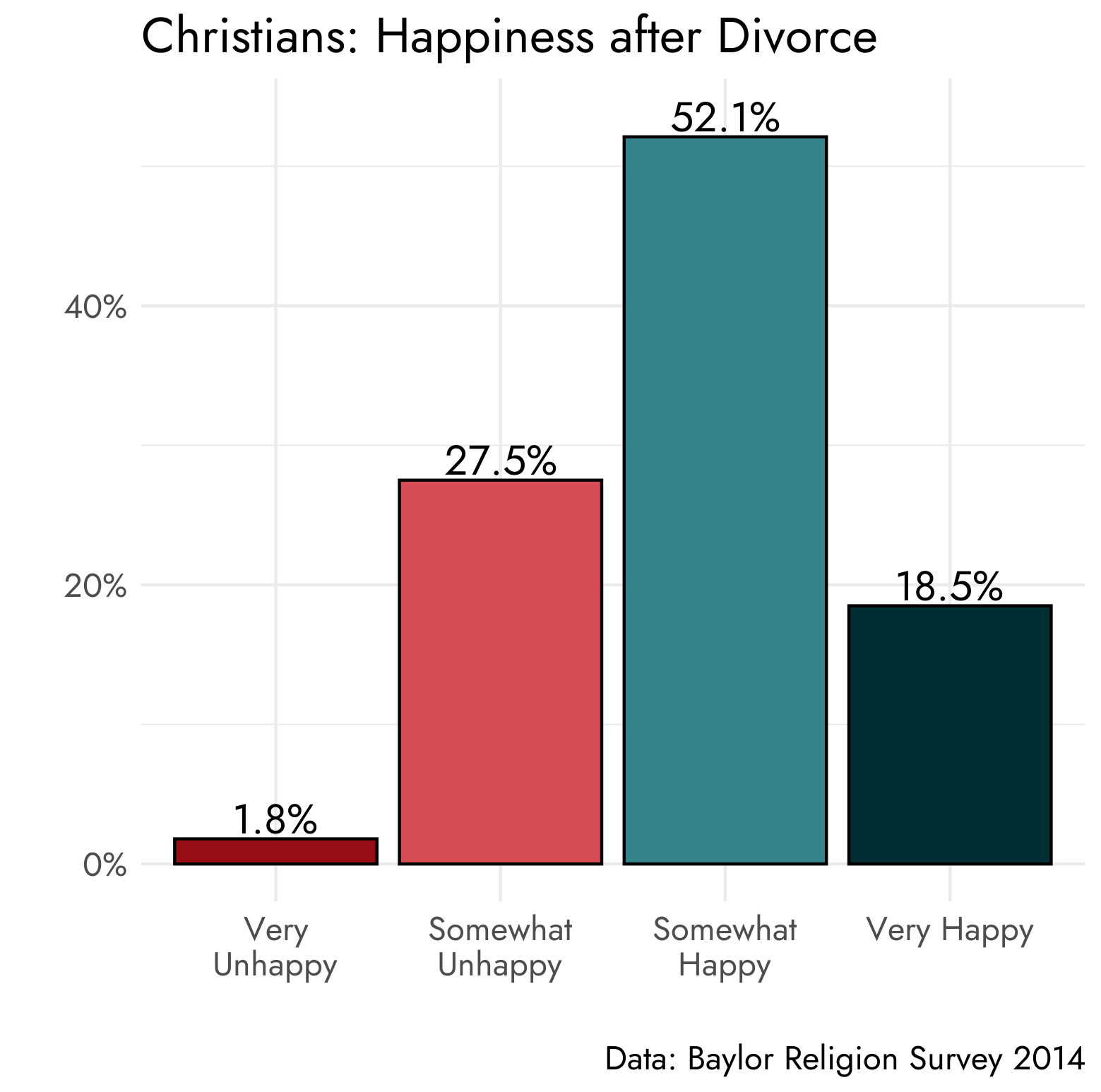
Yes, Baylor University (Baylor is the largest Baptist university in the world) has collected data that indicate that 7 in 10 Christians are happy after divorce. (Five in 10 are “somewhat happy” and 2 in 10 are “very happy” after divorce.)
Footnotes:
[1] M. D. Bramlett and W. D. Mosher, “Cohabitation, Marriage, Divorce, and Remarriage in the United States,” Vital and Health Statistics 23, no. 22 (2002): 78.
[2] Valerie Schweizer, “The Retreat from Remarriage, 1950-2017,” Family Profile 17 (2019), accessed 12/12/19, https://www.bgsu.edu/ncfmr/resources/data/family-profiles/schweizer-retreat-remarriage-fp-19-17.html.
[3] Xenia P. Montenegro, “Divorce Experience: A Study of Divorce at Mid-Life and Beyond,” AARP The Magazine (2004), A-23, accessed 12/18/19, https://assets.aarp.org/rgcenter/general/divorce.pdf.
[4] Schweizer, “The Retreat from Remarriage.”
[5] Daniel Hawkins and Alan Booth, “Unhappily Ever After: Effects of Long-Term, Low-Quality Marriages on Wellbeing,” Social Forces 84, no. 1 (September 2005): 464. The authors of this study mention an earlier study (Waite et al., 2002) that got a lot of attention from religious organizations. That study used only one item to determine marital quality, and it said that two thirds of unhappily married couples who stayed married for 5 more years were happier. The Hawkins and Booth study was different. In addition to being much more thorough, it specifically focused on people who had been married (very unhappily) for more than 12 years; it used several items to measure marital quality, and it determined that those who divorced from these chronically long-term at-risk marriages were significantly happier after divorce than they had been before.
[6] Ibid., 464.
 :
:
 :
: Buy PDF