
Forgiveness Is Complex because Abuse, Betrayal, and Neglect Are Complex
Let’s say your spouse slaps you on the face. If you were confident it was accidental-perhaps he/she was swatting a fly and missed-that would be easy to handle. But in the case of abuse, it’s not accidental. There is a tangle of actions, behaviors, words, and attitudes. A slap is more than a slap, even though they may deny it.
With abuse there’s a build-up of tension: a threatening glance, word, or gesture; a demand; unspoken expectations of certain conduct; a promise of punishment. The atmosphere is dangerous. You feel anxiety building.
After the slap, the blame is put on you. You are told it was just an accident, or it wasn’t as bad as you said, or you deserved it. It didn’t leave a mark so it’s no big deal. You’re over-reacting and being hysterical. Later your spouse apologizes and promises better behavior, but within days, the actions don’t match the words.
Maybe it’s not a slap this time, but the pattern of built-up tension repeats.
Abuse and betrayal are complex. That’s why forgiveness requires untangling your story and unwinding all the injuries that accompanied the slap.
Forgiveness doesn’t necessarily mean dropping charges against the batterer, or ending divorce proceedings, or foregoing a restraining order. You can forgive and keep your boundaries up: even removing this person from your life by going “no contact,” meaning you have no interaction with the other person, unless required by the court on certain topics.
No one can tell you that you must forgive on their timeline. That’s an indication they don’t really understand their God-given duty to protect the vulnerable. Often survivors are given the impression their church doesn’t think they were seriously injured or have a legitimate grievance. And even if they do, it they should be able to “get over it” or “snap out of it.”
My interviews include many stories of people who were pressured by their pastor or biblical counselors to forgive. But how is that really forgiveness? Can you really forgive long before you’ve identified the extent of the offense? It needs to come from the heart when you decide to do it.
Those who encourage you to smooth things over too quickly, before an inventory of the damage, hurt, and pain has been done, are dishonoring the suffering you experienced. They are sweeping the sin under the carpet and not addressing it. Long-term abuse and betrayal must be fully explored, the anger expressed, and the losses mourned by you and the community.
Forgiveness for Trauma Is on Your Timetable, No-One Else’s
Forgiving an abuser isn’t easy. It is not on par with forgiving someone who accidentally rear-ended your car or unintentionally broke your grandmother’s antique wedding crystal. In the case of long-term, systematic abuse during a marriage, regardless of the abuser’s intentions, it takes a long time to process all the pain.
That’s because it is not a series of “accidents.” There is a complex pattern of manipulation and betrayal-from someone who ought to have loved you-that goes with the injury and makes the injury exponentially worse.
In many interviews, I heard stories of Christian friends applying coercion to make the abuse victim forgive on the spot-often in the form of threats or messages saying God won’t forgive you if you don’t forgive (implying that your forgiveness must be on their timetable).
But let’s look at the Bible. It’s interesting to notice that we have no evidence that Jesus forgave those who plotted to kill him, attempted to trap and trick him, told lies about him, and smeared his character, in real time.
These “forgive and forget” messages keep the vulnerable spouse confused and isolated. The victim is told to stay silent, not to tell their story. If they do tell it, they are accused of not “letting it go.” So the healing process is shortchanged.
They need to talk, to be believed, to identify the abuse and the abuser, and to get support in the form of empathy and outrage, as well as comfort and care. When a person is forced to “forgive and forget,” they get the message that the damage done to them is minor, that they are over-reacting and whiney, or that they don’t have the right to speak up or ask for restitution or get to safety.
The victim of abuse who isn’t believed or taken seriously may give up trying. They resign themselves to being trapped with the abuser. If it is not a safe and loving marriage, the abuse is swept under the carpet. The victim is voiceless and may feel they have no choice but to obey the abuser.
Their marriage is more like kidnapping, slavery, or human trafficking than it is like a godly union. No wonder depression and suicidal thoughts are pervasive in these situations.
💔 Forgiveness isn’t always the fix we (and our church leaders) hope it is.
A 2-year study* of 72 newlyweds found that being “more forgiving” helped only when the partner’s behavior was mostly kind and respectful. But when a partner frequently acted in hurtful or demeaning ways, highly forgiving spouses actually became less satisfied and saw their problems worsen.
This research echoes what I explain in The Life-Saving Divorce: forgiveness can’t repair a destructive marriage. True reconciliation requires real change and safety. Forgiveness without repentance often traps people in ongoing harm.
If your spouse’s “bad days” are constant, forgiving more won’t heal the relationship—it may just help them keep mistreating you.
Victims of spousal abuse and betrayal need to talk, to be believed, to identify the abuse and the abuser, and to get support in the form of empathy and outrage, as well as comfort and care. When a person is forced to “forgive and forget,” they get the message that the damage done to them is minor, that they are over-reacting and whiney, or that they don’t have the right to speak up or ask for restitution or get to safety.
The victim of abuse who isn’t believed or taken seriously may give up trying. They resign themselves to being trapped with the abuser. If it is not a safe and loving marriage, the abuse is swept under the carpet. The victim is voiceless and may feel they have no choice but to obey the abuser.
Their marriage is more like kidnapping, slavery, or human trafficking than it is like a godly union. No wonder depression and suicidal thoughts are pervasive in these situations.
- * McNulty, James K. “Forgiveness in Marriage: Putting the Benefits into Context.” Journal of Family Psychology 22, no. 1 (2008): 171–175. https://doi.org/10.1037/0893-3200.22.1.171.
You can forgive and still tell your story
Many people who have endured significant neglect, abuse, or betrayal are silenced and accused of gossip or slander. They wonder, “Am I sinning against my ex-spouse by telling my story (which makes my ex look bad)?”
The answer is no. Your story doesn’t make them look bad: Their own sinful behavior is what makes them look bad. It is not a sin to tell your story, to identify the abuse and the abuser, to ask for empathy, to want support, and to put responsibility where it belongs. If you are telling the truth, you are not slandering.
Slander is a legal term:
To slander someone, you have to meet three criteria. You have to be (1) telling an untruth, (2) which you know is not true (or should have known wasn’t true), and (3) passing it off as truth with the intent of harming the other person. In other words, if your story is true, it is not slander.
Truth is the best defense against slander.
Forgiveness as Part of Trauma Recovery
Forgiveness starts by retelling your story, recounting the offenses and/or wounds, and acknowledging the damage that the person caused: the broken trust, the physical, emotional, sexual, and financial injuries. Many times, the victim needs to identify each part of the trauma and speak to other survivors about the horror of what was done to them. It requires righteous indignation, rage, and contempt for the evil.
And if we’re honest, forgiveness is not a one-time event. As time passes, new memories of betrayals come up in different forms. Those injuries too must be acknowledged, grieved, and denounced as evil.
In some cases, the perpetrator can be required to make restitution. Sometimes not. God knows your heart. He knows your motives. But if that anger is eating you up and sucking life out of you, affecting all your good relationships, it may be best to release it. Forgiveness is for us, not for the offender. Forgiveness sets us free.
| Forgiveness is not… | Forgiveness is… |
| Forgiveness is not letting the offender off scot-free. | Forgiveness is holding the offender responsible, including requiring reparations and accepting the legal consequences of their actions. Forgiveness wants repentance and compensation, if possible, not revenge. |
| Forgiveness is not saying the abuse, cheating, sexual immorality, and addictions are okay. | Forgiveness is saying that the abuse, cheating, and betrayals are wrong and destructive, and there are consequences for the offender, such as the loss of trust and often the loss of the marriage. |
| Forgiveness is not acting as if it never happened. | Forgiveness is saying it happened, and it shouldn’t happen again. |
| Forgiveness is not refusing to look at the offense. It is not sweeping the injury under the carpet or refusing to see the damage done.[3] | Forgiveness is looking at the full damage and expressing the horror and rage. It is to name the injuries and express your anger/sadness/grief aloud. It is speaking about the unspeakable. |
| Forgiveness is not saying “forgive and forget.” | Forgiveness does not require forgetting. Forgiveness doesn’t erase the offender’s guilt or wipe out the consequences for the offender.
Even if you have forgiven a person, you can still divorce them. Forgiveness doesn’t give them a clean slate or a fresh start to hurt you all over again. |
| Forgiveness is not a one-time event. | Forgiveness is a long process. As you tell your story and think about the past, you will uncover some pain or hurt you hadn’t seen before. You may have to forgive various parts of the abuse/betrayal. |
| Forgiveness is not becoming friends again, trusting again, or reconciling again. It does not require you to trust this person again, or to befriend them, or even speak to them ever again. It doesn’t mean answering their letters, emails, voicemails, or messages. | Forgiveness is permission to protect and distance yourself. |
| Forgiveness is not saying, “We’ll go back to the same warm feelings we had before the betrayal.” | Forgiveness is facing the truth about the pain and injury. It means staying away from a dangerous person if possible. In some cases, it might include cooperating with law enforcement to keep this person from injuring others. |
If you wonder where these teachings come from, they are right in the Bible. The Bible says we are to get away from abusers, not to associate with them, not even to eat with them. So it must be possible to love, forgive, and walk away.
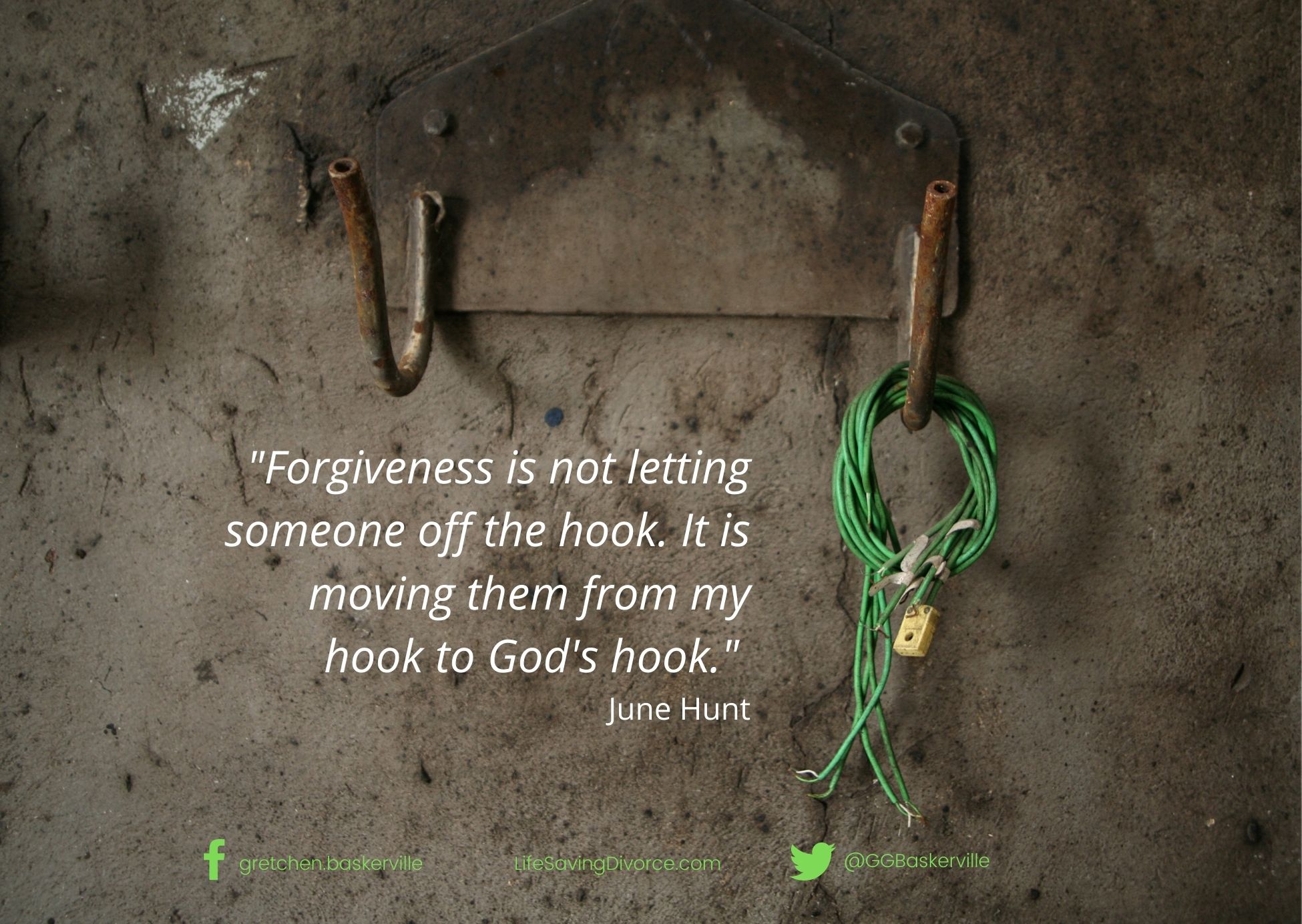
Radio counselor June Hunt says,
“Forgiveness isn’t letting someone off the hook for the bad they’ve done.
[1] Definition for slander based on “Slander,” www.USLegal.com, accessed 11/3/19, https://definitions.uslegal.com/s/slander/.
[2] “Libel vs. Slander: Different Types of Defamation,” Nolo Press, retrieved 11/3/19, https://www.nolo.com/legal-encyclopedia/libel-vs-slander-different-types-defamation.html.
[3] Top author on trauma and recovery, Dr. Judith Herman of Harvard, says, “The ordinary response to atrocities is to banish them from consciousness. Certain violations of the social compact are too terrible to utter aloud: this is the meaning of the word ‘unspeakable.'” She goes on to write, “Remembering and telling the truth about terrible events are prerequisites both for the restoration of the social order and for the healing of individual victims.” Herman, Trauma, 1.
[4] June Hunt, Self-Worth: Discover Your God-Given Worth (Peabody, MA: Rose Publishing, 2013), 65.
 :
:
 :
: Buy PDF