
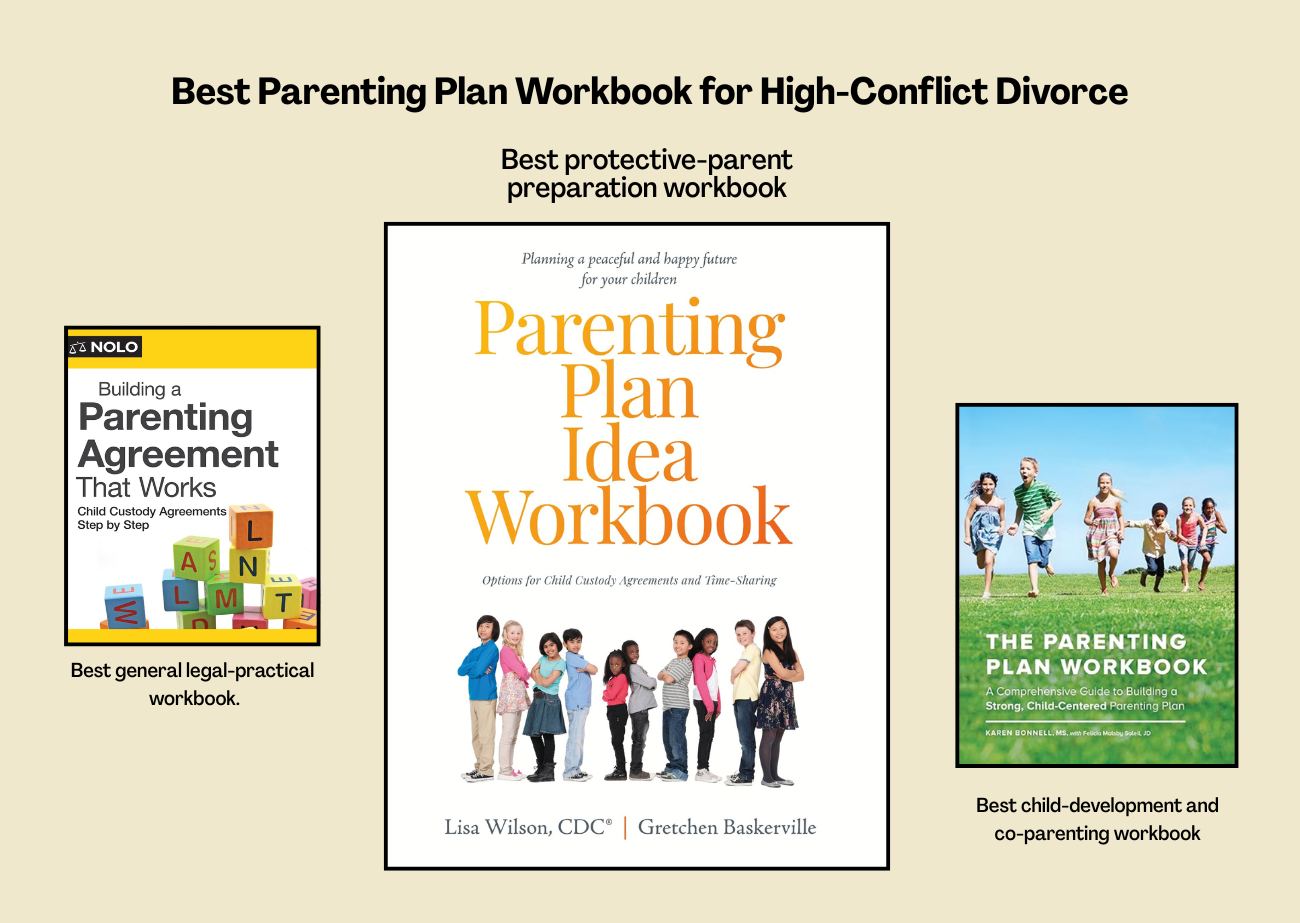
Best Parenting Plan Workbook for High-Conflict Divorce
There are many good parenting plan resources, but they do not all serve the same kind of parent.
Some parenting plan books are written for parents who are basically reasonable, even if they disagree. Some are written to help parents think through child development, schedules, holidays, and transitions. Others provide broad legal-practical checklists and sample agreement language.
But not every parent is negotiating with someone reasonable.
Some parents are trying to create a parenting plan with an ex who stonewalls, rewrites history, withholds money, ignores medical needs, manipulates the children, uses religion as a weapon, refuses to communicate, or looks cooperative in public while creating chaos in private.
That is where the Wilson & Baskerville workbook shines. It’s for the high-conflict divorce.
Its strength is not that it replaces a lawyer. It does not. Its strength is that it helps a protective parent get organized before walking into the lawyer’s office.
It helps the parent move from:
“I know this is going to be a disaster,”
to:
“Here is the pattern. Here is the child impact. Here is the evidence. Here is the safeguard I want my attorney to consider.”
Compared with broader parenting plan workbooks, Wilson & Baskerville is especially useful for high-conflict and safety-conscious cases. It assumes the parenting plan must do more than divide time. It must close loopholes, reduce predictable conflict, protect the child’s routines, and create enforceable structure where vague promises would fail.
That is a very different task from simply asking, “What would be fair?”
The better question is:
“What does this child need, given the reality of these parents?”
For protective parents, that question can change everything.
The Wilson & Baskerville workbook shines as the “protective-parent / high-conflict reality” workbook.
Compared with NOLO/Zemmelman and Bonnell, its strongest niche is that it assumes the reader may be dealing with someone who is not merely “difficult,” but possibly stonewalling, deceptive, intimidating, financially controlling, neglectful, unsafe, or manipulative. It does not just ask, “What parenting agreement would work?” It asks, “What predictable conflict, loophole, or safety risk needs to be structured before it hurts the children?”
Here’s the clean comparison.
1. NOLO shines at broad legal-practical coverage
NOLO is the strongest “general parenting agreement encyclopedia.” It is very broad, practical, and form-oriented. It organizes parenting agreements into basic elements, more parenting issues, serious situations, and special challenges, including domestic violence, alcohol/drug abuse, relocation, new partners, religious training, transportation, mental health care, and reinvolving an absent parent.
It is also strong on sample agreement language and “choose among options” drafting. For example, in serious situations it gives concrete substance-abuse safeguards, such as no driving with children within 12 hours of alcohol/drug use, no alcohol or drug use before or during visits, testing provisions, supervised visits, and a safety adult the children can call.
So NOLO’s strength is: comprehensive legal self-help structure and sample clauses.
2. Bonnell shines at child-centered co-parenting and developmental thinking
Bonnell’s workbook functions more as a child-centered planning guide. It is a child-centered planning workbook, useful for helping parents think through children’s needs, transitions, schedules, and how co-parenting choices affect children emotionally and developmentally. Bonnell says that the schedule should not just be a percentage; it should fit the child’s safety, stability, development, school life, relationships, and emotional health.
So Bonnell’s strength is: developmentally sensitive, child-centered parenting design.
3. Wilson & Baskerville shines at high-conflict translation and loophole prevention
Wilson & Baskerville is strongest where the other books can feel too optimistic for high-conflict divorce cases.
It explicitly tells readers not to share their written answers with the other parent or a custody evaluator without attorney/legal professional approval. That is a very protective-parent-aware instruction.
It also warns that joint custody is common but may not always be best, and tells the parent to be prepared to explain why to a lawyer or judge if joint custody does not suit the children.
Its best contribution is the way it turns fear and overwhelm into organized categories: concerns, patterns, child impact, proposed solutions, and evidence, or “Child-Safety Evaluation Language,” and that is where this workbook has its clearest unique value.
It also shines in the “what could go wrong later?” categories: co-parenting apps, safety provisions, decision-making authority by topic, transportation, belongings, reimbursement procedures, teen costs, step-up plans, and detailed schedules. The workbook covers decision-making options such as shared responsibility, shared responsibility with specific decision-making authority, and sole parental responsibility, with topic-by-topic authority for education, non-emergency health care, extracurriculars, and religion.
Its high-conflict communication approach is especially strong. It recommends co-parenting apps because they make it harder for someone to lie about sending, receiving, or reading messages, and it directs readers to think through app options and attorney recommendations.
The short answer
NOLO is the best general legal-practical workbook.
Bonnell is the best child-development and co-parenting workbook.
Wilson & Baskerville is the best protective-parent preparation workbook for people who need to walk into an attorney’s office with organized facts, safety concerns, decision-making problems, expense patterns, and loophole-prevention ideas.
Where Wilson & Baskerville really shines is here:
It helps a scared, gaslighted, overwhelmed parent move from “I know this will be a disaster” to “Here is the pattern, here is the child impact, here is the evidence, and here is the safeguard I want my attorney to consider.”
That is the niche. It is not just a parenting-plan workbook. It is a pre-attorney organizing tool for high-conflict and safety-conscious cases.
 :
:
 :
: Buy PDF