
Scorecard for Marriage Ministry Articles from Focus on the Family
How Focus on the Family handles abuse, separation, and divorce
Which articles help abuse victims—and which make safety harder
Are you a pastor, parent, or friend wondering whether certain Focus on the Family articles are wise marriage ministry reading?
For marriage articles, the rubric is:
Does this article help a reader in a coercive, deceitful, chronically degrading, sexually abusive, or dangerous marriage recognize the problem clearly, tell the truth about it, seek outside help, take protective action, and pursue separation or divorce when necessary—or does it make those steps harder?
Scoring
1–2 Unsafe | 3–4 Harmful | 5–6 Mixed | 7–8 Cautious | 9–10 Responsible
- Harm named — abuse, coercion, deceit, fear, degradation, danger
- Protective options — outside help, separation, reporting, legal protection, divorce when needed
- Burden-shifting — does it pressure the harmed spouse to endure, submit, forgive, or self-correct first?
- Clarity — are limits and exceptions plain, or buried?
- Practical safety — concrete next steps, not just spiritual ideals
Penalty flags:
abuse omitted; abuse minimized; danger normalized; endurance pressure; final legal protection withheld
Don’t see the article you wanted? Send me the URL and I’ll score it and add it.
“God’s Design for Marriage”
Image:

Wayback URL: https://web.archive.org/web/20260317020517/https://www.focusonthefamily.com/marriage/gods-design-for-marriage/
Quick verdict: This article frames marital suffering mainly as a spiritual growth assignment. It says the main issue is not why struggles happen but “how we deal with them,” urges couples to “fall forward,” and says that if marriage is for God’s glory, “divorce makes no sense.” It mentions infidelity, but gives no guidance on abuse, coercion, fear, separation, reporting, or legal protection.
What it gets right: It encourages prayer, encouragement, and service.
What it misses: It does not name dangerous patterns or protective options.
Penalty flags: abuse omitted; danger normalized; endurance pressure; final legal protection withheld.
“Why and How to Pursue a Healing Separation”
Image:
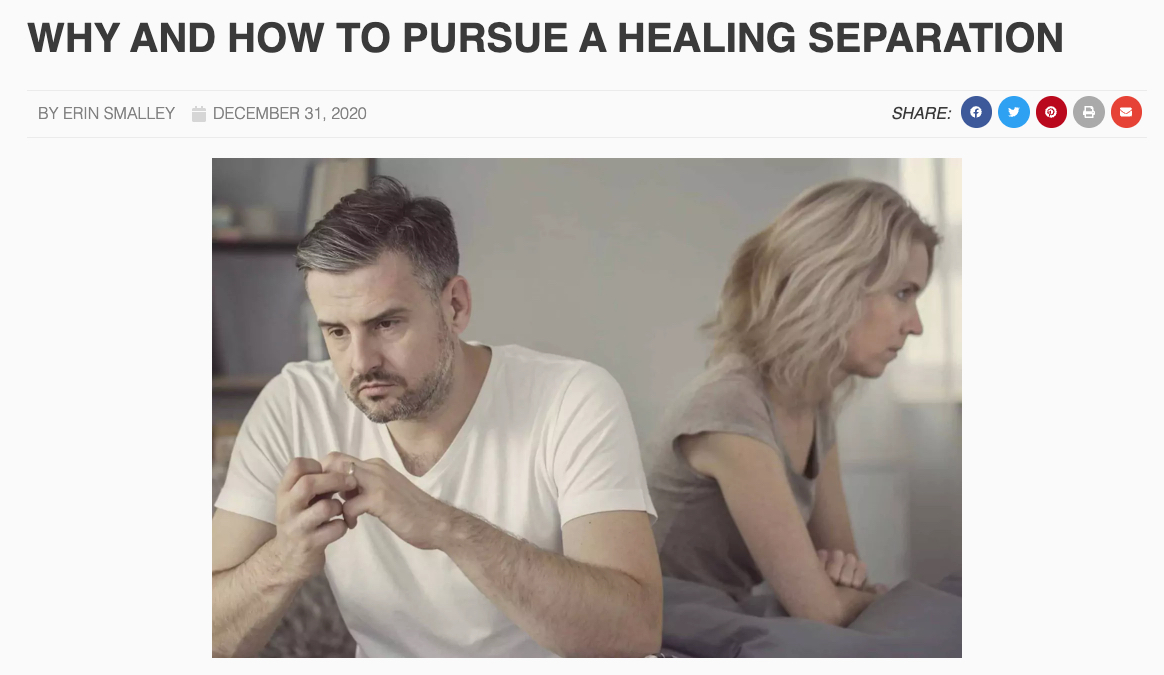
Quick verdict: This is one of the stronger Focus articles. Right up front, it says God’s design for marriage never included “abuse, violence or coercive control,” adds that emotional abuse can severely harm a person, and tells readers in abusive relationships to go to a safe place and contact the hotline. It also says separation can address unsafe homes, physical or emotional abuse, addiction, affairs, deception, and lying.
What it gets right: It names harm clearly, allows unilateral separation, treats separation as a personal boundary, recommends legal advice, and gives concrete structure for safety, communication, living arrangements, children, and finances. The page-3 graphic also lists volatility, addiction relapse, deception, and a desire to separate for safety as reasons a marriage may benefit from separation.
What it misses: It still frames separation mainly as a path to reconciliation and ends by urging readers considering divorce or legal separation to “give your marriage another chance.” It does not affirm divorce itself as a valid legally protective outcome in severe cases.
Penalty flags: reconciliation pressure; final legal protection withheld.
“What Is Sexual Abuse in Marriage?”
Image:
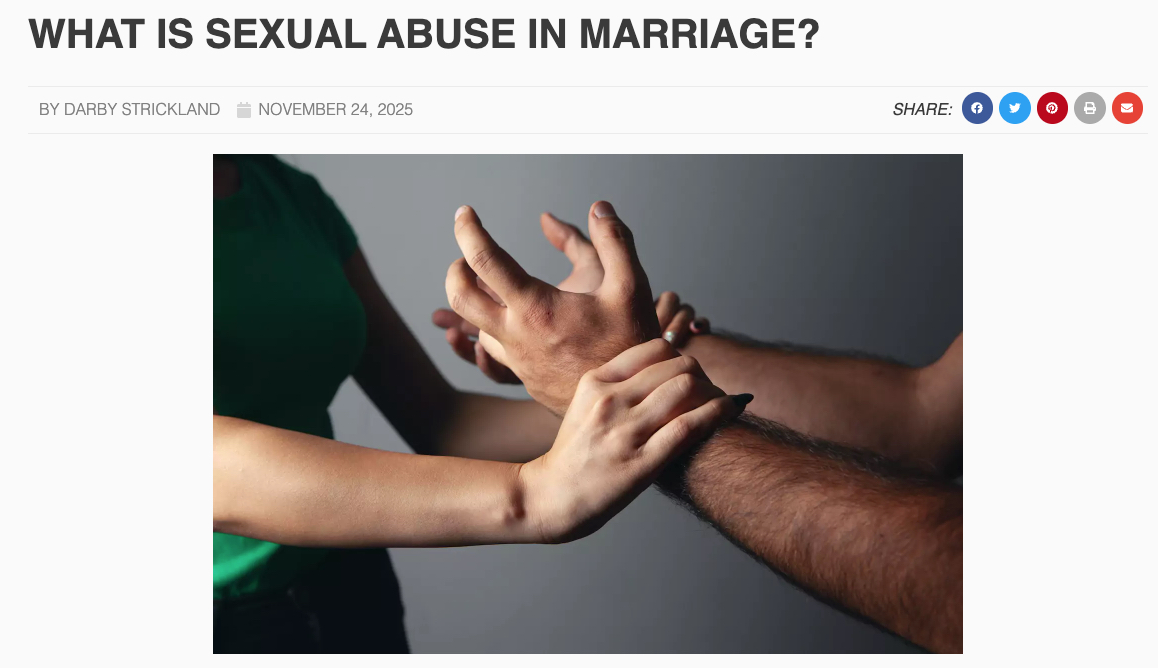
Quick verdict: This is one of the strongest Focus articles in this set. It clearly names marital sexual coercion and assault, gives concrete examples, rejects false teaching that wives owe sex on demand, and explicitly says abuse is not the victim’s fault. It also tells readers in abusive relationships to go to a safe place and contact the hotline.
What it gets right: It names entitlement, coercion, threats, degradation, blame-shifting, and spiritual distortion. It directly counters “withholding sex is always a sin” and “your spouse has rights to your body, anytime and in any way.” It also says a wife can tell his body not to do things to her body.
What it misses: It still stops short of affirming divorce as a legitimate legally protective choice in severe cases.
Penalty flags: final legal protection withheld.
“Signs of Emotional Abuse”
Image:
Wayback URL: https://web.archive.org/web/20260212140010/https://www.focusonthefamily.com/marriage/signs-of-emotional-abuse/
Quick verdict: This article does a solid job naming verbal and emotional abuse, including intimidation, humiliation, gaslighting, power imbalance, and chronic self-blame. It also says nonphysical abuse should not be minimized and urges readers to seek help and safety if things escalate.
What it gets right: It distinguishes normal conflict from abuse, gives concrete examples, and tells readers to seek support from counselors, mentors, or support groups. It also says one spouse can take action even if the other will not.
What it misses: It still leans toward counseling and recovery language. It does not clearly affirm separation or divorce as a legally protective choice in severe cases.
Penalty flags: final legal protection withheld; recovery framing softens protective clarity.
“Warning Signs of Emotional Abuse in Marriage”
Image:
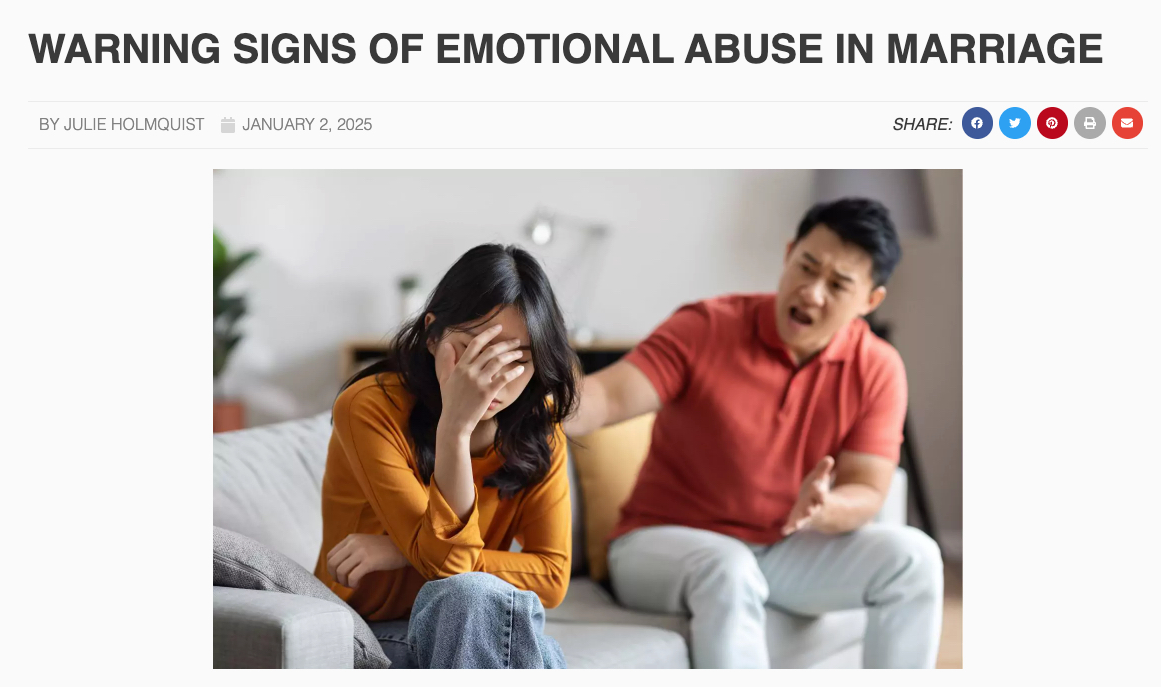
Quick verdict: This is one of the stronger Focus articles. It clearly defines emotional abuse as a pattern tied to coercive control, not just a bad fight. It names intimidation, blame-shifting, gaslighting, threats, isolation, monitoring, humiliation, and fear.
What it gets right: It gives concrete behavior lists, quotes abuse-informed sources, warns that victims often blame themselves, and tells readers concerned about safety to contact the hotline. It also encourages counseling and education.
What it misses: It still stops at help-seeking and safety planning. It does not clearly affirm separation or divorce as a legally protective choice in severe cases.
Penalty flags: final legal protection withheld.
“How to Fight Spiritual Warfare in Marriage”
Image:
Quick verdict: This article turns marital trouble into a spiritual-warfare frame and tells readers that the real enemy is Satan, not the spouse. It warns against blaming your husband and says couples fall apart when they think their spouse is the foe. Then it tells readers to respond quickly to resentment and unforgiveness. In a coercive or abusive marriage, that framing can make truth-telling and harm recognition harder.
What it gets right: It encourages vigilance, unity, and gratitude.
What it misses: It never names abuse, coercion, fear, degradation, separation, reporting, or legal protection. It gives spiritual interpretation where some readers may need safety guidance instead.
Penalty flags: abuse omitted; danger spiritualized; spouse-harm blurred; endurance pressure; final legal protection withheld.
“Coping with Alienation, Anger, and Anxiety in Marriage”
Image:
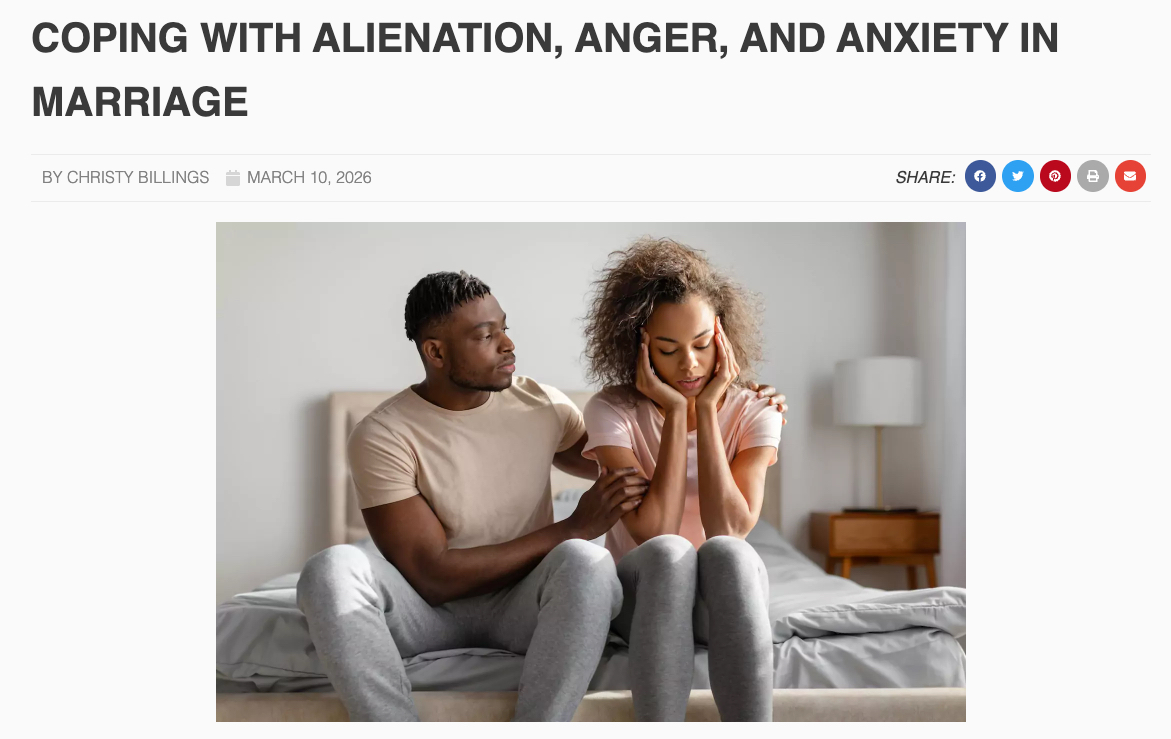
Quick verdict: This article does briefly say to monitor safety and leave immediately if anger puts you or your children at physical risk. But most of the piece reframes alienation, anger, and anxiety as stress responses rooted in childhood wounds, then steers the reader toward empathy, patience, reassurance, and counseling to heal the relationship. That makes it easy to blur chronic control, intimidation, and manipulative anger into mutual coping problems.
What it gets right: It encourages counseling, support groups, healthier coping tools, and, in one important line, says to leave with the children and notify authorities if physical safety is at risk.
What it misses: It does not name abuse, coercive control, degradation, or fear clearly. It presents controlling or manipulative behavior as part of an anger pattern to understand and work through, not as a possible abuse framework requiring stronger protective action.
Penalty flags: abuse blurred into coping language; danger minimized; counseling/repair framing outweighs protection; final legal protection withheld.
How the math works
Each article receives a raw score in five categories:
- Harm named
- Protective options
- Burden-shifting
- Clarity
- Practical safety
Each category is scored from 0 to 2:
- 0 = absent or harmful
- 1 = partial or mixed
- 2 = clear and strong
Then those category scores are weighted:
- Harm named × 3
- Protective options × 3
- Burden-shifting × 2
- Clarity × 1
- Practical safety × 1
That gives a weighted total out of 20.
Then subtract penalties for dangerous problems in the article:
- abuse omitted = -2
- abuse minimized = -2
- danger normalized = -2
- endurance pressure = -2
- final legal protection withheld = -2
So the formula is:
Then convert that to a 10-point scale by dividing by 2.
In other words, an article first earns points for how clearly and protectively it responds to abuse and danger. Then it loses points for omissions or messages that could trap harmed spouses. That is why some articles can sound caring and still score poorly: the penalties matter.
 :
:
 :
: Buy PDF