
You Were Sent Here Because You’re Quoting Linda Waite’s First Book.
Twenty-Five Years Later, Her Own Research Has Changed the Story.
Linda Waite is still pro-marriage. But her later work is far less confident that marriage automatically makes people happier, healthier, safer, or better off.
You were probably sent here because someone quoted Linda Waite and Maggie Gallagher’s 2000 book, The Case for Marriage, as though it ended every argument about marriage and divorce.
The usual line goes like this:
Married people are happier, healthier, and better off financially. Linda Waite proved it.
No, she did not “prove” that every person becomes happier, healthier, or wealthier by marrying. And she certainly did not prove that any marriage is better than no marriage.
Linda Waite’s own later research became much less confident that marriage is automatically good for everyone.
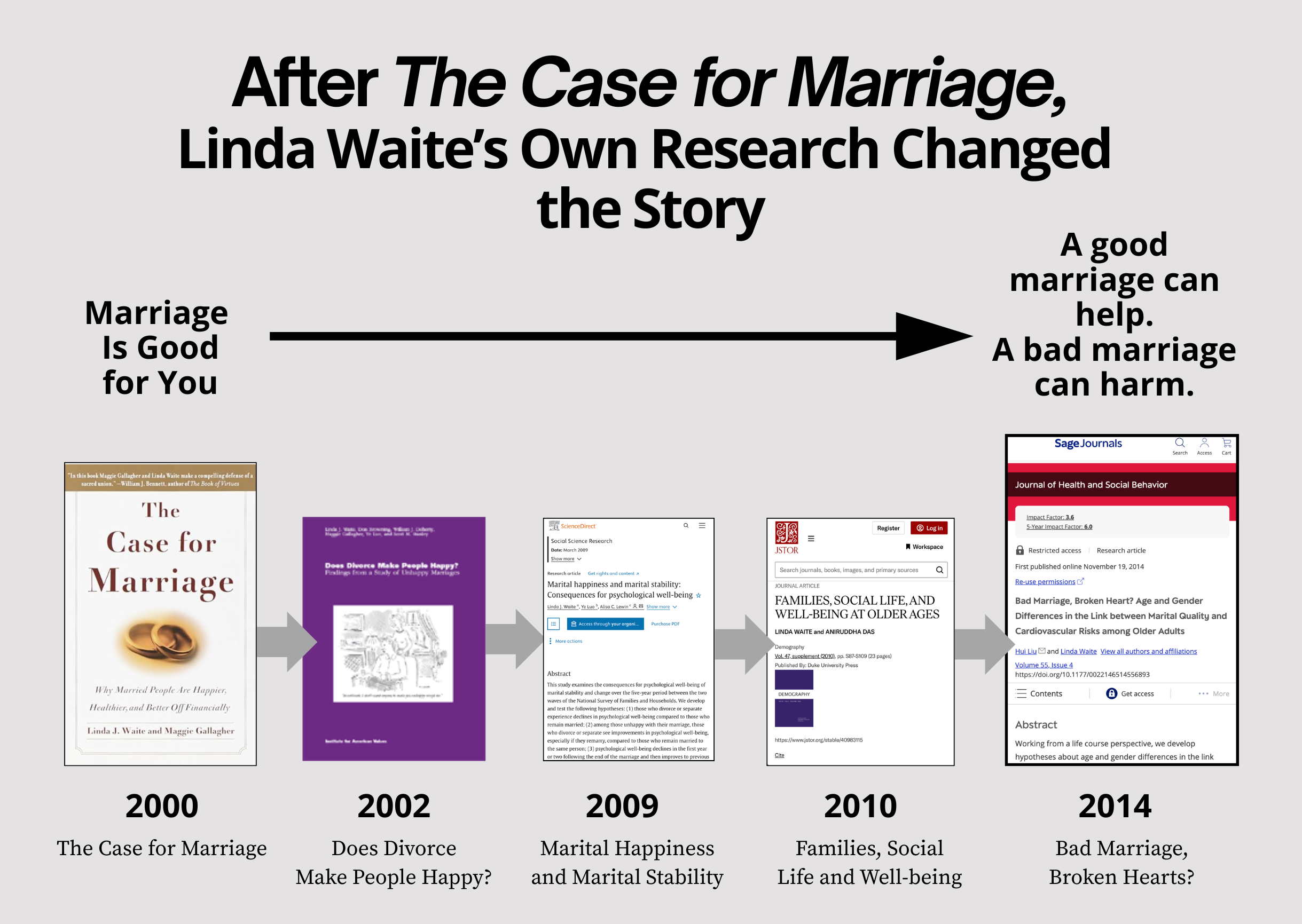
| Year | Waite’s Research Publications | What the Story Became |
|---|---|---|
| 2000 | The Case for Marriage | Marriage is broadly beneficial, though some high-conflict marriages may be better ended. |
| 2002 | Does Divorce Make People Happy? | Many unhappy marriages improve, but destructive, high-conflict, and violent marriages are less likely to. Some are best ended. |
| 2009 | “Marital Happiness and Marital Stability” | Some people recover and become happier after the divorce crisis passes. |
| 2009 | “Marital History and Well-Being in Later Life” | A deteriorating marriage may already have lost—or reversed—its health benefits before divorce. |
| 2010 | “Families, Social Life, and Well-Being at Older Ages” | Partners and family members can provide support, but also conflict, control, mistreatment, and abuse. |
| 2014 | “Bad Marriage, Broken Heart?” | Marital quality may matter more than marital status; a bad marriage can damage health. |
So the real takeaway is not:
Marriage is always better than being unmarried.
It is:
A good marriage can be beneficial. A bad marriage can be harmful. Divorce can sometimes bring relief, recovery, and a better outcome.
Waite and Gallagher did not quite say that every marriage is better than none. But The Case for Marriage was built around a strong presumption in favor of marriage, and Waite’s later work made the limits of that presumption much clearer.
You are free to quote the 2000 book. You are not free to pretend her research stopped there.
Need More Detail? Please Continue.
What Waite and Gallagher did was assemble a large body of research showing that married people often had better average outcomes than unmarried people. The book then presented marriage as the institution producing many of those advantages. Its subtitle did not hedge: Why Married People Are Happier, Healthier, and Better Off Financially.
That book was published in 2000.
Waite kept researching.
And the story became much more complicated.
First, the Obvious Problem: “Married People Do Better” Does Not Tell Us Why
Married people may benefit from companionship, shared expenses, pooled earnings, legal protections, caregiving, and social support.
But married people may also have been healthier, wealthier, or more stable before marriage. People with better relationships are more likely to remain married. People who divorce or become widowed are reassigned to the “unmarried” side of the comparison, leaving the continuously married group unusually selected.
This problem is generally called selection bias or selection into and out of marriage. The people who marry and remain married may already differ from the people who do not marry or whose marriages end.
Even The Case for Marriage sometimes defines the unmarried category broadly enough to include never-married, separated, divorced, and widowed people.
Those are not interchangeable life histories. Combining them can make for a convenient headline, but it is not a clean comparison. Current family textbooks increasingly separate marital status, marital history, relationship quality, prior health, economic resources, and the circumstances surrounding divorce.
A newly bereaved widow, a person recovering from a bitter divorce, and a happily single person who never married should not be treated as one condition called “not married.”
Yet the book’s public message was much simpler:
Marriage is good for you.
That is the message people are still quoting.
It is not where Waite’s later research ended.
2000: Marriage Is Broadly Good—but the Exceptions Were Already There
The Case for Marriage is overwhelmingly pro-marriage. It argues that married people tend to live longer, report better health, earn more, accumulate more wealth, enjoy more satisfying sex, and raise more successful children.
But even this book did not literally claim that every marriage should be preserved.
Waite and Gallagher acknowledged that children’s psychological health may improve when divorce ends sustained, serious conflict. They also said there are circumstances in which children are better off when parents part and cases in which divorce or separation may be the best answer for everyone. See The Case for Marriage, pp. 132 and 140.
“When divorce occurs ·after a sustained period of high conflict between parents, children’s psychological health may actually improve as a result.” — Linda J. Waite and Maggie Gallagher, The Case for Marriage, p. 132.
“Of course, no one doubts that there are cases when divorce or separation really is, the best answer for everyone. There are circumstances in which children are better off when parents part.” — Waite and Gallagher, p. 140
So even the 2000 book contained an important concession:
Some marriages are not better merely because they remain intact.
Still, the book’s dominant message leaned heavily toward marriage as the presumed good and divorce as the presumed harm.
The practical effect was close to:
Marriage is better unless you can prove that your case is exceptional.
That is exactly how many pastors, marriage ministries, and pro-marriage advocates still use it.
2002: Many Unhappy Marriages Improve—but Destructive Ones Are Less Likely To
In 2002, Waite and several coauthors published Does Divorce Make People Happy? Findings from a Study of Unhappy Marriages. The report was published by the Institute for American Values, a nonprofit organization created to promote marriage and family-centered public policy.
This is the source of the famous statistic that about two-thirds of unhappy spouses who stayed married reported happy marriages five years later.
That finding has often been transformed into:
Stay five more years and your marriage will probably become happy.
The study did not prove that.
The people who stayed and the people who left were not randomly assigned. The report could not show that the people who divorced would have become happy if they had remained married.
It also admitted important exceptions. Violent and high-conflict marriages were less likely to improve. Divorce could bring significant relief from marital violence. The authors said averages concealed important individual variation and concluded that some marriages were so destructive that divorce or separation was the best outcome.
The report also found that 24 percent of the unhappy spouses who divorced or separated had remarried within five years. Among that smaller remarried group, 81 percent described their second marriages as happy.
That does not mean 81 percent of everyone who divorced became happily remarried. It means that among the minority who remarried during the study period, most reported happy second marriages.
Still, it is a finding you will rarely hear from people using the report to claim that divorce never improves anyone’s life.
That is a long way from:
Divorce never helps.
Relief from violence is not a trivial technical exception. Relief is closer to happiness than terror, coercion, injury, and danger.
Key Quotes
In the last sentence of the Waite study (2002), Dr. Waite says that divorce or separation are likely the best outcome for a destructive marriage:
“Both people and marriages are likely to be happier in communities with a strong commitment to marital permanence. While some marriages are so destructive that divorce or separation is the best outcome, marriages are more likely to be both happy and stable when marriage is highly valued – a key relation in whose success family, friends, faith communities, counselors, family-law attorneys, and the wider society have an important stake.” – Linda J. Waite, Don Browning, William J. Doherty, Maggie Gallagher, Ye Luo, and Scott M. Stanley, Does Divorce Make People Happy, Institute for Family Values, 2002, p. 33.
“Among those unhappily married spouses who stayed married, what factors predicted happier marriages down the road? Marriages with high conflict and domestic violence were less likely to become happy five years later.” p. 11-12
She’s saying that some warning signs help identify which unhappy marriages are less likely to become happy, especially high conflict and domestic violence.
“If the problem is marital violence, divorce appears to offer significant relief.” p. 12
So, we can reasonably say that people who escape unhappy violent marriages are often better off and closer to happiness. They experience significant relief when they get to safety.
“When an unhappily married adult experiences violence, divorce and remarriage significantly reduce the likelihood he or she will experience domestic violence (at least from spouses).” p. 12
Here Waite says that divorce and remarriage reduces the likelihood of domestic violence.
“…24 percent of those unhappy spouses who divorced or separated ended up in a second marriage within five years. Eighty-one percent of those second marriages were happy.” p. 12
She’s saying that among the unhappily married spouses who divorced and remarried within five years, the vast majority—81%—reported happy second marriages.
“Does divorce make unhappily married people happy? The answer, surprisingly, in this research, seems to be no….With the important exception of reducing the incidence of marital violence for unhappy spouses (in violent marriages), divorce failed, on average, to result in improvements in psychological well-being for unhappy spouses.” p. 13-14
She’s saying, in general, divorce did not increase measured psychological well-being on average. But if a person is in a violent home, divorce will likely reduce the violence and bring significant relief—moving that person closer to happiness and safety.
What kinds of marriages improved? Many of the marriages that improved involved “outside stressors,” rather than only bad behavior by one spouse.
“Many spouses we interviewed who survived marital unhappiness did not see problems within the relationship as the cause. Instead they blamed outside forces for causing both unhappiness and relationship stress: Spouses became ill, lost jobs, got depressed, children got into trouble or created marital stresses by their financial and emotional demands.” p. 15
Waite is saying that many marriages improved when the problems involved illness, lost jobs, financial stress, and children with behavior problems. Marriages marked by high conflict, violence, drunkenness, infidelity, or other serious behavior were less likely to improve.
Waite lists one story of a serious relationship problem that improved: a husband who stopped drinking after two years. (Two years? This is somewhat humorous. All wives of drug and alcohol addicts wish they could be so fortunate!)
2009: Some People Were Happier After the Divorce Crisis Passed
Waite’s 2009 article with Ye Luo and Alisa C. Lewin, “Marital Happiness and Marital Stability: Consequences for Psychological Well-Being,” made a distinction that marriage-promotion slogans often erase:
The crisis of getting divorced is not the same as long-term life after divorce.
Among people who started out unhappily married, those who had been divorced for more than two years and had not remarried reported significantly higher global happiness than those who remained married.
Put more simply:
Some people who left unhappy marriages were happier after the divorce crisis had passed.
That does not prove that divorce makes everyone happier.
But it directly contradicts the blanket claim that people who leave unhappy marriages do not become happier.
Some people recover.
Some people improve.
Some people are happier after the upheaval passes.
2009: The Marriage May Have Stopped Being Healthy Before the Divorce
Waite’s later work also challenged the idea that poor health after divorce can simply be blamed on divorce itself.
In “Marital History and Well-Being in Later Life,” she acknowledged that before divorce, the health benefits associated with marriage may have weakened or even become negative as the relationship deteriorated. She also wrote that most people recover over time from the short-term psychological damage associated with divorce or widowhood.
Quotes
“Prior to a divorce, the health benefits of marriage may have attenuated or become negative as the relationship depreciated in value.”— Linda J. Waite, “Marital History and Well-Being in Later Life,” 2009, p. 693.
“Both divorce and widowhood damage psychological well-being in the short-run, although most people recover over time.”— Waite, 2009, p. 701.
Mary Elizabeth Hughes and Waite made the same point in “Marital Biography and Health at Midlife”: a strained marriage may already have stopped supplying health benefits before it ends.
Quote:
“Prior to a divorce, the health benefits of marriage may have attenuated or become negative as the relationship became strained.” — Mary Elizabeth Hughes and Linda J. Waite, “Marital Biography and Health at Midlife,” manuscript p. 4.
That matters enormously.
Suppose a person develops anxiety, depression, hypertension, sleep problems, or chronic stress while living in a hostile marriage. If that person later divorces, researchers cannot simply point to the later health problem and say:
Divorce caused this.
Some of the damage may have begun inside the marriage.
2010: Families and Partners Can Be Sources of Abuse, Conflict, and Control
In “Families, Social Life, and Well-Being at Older Ages,” Waite and Aniruddha Das described families as sources of support and resources—but also as sources of criticism, conflict, demands, mistreatment, and abuse.
Quote:
“But not all family ties or other social connections bring benefits. Some are sources of conflict or abuse.”— Linda Waite and Aniruddha Das, “Families, Social Life, and Well-Being at Older Ages,” 2010, p. S104.
That is a much less romantic framework than the popular reading of The Case for Marriage.
The spouse is not automatically the protector.
The spouse may be the stressor.
The family is not automatically a safe haven.
The family may be the location of control or mistreatment.
2014: Marital Quality May Matter More Than Marital Status
Then came Hui Liu and Linda Waite’s 2014 article, “Bad Marriage, Broken Heart?”
The title itself should have ended the lazy use of “married equals healthy.”
Quote:
“Recent research points to marital quality—broadly defined as spouses’ subjective appraisals of their marital relationship—as more important than marital status for health.” — Hui Liu and Linda J. Waite, “Bad Marriage, Broken Heart? Age and Gender Differences in the Link between Marital Quality and Cardiovascular Risks among Older Adults,” Journal of Health and Social Behavior 55, no. 4 (2014), p. 404.
The article says that marital quality may be more important for health than marital status. It found that worsening negative marital quality was associated with cardiovascular risks, with particularly strong patterns among older women.
In plain language:
A good marriage may help your health.
A bad marriage may hurt it.
That is not the same story as:
Marriage is good for you.
It is:
The relationship matters more than the ring.
Did The Case for Marriage Imply That Every Marriage Is Better Than None?
Not literally.
The book acknowledged high-conflict exceptions and cases in which divorce may be better for children or for everyone involved.
But rhetorically, the book came close to making intact marriage the default good. Its chapters and subtitle built a cumulative case that marriage improves health, happiness, sex, money, children, and society.
The burden then falls on the harmed spouse to prove that this particular marriage is bad enough to count as an exception.
That is the danger.
A person facing abuse, coercive control, serial betrayal, addiction, abandonment, or chronic degradation may hear:
Marriage is usually beneficial.
Children usually need an intact home.
Divorce usually makes things worse.
Therefore, maybe I just need to tolerate more.
Waite and Gallagher did not quite say that every marriage is better than none.
But they built a book around a strong presumption in favor of marriage—and Waite’s later research had to make much clearer that some marriages are physically and psychologically harmful.
The Short Timeline
| Year | Waite’s Research Publication | What the Story Became |
|---|---|---|
| 2000 | The Case for Marriage | Marriage is broadly beneficial, though some high-conflict marriages may be better ended. |
| 2002 | Does Divorce Make People Happy? | Many unhappy marriages improve, but destructive, high-conflict, and violent marriages are less likely to. Some are best ended. |
| 2009 | “Marital Happiness and Marital Stability” | Some people recover and become happier after the divorce crisis passes. |
| 2009 | “Marital History and Well-Being in Later Life” | A deteriorating marriage may already have lost—or reversed—its health benefits before divorce. |
| 2010 | “Families, Social Life, and Well-Being at Older Ages” | Partners and family members can provide support, but also conflict, control, mistreatment, and abuse. |
| 2014 | “Bad Marriage, Broken Heart?” | Marital quality may matter more than marital status; a bad marriage can damage health. |
Waite remained pro-marriage.
But the shift is unmistakable:
Marriage is good for you.
became:
A good marriage can be good. A bad marriage can be harmful.
No, I Am Not the Only Person Who Noticed Problems
Bella DePaulo
Social psychologist Bella DePaulo offered one of the fiercest critiques of the marriage-advantage literature in Singled Out. She argued that researchers often compare the continuously married with categories containing divorced, separated, widowed, and lifelong single people, then describe the difference as though marriage caused it.
She also emphasized longitudinal research in which people who married experienced only a small or temporary rise in happiness before returning close to their prior level. See Singled Out, pp. 36–37.
DePaulo directly challenged Waite and Gallagher’s treatment of health and single men, arguing that their broad narrative exceeded what the underlying data established. See Singled Out, pp. 153–155.
On sexual satisfaction, she criticized one-time comparisons that could not establish that marriage caused the reported differences. She also noted that one favorable survey cited by Waite and Gallagher was sponsored by the Family Research Council, an advocacy organization rather than a neutral scholarly institution. See Singled Out, pp. 54–55.
Sheila Wray Gregoire, Rebecca Gregoire Lindenbach, and Joanna Sawatsky
Sheila Wray Gregoire, Rebecca Gregoire Lindenbach, and Joanna Sawatsky’s later research challenges broad claims that married people have “better sex” by asking the question those averages often bury:
Better sex for whom?
Their survey work for The Great Sex Rescue found a 47-point orgasm gap among evangelical couples: about 95% of men said they almost always or always reached orgasm, compared with only 48% of women.
That is a remarkable gap to hide inside the reassuring phrase “married people report more satisfying sex.”
Frequency is not mutual pleasure. A marriage license does not tell us whether sex is wanted, painless, equal, safe, or satisfying to both spouses. Their work is especially important for women whose sexual experiences are shaped by obligation, pain, pressure, unequal power, or the teaching that a wife owes her husband sex.
Waite and Gallagher were working with the research available at the time. But anyone still quoting their sexual-satisfaction claims should now account for mutuality, consent, pain, orgasm, equality, and duty sex—not merely marital status.
Daniel Hawkins and Alan Booth
Daniel Hawkins and Alan Booth later examined long-term low-quality marriages and found that remaining unhappily married was associated with lower happiness, life satisfaction, self-esteem, and overall health than remaining in a better marriage.
Quote:
“Remaining unhappily married is associated with significantly lower levels of overall happiness, life satisfaction, self-esteem and overall health along with elevated levels of psychological distress compared to remaining otherwise continuously married. There is also some evidence that staying unhappily married is more detrimental than divorcing, as people in low-quality marriages are less happy than individuals who divorce and remarry. They also have lower levels of life satisfaction, self-esteem and overall health than individuals who divorce and remain unmarried. Unhappily married people may have greater odds of improving their well-being by dissolving their low-quality unions as there is no evidence that they are better off in any aspect of overall well-being than those who divorce.” -Daniel N. Hawkins and Alan Booth, Unhappily Ever after: Effects of Long-Term, Low-Quality Marriages on Well-Being, Social Forces, Vol. 84, No. 1 (Sep., 2005), pp. 451-471, from the abstract
Their results also indicated that people in persistent low-quality marriages were not clearly better off than those who divorced. See their 2005 article, “Unhappily Ever After: Effects of Long-Term, Low-Quality Marriages on Well-Being.”
That is a major corrective to the slogan:
Just stay. It will probably improve.
Some do.
Some do not.
Some remain damaging for years.
Mavis Hetherington
Family researcher E. Mavis Hetherington’s long-term work sharply complicates blanket claims that divorce is uniformly devastating. In For Better or For Worse: Divorce Reconsidered, she argues that much popular and academic writing exaggerated divorce’s negative effects and overlooked its sometimes substantial positive effects.
Her research followed nearly 1,400 families and more than 2,500 children, many for decades. She found that divorce could devastate some families, but that others adapted well and a meaningful minority actually improved. She also emphasized that divorce had rescued many adults and children from domestic abuse and sometimes created opportunities for substantial personal growth, especially for women and girls. See pp. 3–7.
Hetherington’s central point was not that divorce is harmless. It was that the outcomes vary widely: some people struggle, many recover, and some thrive. The quality of the marriage before divorce and the conditions afterward matter enormously.
Again, the quality of the marriage before divorce matters.
Judith Wallerstein
Judith Wallerstein was not a critic of Waite’s basic concern about the effects of divorce on children. Waite quotes Wallerstein positively in her chapter on children in Case for Marriage.
But even Wallerstein did not support preserving every marriage at any cost. In her 2003 What About the Kids? she distinguished ordinary marital unhappiness from homes marked by repeated, frightening conflict, and advised that in such cases separation may be better sooner rather than later. So Wallerstein belongs in the same broad pro-marriage camp as Waite, but she still undercuts the slogan that children are always better off when parents stay together.
Even the Textbooks Say: Look at More Than Marital Status
This is not fringe criticism.
Andrew Cherlin: Public and Private Families
In Public and Private Families, Cherlin explains that children exposed to high marital conflict were doing better later if their parents divorced than if their parents remained together. Children from low-conflict homes, by contrast, generally did worse after divorce. See p. 336 of the ninth edition.
That means responsible analysis must ask:
What were the children living through before the divorce?
Not merely:
Did their parents divorce?
Philip N. Cohen: The Family
Philip Cohen’s textbook, The Family, situates marriage outcomes within selection, inequality, gender, marital quality, and family history rather than treating marriage as a universal treatment.
The modern sociological question is not simply whether married people look better at one point in time.
It is:
Who marries? Who remains married? What kind of marriage is it? What advantages did they already have? What happens to the same people over time?
Marriage and Divorce in America
The 2026 academic encyclopedia Marriage and Divorce in America still cites Waite and Gallagher for the general finding that married people often report better average outcomes.
But it also notes that some highly dissatisfied women—especially those with enough economic resources—experience relief and improved psychological outcomes after divorce. See pp. 159–160.
That finding should not be twisted into:
Wealthy women can safely leave, but poor women should stay.
The proper lesson is:
Money buys safety, legal help, housing, childcare, and recovery time. Poor women need more exit resources—not more lectures about the benefits of marriage.
The Bottom Line
Linda Waite did not become anti-marriage.
She remained pro-marriage.
But her later research is far less sanguine about marriage’s automatic benefits.
Her own work increasingly emphasized:
- marital quality;
- prior marital history;
- violence and high conflict;
- short-term crisis versus long-term recovery;
- age and gender;
- reciprocal effects between health and marriage;
- and the possibility that the marriage itself is the source of harm.
So the next time someone quotes The Case for Marriage as though the subtitle settled everything, ask:
Which Linda Waite are you citing?
- The 2000 Waite who made the sweeping case for marriage?
- The 2002 Waite who said some marriages are so destructive that separation is the best outcome?
- The 2009 Waite who found that some people were happier after the divorce crisis had passed?
- The 2010 Waite who acknowledged that families and partners can be sources of abuse and mistreatment?
- Or the 2014 Waite who said marital quality may matter more for health than marital status?
You do not get to quote the boldest claims from 2000 and ignore everything that came afterward.
Stop using a 25-year-old book subtitle as a substitute for reading the research.
 :
:
 :
: Buy PDF