
🧒 The #GreaterThan Campaign Video
Who’s Speaking, What’s Missing, and Why Abuse Can’t Be Ignored
🎧 Audio summary (multiple languages)
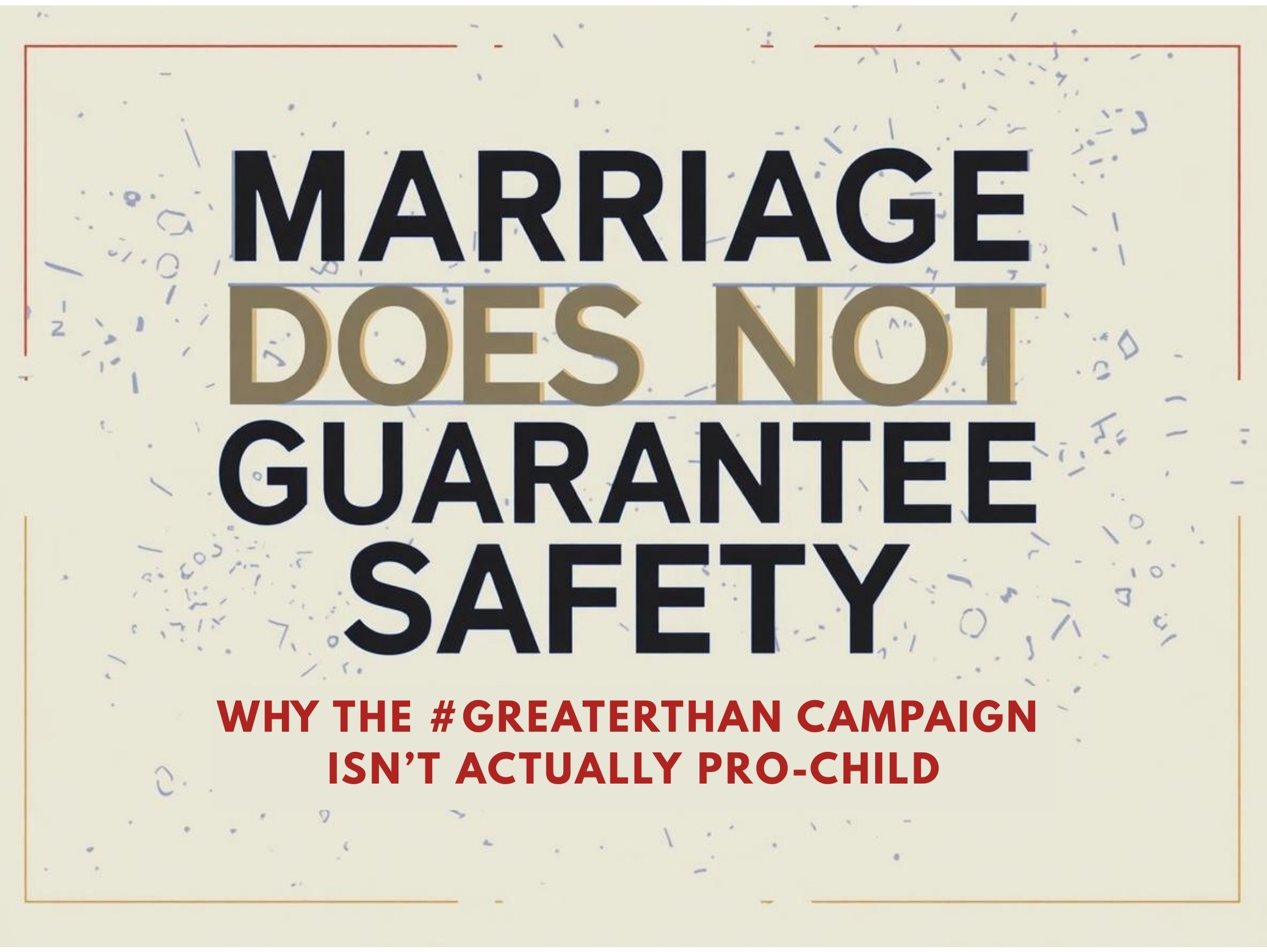
The #GreaterThan campaign presents itself as child-centered: children’s well-being should be greater than adult desires. On the surface, that sounds unifying.
This post documents the #GreaterThan campaign video and explains what it claims — and what it omits about abuse and child safety.
I write as a Christian domestic violence awareness advocate who has spent nearly 30 years working with devout people of faith who are survivors of abuse, betrayal, and high-conflict marriages—and with the children raised inside those homes. My concern is not partisan or political. It is protective. 🛡️
When marriage and family policy are discussed without naming abuse, children are not actually being protected.
🎙️ Who Is Speaking (in the video)
The #GreaterThan campaign video features voices from evangelical institutions, advocacy groups, and media platforms that have shaped Christian marriage messaging for years. Several of these same voices have also publicly opposed no-fault divorce or advocated making divorce harder to obtain.
(Optional: link to the #GreaterThen transcript including timestamps and speaker’s names.
And link to information about each #GreaterThan speaker.)
That overlap matters—not politically, but pastorally and practically.
📣 What the Video Claims
Across the video, several themes repeat:
- 💍 Marriage is framed as universally child-protective
- 👨👩👧 Children are said to need married biological parents in order to thrive
- ⚖️ Adult (parents’) safety and well-being are treated as less important than maintaining the marriage
- 🏛️ Family breakdown is blamed on culture, courts, and law—never on harm inside marriages
🚨 What Is Consistently Missing
What’s striking is not what’s said—but what’s absent:
- Abuse inside married homes is not acknowledged
Physical abuse, coercive control, sexual violence, chronic intimidation, and terrorizing behavior are not discussed—despite being well-documented drivers of child harm. For readers unfamiliar with the data: research shows that roughly 1 in 4 highly religious marriages report abuse. See:
👉 1 in 4 Christian Marriages Are Abusive - ACEs are ignored
For more than 25 years, research on Adverse Childhood Experiences (ACEs) has identified childhood harms—mostly abuse-related—that predict poor long-term outcomes far more strongly than parents’ marital status alone. - Parents’ safety is treated as irrelevant
Yet decades of research show that a child’s outcomes are closely tied to the mental health, safety, and stability of the caregiving parent. Witnessing the abuse of a parent is itself a recognized ACE. - Divorce is not named, but its role is implied
In the video, marriage is framed as inherently child-protective, while adults who exit are portrayed as driven by selfish “fantasies” or “desires.” Missing is evidence that some divorces improve children’s well-being by ending exposure to abuse or high conflict—core ACE-related harms.
⭐ Why Abuse Keeps Disappearing from These Conversations
This pattern is not new—and it is not accidental.
If abuse inside marriage is named clearly, then divorce becomes a moral option, no-fault divorce looks necessary, and marriage can no longer be presented as universally protective to children. That reality complicates efforts to shape public policy that restricts exit from marriage or treats permanence as the highest good.
So harm is relocated outside the home—to culture, courts, or adult desire—rather than confronted inside marriages themselves. The result is a child-centered message that quietly sidelines the very factors most likely to endanger children.
📊 What the Research Actually Shows
Anyone claiming to put children first must include these findings:
- Divorce can harm children when it ends a low-conflict marriage
- But when divorce ends a high-conflict or abusive marriage, children’s well-being is far higher on average—by as much as ten times — than children whose parents stayed together (Amato).
- Children exposed to chronic conflict or violence in intact homes often fare worse than children whose parents divorce into safer environments
- Most child abuse occurs in biological, married-parent households—not because marriage causes abuse, but because abuse happens where children live
⚖️ Why No-Fault Divorce Still Matters
The video does not mention no-fault divorce—but it is directly related.
No-fault divorce laws were created because fault-based systems routinely trapped victims with abusers. After these laws passed, Harvard research showed:
-
📉 Domestic violence dropped by about 30%
-
💔 Wife homicide by partners declined by about 10%
-
🕊️ Suicide among wives dropped 8–16%
Any framework that minimizes abuse while questioning legal exits from dangerous marriages raises legitimate safety concerns—for children and parents.
🧭 Bottom Line
You don’t have to reject marriage, faith, or child well-being to ask these questions.
But you cannot claim to put children first while:
- Ignoring violence in their homes
- Treating caregiver safety as expendable
- Framing survival as moral failure
Children deserve more than slogans.
They deserve protection grounded in reality. 💛
💬 Faith-Coded Conversation Starters
-
If we truly care about children, we have to talk honestly about what harms them inside families—not just defend marriage at all costs.
-
Scripture calls us to protect the vulnerable, which includes naming abuse when it exists.
-
A child’s well-being is deeply connected to the safety and health of the parent caring for them.
-
Some marriages reflect God’s design for love and protection; others sadly do not.
-
Putting children first means choosing truth and safety, even when that truth is uncomfortable.
 :
:
 :
: Buy PDF