
Divorce Is Not the Mass-Shooter Warning Sign People Think It Is
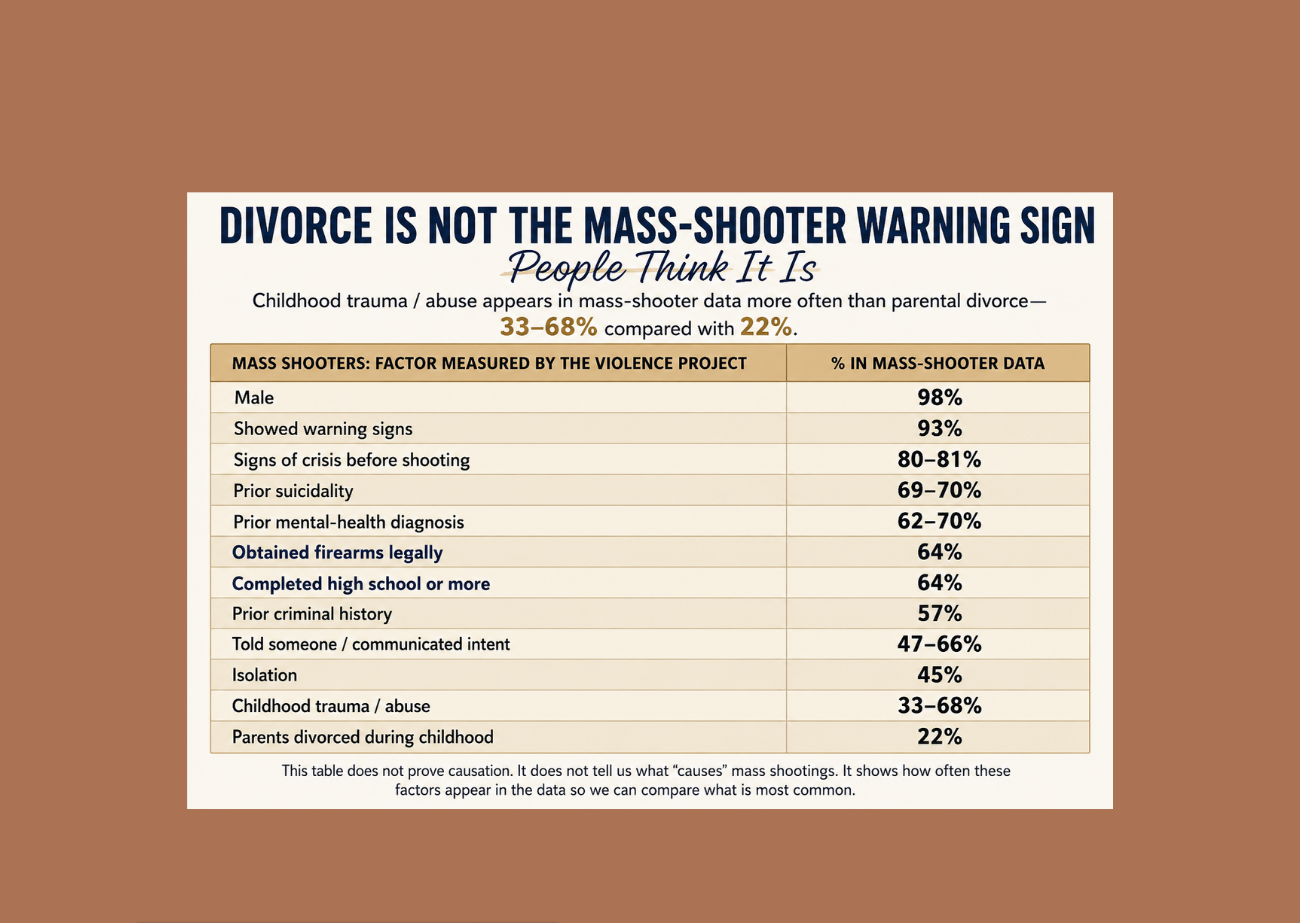
In The Violence Project data, childhood trauma / abuse appears more often than parental divorce — 33–68% compared with 22%.
When tragedies happen, people often search for one simple explanation. In Christian and marriage-at-any-cost circles, one claim comes up again and again: “This is what happens when children come from divorced homes.”
But when we look at the actual data from The Violence Project’s mass-shooter database, that claim does not hold up very well. (See chart below. )
Yes, “parents divorced during childhood” appears in the data. But it appears near the bottom of the measured factors, in only 22% of cases. That is far lower than many other measured factors: being male, showing warning signs, being in crisis, prior suicidality, mental-health history, legal firearm access, criminal history, isolation, substance-abuse history, depressed mood, and communicated intent.
In other words, a divorced home is not absent from the data, but it is also not one of the leading patterns.
That matters because blaming divorce can easily become a way of blaming the wrong people — often single mothers, divorced parents, or abuse survivors who left dangerous marriages to protect themselves and their children.
The Violence Project data points us in a different direction. The more common patterns are crisis, warning signs, suicidality, isolation, communicated intent, mental-health history, childhood abuse or trauma, and access to weapons.
This table does not prove causation. It does not tell us what “causes” mass shootings. But it does help us compare which measured factors appear most often. And when we do that, “parents divorced during childhood” is relatively low on the list.
Important comparison: parental divorce appears in 22% of cases, while childhood trauma / abuse appears in 33–68% of cases.
Put in relative terms, childhood trauma / abuse appears about 50% to 209% more often than parental divorce in this dataset. Put in plain terms: trauma and abuse show up much more often than divorce. All data from The Violence Prevention Project, a nonpartisan research center, funded by the National Institute of Justice, which is part of the U.S. Department of Justice’s Office of Justice Programs.
What the Data Shows
| Mass Shooters: Factor measured by The Violence Project | % in mass-shooter data |
|---|---|
| Male | 98% |
| Showed warning signs | 93% |
| Signs of crisis before shooting | 80–81% |
| Prior suicidality | 69–70% |
| Prior mental-health diagnosis | 62–70% |
| Obtained firearms legally | 64% |
| Completed high school or more | 64% |
| Prior criminal history | 57% |
| Increased agitation | 50% |
| Told someone / communicated intent | 47–66% |
| Isolation | 45% |
| Substance-abuse history | 40% |
| Depressed mood | 40% |
| Interpersonal conflict motive | 35% |
| Mood swings | 35% |
| Childhood trauma / abuse | 33–68% |
| Significant planning | 31% |
| Abusive behavior | 30% |
| Parents divorced during childhood | 22% |
| Domestic-abuse history | 19% |
| Domestic/family-issue motive | 16% |

 :
:
 :
: Buy PDF