
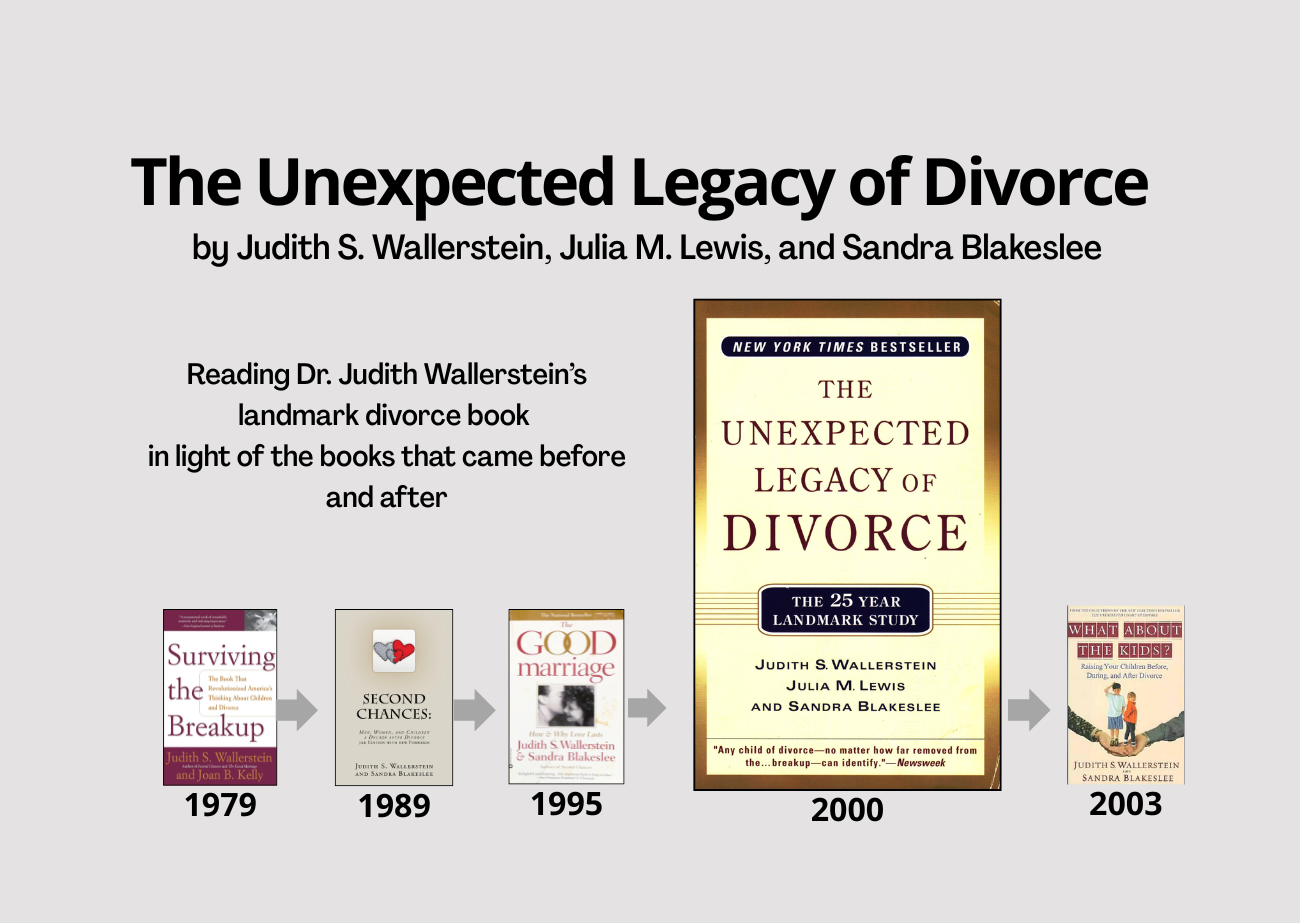
Judith Wallerstein on Divorce and Children: What Pastors, Counselors, and Divorcing Parents Need to Know
A critical review of Judith Wallerstein’s five major books on divorce, children, and marriage, with special attention to what The Unexpected Legacy of Divorce actually says and the key passages most readers never hear about.
Judith Wallerstein is often cited as the scholar who proved that divorce devastates children and that its deepest effects do not fully emerge until adulthood. Many divorcing parents have heard some version of the same frightening claim: Wallerstein showed that divorce leaves lasting damage, and that the worst of it may appear years later. That warning has been repeated for decades in conservative Christian commentary, family-policy arguments, and church-based divorce ministry.
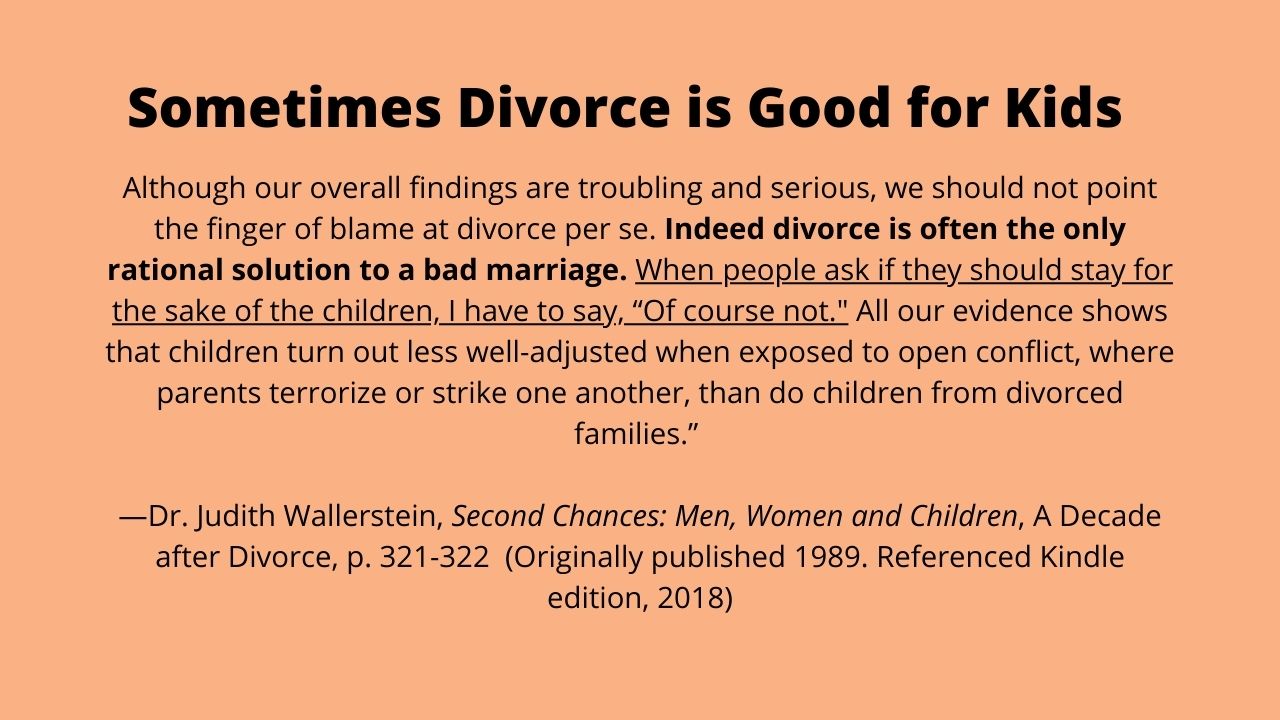
But that is only part of the story. Wallerstein is often quoted by marriage-at-any-cost voices in a way that leaves out her more than a dozen statements that some marriages should end, and that divorce can at times be necessary to protect children.
And once you read Wallerstein’s books carefully, another question begins to emerge. Was she really isolating the effects of divorce itself, or was she often describing the effects of growing up with parents whose marriages were already deeply unstable and whose psychological functioning was seriously impaired long before the breakup? Her famous study was based on just 60 families, and most of the parents in that sample—80 out of 120—were classified as moderately or severely troubled (Surviving the Breakup, 1996, p. 328).
No wonder groups with a marriage-preservation agenda find Wallerstein’s negative findings so useful. They can quote her bleakest lines as if they settle the question, while quietly setting aside her small and troubled sample, the broader research literature, and her own acknowledgment that some marriages should end.
Marriage-at-any-cost organizations also tend to leave out an important part of Wallerstein’s position: she did not believe parents should “stay for the kids” in desperate, conflict-ridden marriages, and she wrote that when a home was abusive, the best time to divorce for the children was “the sooner the better.”
The Big Flaw: Was Wallerstein Studying Divorce, or the Effects of Deeply Troubled Parents?
- The central weakness of Judith Wallerstein’s study is that it may tell us less about the effects of divorce on children than about what happens when children are raised by moderately to severely troubled parents who were often unable to sustain a safe, loving, stable marriage in the first place.
- The sample was small from the start:
- 60 families
- in one northern California county
- later reduced to 45 families at the 25-year follow-up
- But the biggest problem is not just the sample size. It is the condition of the parents.
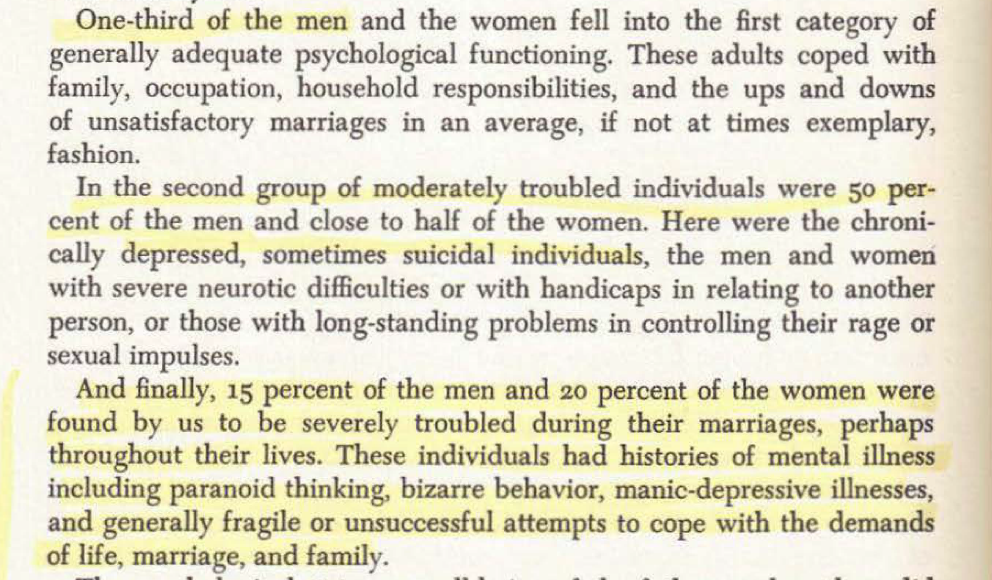
Click to enlarge: Portion of page 328 in Surviving the Breakup (1979) by Judith Wallerstein
What Wallerstein’s earlier book says about the parents
In Surviving the Breakup, Wallerstein and Kelly divide the parents into three groups.
- Only “one-third of the men and the women” fell into the category of “generally adequate psychological functioning.” (Surviving the Breakup, 1996, p. 328)
- The rest were classified as:
- moderately troubled
- or severely troubled
- The book describes cases involving:
- hospitalization for severe mental illness
- suicide attempts
- severe psychosomatic illnesses
- work histories riddled with unsatisfactory performance
- arrests for assault
(Surviving the Breakup, 1996, p. 328)
- The “moderately troubled” group (about 50% of the parents) included:
- chronically depressed, sometimes suicidal individuals
- adults with long-standing problems controlling rage
- adults with long-standing problems controlling sexual impulses
(Surviving the Breakup, 1996, p. 328)
- The “severely troubled” group (15% of the men and 20% of the women) included people with:
- paranoid thinking
- bizarre behavior
- manic-depressive illnesses
- chronic failure to cope with life, marriage, and family
(Surviving the Breakup, 1996, p. 328)
The arithmetic problem
If you treat the sample as:
- 60 marriages
- 120 parents
and if only one-third were “generally adequate,” then:
- about 40 parents were generally adequate
- about 80 parents were moderately or severely troubled
That leads to a striking implication:
- at least 20 of the 60 marriages
- and possibly as many as 40
- must have included two troubled parents
That matters because it changes the whole frame of interpretation.
Why this changes the meaning of the study
Once you know how troubled the parent sample was, Wallerstein’s findings can be read in two different ways:
- as evidence about the effects of divorce
- or as evidence about the effects of being raised by unstable, psychologically impaired parents long before the divorce took place
That is the central interpretive problem in The Unexpected Legacy of Divorce.
- If a child grows up around:
- suicidality
- assault
- severe depression
- bizarre behavior
- chronic rage
- sexual impulse problems
then that child is already growing up in a damaged emotional world before the marriage formally ends.
- In that kind of sample, divorce may not be the main cause of later trouble.
- It may be only one part of a much larger family breakdown.
What Wallerstein still got right
This does not mean Wallerstein saw nothing real.
Her book still does some important things well:
- It rejects the shallow idea that children can be evaluated only by how they look two years after the split.
- It takes adult love, marriage, trust, and commitment seriously.
- It argues that children lose not only a household but also an internal model of marriage.
- Its case histories are vivid and psychologically memorable.
Even Paul Amato, one of Wallerstein’s clearest critics, says her work is valuable in showing the mechanisms by which divorce may affect later intimacy and well-being.
Where Wallerstein overreaches
Wallerstein’s famous claim is that divorce leaves its deepest mark not in childhood but in adulthood, especially in love and commitment.
- In her 2004 summary, she calls the “central finding” the damage divorce does to the later “capacity to love and be loved within a lasting, committed relationship.”
But that claim is hard to isolate from the sample itself.
- If many of the parents were already seriously impaired,
- then later adult outcomes may reflect preexisting family mental illness or psychological issues
- at least as much as divorce itself
That is why the book often feels more certain than it should.
- Its emotional force comes from real suffering.
- But its rhetoric often treats divorce as the main explanatory cause,
- when in this sample divorce may have been only one part of a much larger pattern of instability and dysfunction.
What family researchers Amato and Cherlin add
Wallerstein’s contemporaries, other researchers, had issues with her study and the conclusions.
Dr. Paul Amato
- argues that Wallerstein’s sample was nonrandom
- notes that the core design lacked a proper comparison group
- says her evidence cannot support broad claims about how many children of divorce are harmed in the general population
Dr. Andrew Cherlin
- makes the same point more bluntly
- says the negative long-term effects of divorce are “probably not as widespread as Wallerstein claims”
- points to her “modest sample of 60 families”
- and the fact that many parents had “extensive psychiatric histories”
Bottom line
The main problem with The Unexpected Legacy of Divorce is not that it recognizes real suffering.
The main problem is this:
- it draws sweeping conclusions
- from a small
- local
- nonrandom
- and heavily troubled sample
So the book may tell us something important.
But what it most clearly tells us may be this:
- troubled parents often raise troubled children
- and divorce in such families may carry those troubles forward
That is a very different claim from saying divorce itself is the main cause of the damage.
Wallerstein was not anti-divorce, and that matters
A serious review of Dr. Judith Wallerstein’s life work has to grapple with these findings. Without them, the review is incomplete.
- A fair review has to say this clearly: Wallerstein did not believe every marriage should be preserved. In fact, in her third book, she stated that divorce could be “a gift” and “a blessing.”
- She wrote, “I am not against divorce. How could I be? I’ve seen more examples of wretched, demeaning, and abusive marriage than most of my colleagues.” (The Unexpected Legacy of Divorce, 2000, p. xxxix)
- She also said, “I don’t know of any research, mine included, that says divorce is universally detrimental to children.” (The Unexpected Legacy of Divorce, 2000, p. xxxix)
- In Second Chances, she goes further, saying divorce is “often the only rational solution to a bad marriage,” and that when people ask whether they should stay together “for the sake of the children,” the answer is “Of course not.” (Second Chances, 2018 ed., pp. 321–322)
- She also acknowledges in The Unexpected Legacy of Divorce that many children of divorce do well: some become “successful,” “independent, resourceful, and flexible,” and some “manage to build good marriages in spite of their fears.” (The Unexpected Legacy of Divorce, 2000, p. xiii)
- Even her own 25-year outcome summary is more mixed than her rhetoric often suggests: 30 percent of the children were doing poorly, 34 percent were in the average range, and 36 percent were doing very well to outstanding. (The Unexpected Legacy of Divorce, 2000, p. 333) So 7 in 10 children of divorce were doing fine.
- More Wallerstein quotes about divorce as sometimes being necessary.
For people facing a life-saving divorce, the good news is this: even Wallerstein did not believe every marriage should be preserved at all costs, and her own earlier work suggests that most of the parents in her original sample fell outside the category of generally adequate psychological functioning. In other words, some of what she blamed on divorce may have come more from troubled parents than from divorce itself.
Ironically, one of the clearest objections to the conservative Christian use of Wallerstein came from Wallerstein herself. Wallerstein explicitly pushes back against religious and moral voices who use her work as if it proves divorce is always or almost always wrong. In the introduction, she says she is “not against divorce” and adds, “I don’t know of any research, mine included, that says divorce is universally detrimental to children.” She also says she is aware of voices “in certain political and religious circles” that say divorce is sinful, but she does not endorse that use of her work. She objected to Christians who misused her works.
What Wallerstein Wrote About Fatherlessness and Bad Fathers
Judith Wallerstein reported that many children were distressed about the loss of a father—whether “good, bad, or indifferent”—through divorce. (SC, 248-249) But Judith Wallerstein and Joan Kelly also observed that some children actually improved after divorce, particularly when they were protected by the custodial mother from harmful fathers. They wrote:
“This group included younger and older children who had been poorly parented by an indifferent father who was not much missed after the divorce, children who had been poorly treated, verbally or physically abused, or sexually misused by fathers they feared, as well as children who had frequently witnessed the father’s cruelty to the mother. For these children, the divorce represented a welcome release from a painful and frightening situation. They were able to move ahead developmentally with the support of a caring custodial mother and without the constant burden of fear and tension that had characterized their lives before the separation.”
“In these situations the children appeared to be freed from the psychopathology and burdening of a corrosive relationship with the father.”—Judith S. Wallerstein and Joan B. Kelly, Surviving the Breakup: How Children and Parents Cope with Divorce (New York: Basic Books, 1979; 1996 ed.), pp. 217–218.
What Wallerstein Says About Good Marriages After Divorce
Different readers will hear different things
- Adult children of divorce may read The Unexpected Legacy of Divorce as a language for wounds they have carried for years. Some of Wallerstein’s descriptions will feel exact because they come from real pain.
- Marriage-promoters and permanence advocates may want to use the book as proof that divorce is almost always catastrophic. But that goes beyond what the evidence can support.
- Men and women in cruel, chaotic, violent, unfaithful, or chronically dead marriages may read the book while trying to decide whether they should stay for the sake of the children. They should remember that Wallerstein herself did not think every marriage should be saved at all costs. In fact, she wrote in her later book that when there was chronic violence or repeated high conflict (What About the Kids, pp. 127–128) or a cruel marriage or an intensely lonely one (Second Chances, p. xxxiv), divorce should be pursued as quickly as possible.
- So the book should be read neither as a blanket indictment of divorce nor as something to dismiss entirely. It is a flawed warning from a very damaged sample, not a final rule for everyone.
Discussion
- The Unexpected Legacy of Divorce is powerful, memorable, and deeply overstated if read by itself. Any account of Judith Wallerstein’s thought that ignores all five books that discuss her study and findings misses a central part of her body of work on divorce, children, and wellbeing.
- Its central weakness is present from the start of Unexpected Legacy of Divorce: the study may tell us less about divorce and children than about what happens when children are raised by moderately to severely troubled parents who were often unable to sustain a safe, loving, stable marriage in the first place.
- The evidence raises the possibility that divorce itself played only a limited role in many of these children’s later outcomes. The stronger influence may have been that they were raised by adults who were already unstable, psychologically impaired, and often unable to provide ordinary emotional security before the marriage ended.
- That does not make the book worthless. Its lasting value lies in the warning that troubled parents often raise troubled children, and that divorce in such families may carry those troubles forward into adult life.
- Its great mistake is to blur that grim truth into a sweeping claim about divorce itself.
This concern is strengthened by later research. Wallerstein’s sample may have captured not the hidden damage of divorce in general, but the predictable damage done by badly impaired parents. Wallerstein’s sample may have captured not the hidden damage of divorce in general, but the predictable damage done by badly impaired parents; later work by Sara Jaffee and colleagues supports exactly that concern, finding that children may do worse, not better, the longer they remain with highly antisocial fathers.
Her major books were first published in these years:
- STB = Surviving the Breakup — 1979
- SC = Second Chances — 1989
- TGM = The Good Marriage — 1995
- TULD = The Unexpected Legacy of Divorce — 2000
- WATK = What About the Kids? — 2003
 :
:
 :
: Buy PDF