
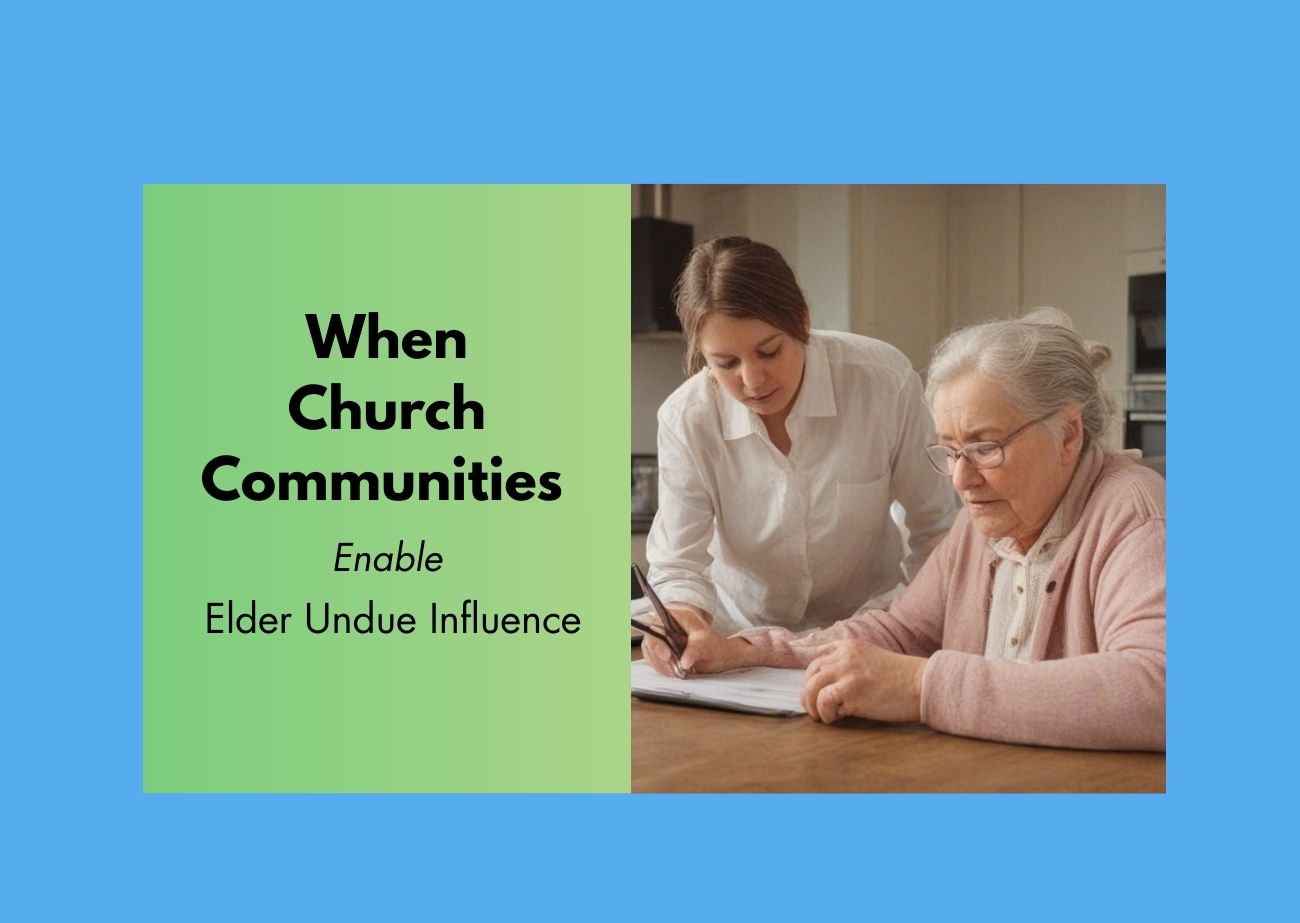
When Church Communities Enable Elder Undue Influence
Warning Signs of Elder Financial Abuse, Dementia Denial, and Isolation from Family
Sometimes elder abuse doesn’t look like bruises or obvious fraud.
Sometimes it looks like a vulnerable parent being encouraged to “take back control” — even as cognitive decline, dementia, or impaired judgment quietly reshape their decision-making.
In these situations, the harm is often subtle: isolation framed as independence, secrecy framed as dignity, and protective family members recast as threats.
This post is written for adult children searching questions like:
- elder undue influence by church
- parent with dementia cutting off children
- sudden estate changes in an elderly parent
- church leaders encouraging unsafe independence
- how to protect an elderly parent from manipulation
If that’s you, read carefully.
And if you’re struggling to put your concerns into clear, non-accusatory words, I’ll share a practical screening framework used by Adult Protective Services at the end of this post.
The pattern that should make you pause
Undue influence often arrives dressed as “help.” New friends. New advisors. People who suddenly take a strong interest in your parent’s “independence,” especially if your parent is aging, grieving, lonely, ill, or forgetful.
One of the biggest red flags is a sudden reshuffling of roles: people who have known your parent casually begin positioning themselves as the trusted inner circle, while responsible adult children—who have been consistently involved—are pushed to the margins.
You might notice abrupt changes: a new “advisor” weighing in on legal or financial decisions, or a sudden push to keep finances secret. You might learn—after the fact—about changes to wills, trusts, or power of attorney. You might hear your parent repeating new phrases that don’t sound like them, or accusing you of motives you’ve never had.
And sometimes the shift becomes dramatic.
“Forced independence” and dementia denial
In some faith communities, well-meaning people unintentionally reinforce unsafe independence by treating cognitive decline as an insult to dignity—or even a spiritual immaturity issue. They may frame the adult children’s concern as “control.” They may encourage a parent to refuse help “in the name of autonomy,” even when a medical team has documented impairment.
This is where it gets dangerous.
A parent who is cognitively declining can be urged to make big decisions that require good judgment—while simultaneously being encouraged to reject the very supports that keep them safe.
That can look like: firing caregivers against medical advice, even when doctors have warned that care is necessary. It can also include paranoia:
“An impaired parent begins accusing caregivers of theft, spying, or harm, and dismisses them despite medical warnings.”
That’s not a personality quirk. In dementia (and sometimes delirium), suspicious delusions can escalate fast—and they can be exploited.
When protective family members are recast as threats
Another classic move in undue influence cases is narrative reversal.
The adult child who requests a medical evaluation, asks about sudden estate changes, raises concerns about dementia, or simply wants financial transparency gets described as “controlling,” “greedy,” “manipulative,” or “abusive.”
In other words: concern gets reframed as coercion.
This is one reason adult children feel like they’re losing their parent in real time. The more you try to keep them safe, the more you’re portrayed as the problem.
Is this elder abuse—or family conflict?
Disagreement between adult children and aging parents is common. The concern shifts when documented cognitive impairment is paired with isolation, secrecy, and major legal or financial changes.
But when you see cognitive decline + isolation + sudden legal/estate changes + secrecy, you’re no longer in ordinary “family drama.” You’re in elder exploitation risk territory.
A helpful way to name the difference is this: in undue influence dynamics, the adult child is often not trying to control the parent’s life—they’re trying to keep the parent medically, legally, and financially protected while the parent’s judgment is compromised and outside voices are steering the wheel.
Protective presence
If you suspect elder manipulation or dementia-driven paranoia, the goal is not just emotional closeness. The goal is safety.
Sometimes the mindset has to shift from “We need to be reconciled” to: “I will not disappear while you are vulnerable.”
That might mean structured, limited contact and practical safeguards: short wellness check-ins, pushing (gently and persistently) for cognitive assessment, documenting behavioral changes, consulting an elder law attorney, and involving third parties like doctors, social workers, or—when necessary—Adult Protective Services.
Safety comes before sentiment.
A word to churches and community leaders
If you work with elderly congregants, please slow down before you encourage “independence” that includes rejecting caregiving support, qualified physicians, or cutting off family.
Ask a few basic questions first: Has cognitive impairment been medically evaluated? Are legal documents being changed abruptly? Are protective family members being excluded? Is secrecy being encouraged?
Good intentions do not prevent elder financial abuse or undue influence. And in some situations, advising vulnerable adults in ways that contribute to isolation or exploitation may carry serious ethical—and even legal—consequences.
If you’re searching for answers
If you’ve Googled: how to protect elderly parent from church manipulation, parent with dementia accusing me of stealing, elderly mother changed will suddenly, or church encouraging elderly to cut off family—you are not alone.
Trust your instincts.
Document carefully.
Bring in professionals early.
Elder vulnerability deserves protection—not isolation.
A Practical Tool for Naming What You’re Seeing
If you’re struggling to explain your concerns without sounding emotional or accusatory, there is a structured framework used by Adult Protective Services called the CUIST California Undue Influence Screening Tool (CUIST).
It asks four grounded questions:
- Is the elder vulnerable?
(Declining health, cognitive impairment, grief, isolation.) - Does someone hold power or authority?
(Caregiver, family member, spiritual adviser, professional, power of attorney.) - Are specific tactics being used?
(Isolation, secrecy, rushing decisions, instilling distrust, changing doctors or attorneys, controlling access.) - Are there suspicious or unfair outcomes?
(Sudden estate changes, financial loss, loss of housing, deterioration of care, emotional decline.)
When adult children use a framework like this, it shifts the conversation from “I feel something is wrong” to “Here are the specific vulnerability factors, power dynamics, tactics, and outcomes I am observing.”
That kind of language is clearer, calmer, and far more effective.
Concern becomes easier to articulate when it is grounded in recognized undue influence criteria rather than emotion alone.
My blog focuses on abuse, betrayal, and power dynamics in marriage and divorce, but these patterns apply to elderly parents too.
 :
:
 :
: Buy PDF