
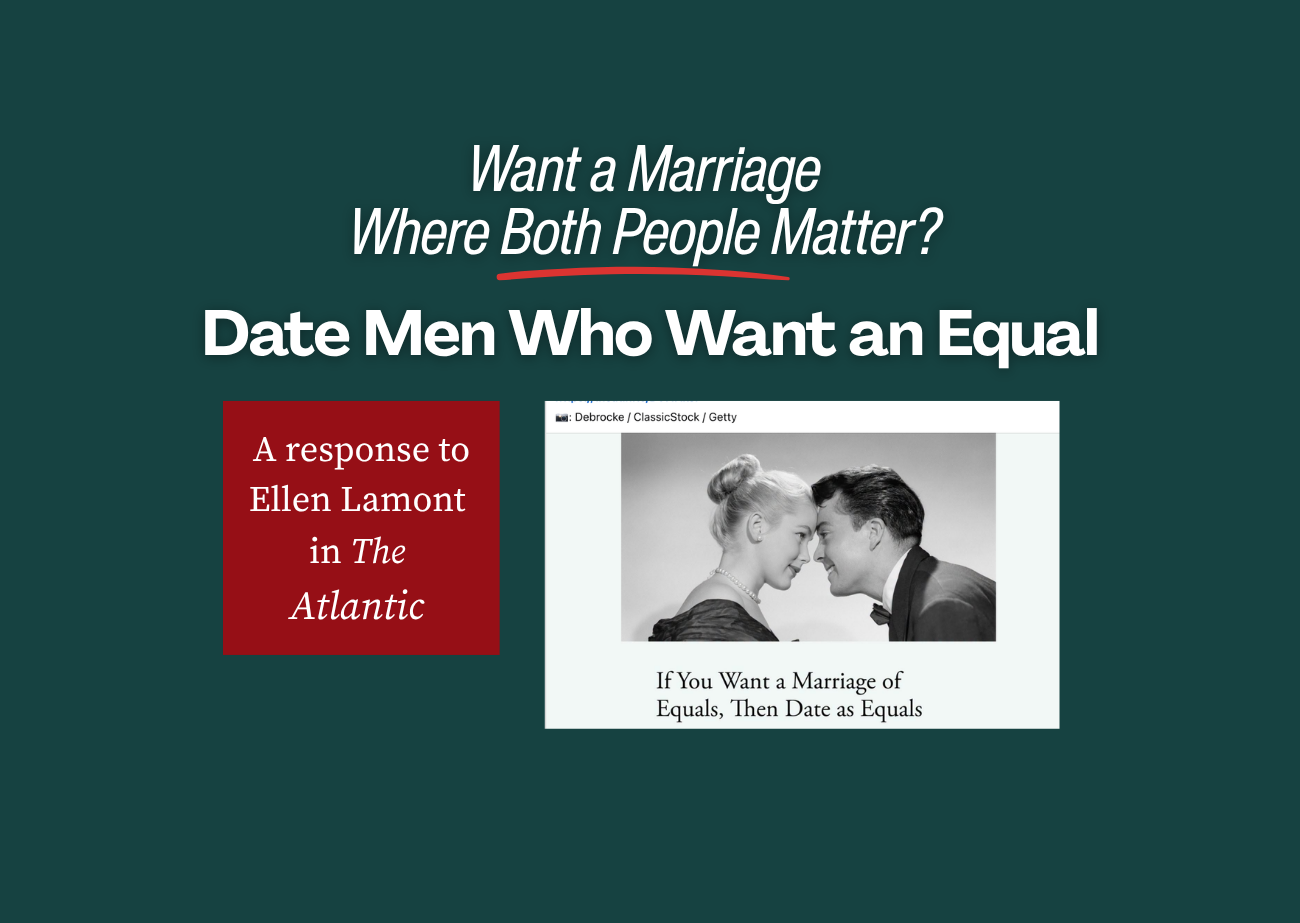
Want a Marriage Where Both People Matter? Date Men Who Treat You As an Equal.
In her Atlantic article, “If You Want a Marriage of Equals, Then Date as Equals,” sociologist Ellen Lamont raises an interesting concern: Many women want egalitarian marriages but still expect men to initiate dates, make plans, and propose marriage.
Lamont argues that traditional dating roles can establish patterns of inequality that continue into marriage.
But does her research actually demonstrate that expecting a man to initiate dates, make plans, or propose marriage leads to a marriage in which a woman carries more of the responsibilities? That’s a much bigger claim, and the evidence she presents doesn’t establish it.
One distinction is important for credibility: Lamont provides evidence that traditional gender expectations persist in dating and marriage. What she doesn’t demonstrate is that specific courtship practices cause unequal marriages.
What Does Lamont’s Research Actually Prove?
| Evidence Lamont presents | What it shows | What it doesn’t prove |
|---|---|---|
| Interviews with more than 100 educated young adults | Traditional dating expectations remain common, even among people who value equality | That expecting men to initiate dates causes unequal marriages |
| Interviews with married heterosexual couples | Some husbands leave most housework and caregiving to their wives | That men’s initiative during courtship caused this behavior |
| National time-use statistics | Women perform substantially more unpaid domestic labor than men | That women’s dating preferences explain this imbalance |
| Interviews with LGBTQ participants | Couples who actively question traditional roles often negotiate responsibilities more deliberately | That heterosexual women must initiate or pay for dates to achieve similar results |
There’s an important distinction here.
Lamont’s research shows that traditional gender expectations can carry over into marriage. But she hasn’t established that women who expect men to pursue them are more likely to end up in marriages where they’re doing most of the work.
In fact, her own interviews reveal something interesting. Some men liked splitting dating expenses but still held traditional expectations about women and marriage.
So splitting the dinner bill doesn’t necessarily tell you whether a man will respect your opinions, support your career, or share household responsibilities.
After studying the marriages of hundreds of couples, including both happy and unhappy marriages, I’ve seen how much a husband’s character and willingness to contribute matter.
A man can plan the first date and still become a wonderful husband who respects his wife’s wishes, supports her goals, and shares household responsibilities. (Mine did and still does.) Another man can split every restaurant bill and still expect his wife to handle most of the housework.
That’s why I encourage women to pay attention to a man’s behavior during dating. Does he follow through? Does he consider your preferences? Does he respect your boundaries? Does he make an effort without being prompted?
Those qualities tell you much more than who pays for coffee.
Now, I’m not suggesting that a man must always pay for dinner or that a woman should never initiate a date. Healthy relationships involve generosity, consideration, and effort from both people.
But there’s a difference between both people contributing to a relationship and one person taking responsibility for making everything happen.
The goal isn’t to make dating look perfectly equal on paper. It’s to identify someone who respects you as a person, values your opinions and preferences, and demonstrates through his actions that they’re willing to be a true partner.
Because the best preparation for a happy marriage isn’t doing more work while dating.
It’s choosing someone who will gladly share the responsibilities of married life.
Dating Advice
I’m becoming quite a fan of Jennie Young, PhD, creator of the Burned Haystack Dating Method and her book. She’s a university professor who uses her expertise in rhetoric and communication to teach women how to recognize manipulation, dishonesty, entitlement, and other warning signs in men’s words and behavior.
What I particularly appreciate is that Jennie doesn’t tell women they need to try harder, be more accommodating, or give every man the benefit of the doubt. Instead, she teaches women how to recognize men who may waste their time, exploit their generosity, undermine their confidence, or even put their safety at risk—and how to eliminate those men from consideration early.
Her approach isn’t simply about finding someone compatible. It’s about protecting women from harmful relationships while making room for men who are emotionally healthy, respectful, trustworthy, and genuinely interested in building a loving partnership.
That’s advice I can get behind! After all, choosing whom to marry is one of the most consequential decisions a woman will ever make.
If you’re dating with marriage in mind, I encourage you to explore Jennie Young’s Burned Haystack Dating Method. Her work combines practical dating strategies, sharp analysis of men’s language, and a healthy dose of humor.
 :

 :
 Buy PDF